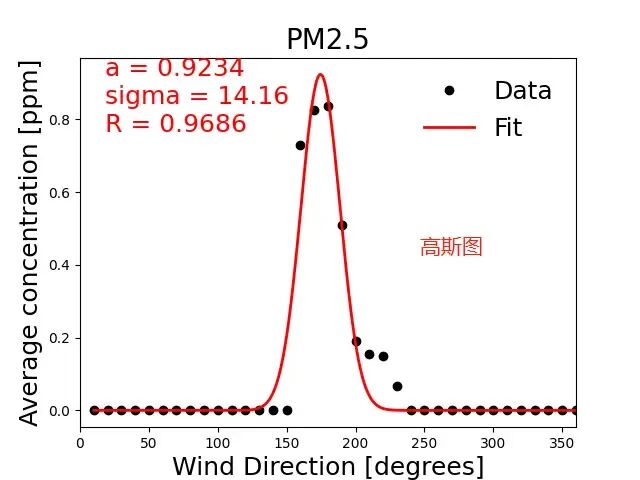
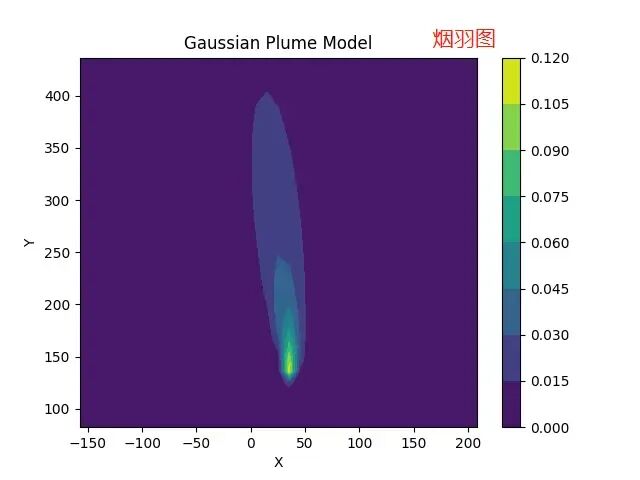
from math import trunc # 用于截断数字的函数import numpy as np # 数值计算库from scipy.optimize import curve_fit # 曲线拟合函数#################### 常量定义 ####################R = 0.08205746 # 通用气体常数 [L atm K-1 mol-1]P_stp = 1. # 标准大气压 [atm]T_stp = 298 # 标准温度 [K]def gaussian_func(x,a,sigma,x_0): """ 高斯函数 返回具有适当系数的高斯函数值 :param x: 自变量 :param a: 振幅参数 :param sigma: 标准差参数 :param x_0: 中心位置参数 :return: 高斯函数值 """ return a*np.exp(-((x - x_0)**2)/(2*sigma**2))def stability_class(std_wind,turb,v=False): """ 根据风速标准差和湍流强度确定平均稳定性等级 :param std_wind: 水平风向标准差 [度] :param turb: 湍流强度 :param v: 是否输出详细信息 :return: 平均稳定性等级 """ # 根据风速标准差确定水平稳定性等级 if std_wind > 27.5: pg_wind = 1 elif std_wind <=27.5 and std_wind > 23.5: pg_wind = 2 elif std_wind <=23.5 and std_wind >19.5: pg_wind = 3 elif std_wind <= 19.5 and std_wind > 15.5: pg_wind = 4 elif std_wind <= 15.5 and std_wind > 11.5: pg_wind = 5 elif std_wind <= 11.5 and std_wind > 7.5: pg_wind = 6 elif std_wind <= 7.50: pg_wind = 7 if v: print("Horizontal Stability class = %d "%(pg_wind)) # 根据湍流强度确定垂直稳定性等级 if turb > 0.205: pg_turb = 1 elif turb <= .205 and turb > 0.180: pg_turb = 2 elif turb <= 0.180 and turb > 0.155: pg_turb = 3 elif turb <=0.155 and turb > 0.130: pg_turb = 4 elif turb <= 0.130 and turb > 0.105: pg_turb = 5 elif turb <= 0.105 and turb > 0.080: pg_turb = 6 elif turb <= 0.080: pg_turb = 7 if v: print("Vertical Stability class = %d "%(pg_turb)) # 计算最终的平均稳定性等级 final_pg = int(np.ceil(np.mean((pg_wind,pg_turb)))) return final_pgdef sigma_func(I,J,K,dist): """ 用于基于稳定性参数估算sigma_y和sigma_z的函数 :param I: 参数I :param J: 参数J :param K: 参数K :param dist: 距离 :return: 计算结果 """ return np.exp(I + J*np.log(dist) + K*(np.log(dist)**2))def sigma(dist,std_wind=None,turb=None,stab= None,tables=False,v=False): """ 计算排放分布的水平和垂直标准差 七个自定义类别基于Pasquill-Gifford模型的方式: 1 - PG class A 2 - PG classes A and B之间的线性插值 3 - PG class B 4 - PG classes B and C之间的线性插值 5 - PG class C 6 - PG classes C and D之间的线性插值 7 - PG class D :param dist: 接收器和源之间的距离 :param std_wind: 水平风向标准差 [度] :param turb: 湍流强度 :param stab: 稳定性等级 :param tables: 是否使用表格 :param v: 是否输出详细信息 :return: sigma_y, sigma_z, 稳定性等级 """ if stab == None: stab = stability_class(std_wind,turb,v=v) # 加载水平扩散参数表 file_y = np.load('ota33a/pgtabley.npz') pgtabley = file_y['data'] sigma_y = pgtabley[trunc(np.round(dist)-1),stab-1] # 加载垂直扩散参数表 file_y = np.load('ota33a/pgtablez.npz') pgtablez = file_y['data'] sigma_z = pgtablez[trunc(np.round(dist)-1),stab-1] return sigma_y,sigma_z,stabdef ppm2gm3(conc,mw,T,P): """ 将以ppm为单位的浓度转换为g/m3单位的浓度 :param conc: 浓度 [ppb] :param mw: 分子量 [g/mol] :param T: 温度 [K] :param P: 压力 [atm] :return: 浓度 [g/m3] """ R = 0.08205746 # 通用气体常数 [L atm K-1 mol-1] mass = conc*mw V = (1e6*R*T)/(P*1000.) return mass/Vdef fit_plot(x,y_data,fit,name): """ 绘制实际数据与执行的高斯拟合对比图 :param x: 风向箱 :param y_data: 计算的平均浓度 :param fit: 高斯函数的拟合系数 :param name: 图表标题 :return: 最大拟合值对应的x轴值 """ try: import matplotlib.pyplot as plt xAnalytic = np.linspace(x.min(),x.max(),1000) y_fit = gaussian_func(xAnalytic,fit[0],fit[1],fit[2]) R = np.corrcoef(y_data,gaussian_func(x,fit[0],fit[1],fit[2]))[0,1] fs=18 fig = plt.figure() ax = fig.add_subplot(111) ax.plot(x,y_data,'o',c='k',label='Data',lw=2) ax.plot(xAnalytic,y_fit,c='r',label='Fit',lw=2) #画线 可用来确认对高点 ax.set_xlabel('Wind Direction [degrees]',fontsize=fs) ax.set_ylabel('Average concentration [ppm]',fontsize=fs) ax.set_title(name,fontsize=fs+2) ax.set_xlim(0,360) ax.text(np.diff(ax.get_xlim())*.05+ax.get_xlim()[0],np.diff(ax.get_ylim())*.8+ax.get_ylim()[0],'a = %.4f\nsigma = %.2f\nR = %.4f' % (fit[0],fit[1],R),color='r',fontsize=18) leg=ax.legend(fontsize=fs) leg.get_frame().set_alpha(0.) plt.show() #plt.savefig("./pic/" + name + ".png", transparent=True, bbox_inches="tight", pad_inches=0) #找y_fit中的最大值 对应的 x轴方向度数 yFitMax = max(y_fit) for i in range(len(y_fit)): if y_fit[i] == yFitMax: return xAnalytic[i] except: print('Your system does not appear to have Matplotlib installed. This is \ required to make a plot')def yamartino_method(wd): """ 使用Yamartino方法计算风向标准差 该方法的更多信息可以在Wikipedia上找到(http://en.wikipedia.org/wiki/Yamartino_method) 或原始论文: Yamartino, R.J. (1984). "A Comparison of Several "Single-Pass" Estimators of the Standard Deviation of Wind Direction". Journal of Climate and Applied Meteorology 23 (9): 1362-1366. :param wd: 风向数组 [度] :return: 风向标准差 [度] """ n = float(len(wd)) sa = np.mean(np.sin(wd*np.pi/180)) ca = np.mean(np.cos(wd*np.pi/180)) epsilon = np.sqrt(1 - (sa**2 + ca**2)) std_wd = np.sqrt(n/(n-1))*np.arcsin(epsilon)*(1 + (2./np.sqrt(3) - 1)*epsilon**3) return std_wd*180/np.pidef wrap(wd): """ 确保输入的风向数组值都在0到360之间 :param wd: 风向数组 [度] :return: 修正后的风向数组 """ wd[np.where(wd >=360.)] -= 360. wd[np.where(wd <0.)] += 360. return wddef sonic_correction(u,v,w): """ 将3D声学坐标系旋转到流线坐标系(-180度) 现场数据应该通过手动声学旋转设置接近-180度 如果平均方向在北半球,则旋转设置为0度(警告) 输出<x>, <z>, = 0 或检查文件 :param u: u方向风速分量 :param v: v方向风速分量 :param w: w方向风速分量 :return: 旋转后的u,v,w分量及风向、风速 """ mdir = 180 + (np.arctan2(-1*(np.mean(v)),-1*(np.mean(u)))*180/np.pi) RA = np.arctan(np.mean(v)/np.mean(u)) # 第一次旋转(设置<x> = 0) CRA = np.cos(RA) SRA = np.sin(RA) u_rot = u*CRA + v*SRA v_rot = -u*SRA + v*CRA mndir = 180 + (np.arctan2(-1*(np.mean(v_rot)),-1*(np.mean(u_rot)))*180/np.pi) RB = np.arctan(np.mean(w)/np.mean(u_rot)) # 第二次旋转(设置<z> = 0) CRB = np.cos(RB) SRB = np.sin(RB) u_rot2 = u_rot*CRB + w*SRB w_rot = (-1)*u_rot*SRB + w*CRB mnnws3x = np.mean(u_rot2) mnws3z = np.mean(w_rot) mmndir = 180 + (np.arctan2(-1*(mnws3z),-1*(mnnws3x))*180/np.pi) # 计算并分配新的3D声学2D风向 wd3 = 180+(np.arctan2(-1*(v_rot),-1*(u_rot2))*180/np.pi) # 计算并分配新的3D声学2D风速 ws3 = np.sqrt(u_rot2**2 + v_rot**2) return u_rot2,v_rot,w_rot, wd3, ws3class fieldData: """ 现场数据类,用于处理气体浓度、温度、压力、风速分量等数据 """ def __init__(self,gasConc,temp,pres,ws3z,ws3x,ws3y,distance,mw_chemical,chemical_name): """ 初始化现场数据对象 :param gasConc: 气体浓度 :param temp: 温度 :param pres: 压力 :param ws3z: 垂直风速分量 [m/s] :param ws3x: x方向风速分量 [m/s] :param ws3y: y方向风速分量 [m/s] :param distance: 距离 :param mw_chemical: 化学物质分子量 :param chemical_name: 化学物质名称 """ self.gasConc = np.ma.array(gasConc) self.T = np.ma.array(temp) self.P = np.ma.array(pres) self.distance = distance self.mw_chemical = mw_chemical self.chemical_name = chemical_name # 修正3D声学数据,使mean(wsz) ~ 0. self.u, self.v, self.w, self.windDir, self.windSpeed = sonic_correction(np.ma.array(ws3x),np.ma.array(ws3y),np.ma.array(ws3z)) def getEmissionRate(self,wslimit=0.,wdlimit=60.,cutoff=2.,theta_start=5,theta_end=365.,delta_theta=10.,make_plot=False,verbose=False): """ 这个定义是程序的核心。它将接受以下参数: 输入参数: gasConc :: 气体浓度[ppb]作为时间的函数 temp :: 转换为质量单位的温度[K] pres :: 用于转换的压力[Pa] ws3z :: 来自声学风速计的垂直风速分量[m/s] ws3x :: 来自声学风速计的x风速分量[m/s] ws3y :: 来自声学风速计的y风速分量[m/s] wslimit :: 风速下限[m/s] wdlimit :: 接受的风向范围(180表示无过滤) cutoff :: 箱的截止百分比(即如果箱的值少于所有值的cutoff%,则箱=0) distance :: 从源到接收器的距离[m] theta_start :: 风向箱的起始角度 theta_end :: 风向箱的结束角度 delta_theta :: 风向箱大小 mw_chemical :: 气体的分子量[g/mol],用于转换为质量单位 make_plot :: 如果要查看分布和高斯拟合图,则为True 输出: emission_gasConc_volume_per_time :: 以SLPM为单位的排放率 emission_gasConc_mass_per_time :: 以[g/s]为单位的排放率 """ # 应用风速限制截止 if wslimit > 0.0: # 创建一个掩码数组,其中False索引是风速<wslimit的地方 ws_mask = np.ma.masked_less_equal(self.windSpeed,wslimit).mask # 将创建的掩码应用于相关变量 self.time.mask = ws_mask self.gasConc.mask = ws_mask self.windSpeed.mask = ws_mask self.windDir.mask = ws_mask self.T.mask = ws_mask self.P.mask = ws_mask self.w.mask = ws_mask else: # 如果我们不想屏蔽任何风速,我们必须确保在np.percentile步骤中不会丢失任何数据 pass ws_mask = np.ones_like(self.gasConc.mask)*False # 减去示踪剂背景。我必须在percentile函数内手动应用掩码 # 因为目前np.percentile与掩码数组不兼容。 #np.where 条件是否成立 np.percentile 百分位5的值 np.mean求平均值 percen = np.percentile(self.gasConc[:], 5) isWhere = np.where(self.gasConc < percen) if(len(isWhere)==1): isWhere = np.where(self.gasConc <= percen) isMean = np.mean(self.gasConc[isWhere]) gasConcAboveBG = self.gasConc - isMean #gasConcAboveBG =self.gasConc- np.mean(self.gasConc[np.where(self.gasConc < np.percentile(self.gasConc[:],5))]) # [g m-3] # 根据输入创建风向箱 bins = np.arange(theta_start,theta_end+delta_theta/2.,delta_theta) # 获取每个测量风速属于哪个箱的索引 indices= np.digitize(self.windDir[:],bins)-1 # 创建每个箱中间的数组;len(mid_bins) = len(bins) - 1 mid_bins = (bins[:-1] + bins[1:])/2. # 创建空数组来存储风向函数的平均浓度 gasConc_avg = np.zeros_like(mid_bins) # 对于每个风向箱,找到相应的平均示踪浓度 for i in range(indices.min(),indices.max()): temp_vals = gasConcAboveBG[:][np.where(indices == i)] # 确保数据点数量超过截止值 # 我们不希望有几个值的箱主导拟合 #print(mid_bins[i],len(temp_vals),temp_vals.mean()) if len(temp_vals) >np.ceil(cutoff*len(gasConcAboveBG[:])/100.): gasConc_avg[i] = temp_vals.mean() # 获取平均浓度最高的箱 max_bin = mid_bins[np.where(gasConc_avg == gasConc_avg.max())[0][0]]# - delta_theta/2. # 根据输入值计算风向截止 bin_cut_lo = max_bin - wdlimit + delta_theta/2. bin_cut_hi = max_bin + wdlimit - delta_theta/2. # 掩码不在风向范围内的值 self.windDir[np.where((self.windDir <= bin_cut_lo) | (self.windDir >= bin_cut_hi))] = np.ma.masked wd3_mask = self.windDir.mask # 确保峰值浓度在拟合时大约为180度 roll_amount = int(len(gasConc_avg)/2.-1) - np.argmin(abs(gasConc_avg - np.average(self.windDir[:],weights=gasConcAboveBG[:]))) gasConc_avg = np.roll(gasConc_avg,roll_amount) # 获取滚动后的最大箱,以防不是正好180 max_bin2 = mid_bins[np.where(gasConc_avg == gasConc_avg.max())[0][0]] # 仅为拟合制作新的箱截止 bin_cut_lo2 = max_bin2 - wdlimit + delta_theta/2. bin_cut_hi2 = max_bin2 + wdlimit - delta_theta/2. # 拟合过程 # 这里是一些产生良好结果的初始猜测 const_0 = [gasConc_avg.max(),2,180] # 不包括在wd限制外的值在拟合程序中 gasConc_avg[np.where((mid_bins >= bin_cut_hi2) | (mid_bins <= bin_cut_lo2))] = 0. # curve fit函数使用Levenberg-Marquardt算法 # 在我看来,这个算法做得很好 fit_gasConc,cov_gasConc = curve_fit(gaussian_func,mid_bins,gasConc_avg,p0 = const_0) # 拟合系数 #取 gasConc_avg的非0零值及对应的值 对应的mid_bins值 yArr = [] xArr = [] for i in range(len(gasConc_avg)): if(gasConc_avg[i] != 0): yArr.append(gasConc_avg[i]) xArr.append(mid_bins[i]) print(xArr) print(yArr) #画图 yFitMax = float(0) if make_plot: yFitMax = fit_plot(mid_bins,gasConc_avg,fit_gasConc,self.chemical_name) # 如果需要,绘制图表 # 计算风向标准差和湍流强度 # 用于查找PG稳定性类别 turbulent_intensity = np.std(self.w[~wd3_mask])/np.mean(self.windSpeed[~wd3_mask]) # 湍流强度 std_wind_dir = yamartino_method(self.windDir[~wd3_mask]) # 风向标准差 [度] # 使用PGT稳定性类别计算高斯羽流的垂直和水平扩散 #stab 等级 sy, sz, stab = sigma(self.distance,std_wind = std_wind_dir,turb = turbulent_intensity,tables=True,stab=None,v=verbose) # [m] print(self.chemical_name + "等级为:" + str(stab)) # 将示踪剂从ppm转换为g m-3 fit_amplitude = ppm2gm3(fit_gasConc[0],self.mw_chemical,np.mean(self.T[~wd3_mask]),np.mean(self.P[~wd3_mask])) # 使用理想气体定律计算示踪剂密度,用于转换回L/min(如果需要) rho_gasConc_stp = (P_stp*self.mw_chemical)/(R*T_stp) # 标准条件下的气体密度 [g L-1] rho_gasConc = (np.mean(self.P)*self.mw_chemical)/(R*np.mean(self.T)) # 环境条件下的气体密度 [g L-1] # 综合计算,以g/s为单位计算排放率 massRate = 2*np.pi*fit_amplitude*np.mean(self.windSpeed[~wd3_mask])*sy*sz # [g s-1] # 现在计算以L/min为单位的排放率 emission_gasConc_volume_per_time = 2*np.pi*fit_amplitude*np.mean(self.windSpeed[~wd3_mask])*sy*sz/rho_gasConc*60 # [L min-1] # 现在在STP下计算L/min volumeRate = 2*np.pi*fit_amplitude*np.mean(self.windSpeed[~wd3_mask])*sy*sz/rho_gasConc_stp*60 # [L min-1] return massRate , yFitMax

 10个月宝宝每天需要喝多少奶粉?