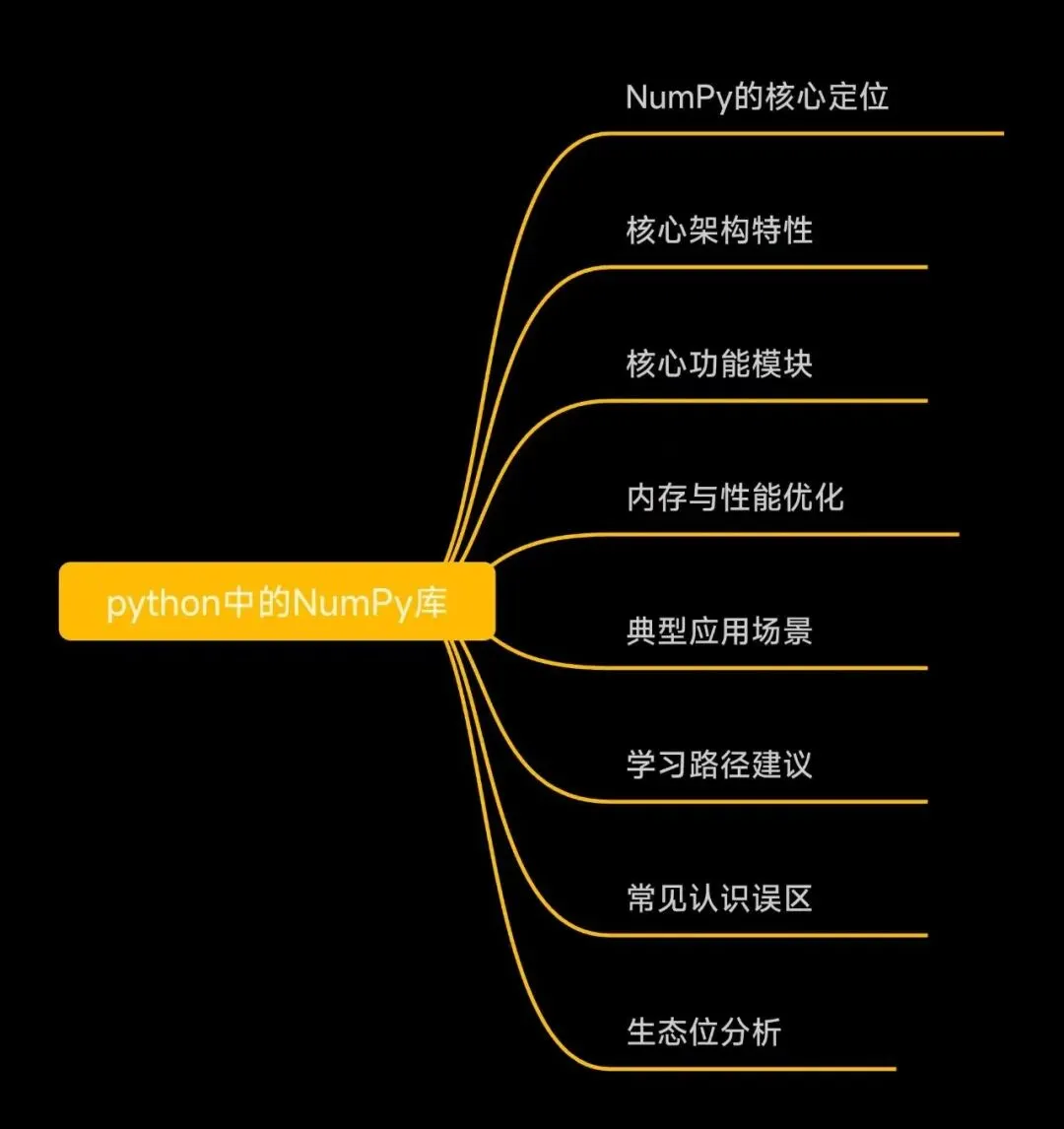
Share interest, spread happiness,increase knowledge, and leave beautiful.Dear, this is the LearingYard Academy!Today, the editor brings the"The NumPy library in Python".NumPy的核心定位
Core Positioning of NumPy
NumPy(Numerical Python)是Python科学计算生态系统的基石性库,其核心价值在于突破了Python原生列表的性能限制,为大规模数值计算提供了高效解决方案。该库通过精心设计的多维数组对象和配套操作接口,使得Python在数据处理、机器学习等领域能够媲美传统科学计算工具(如MATLAB)的效率。
NumPy (Numerical Python) is a foundational library in the Python scientific computing ecosystem. Its core value lies in overcoming the performance limitations of Python’s native lists and providing efficient solutions for large‑scale numerical computing. Through its well‑designed multidimensional array object and accompanying operation interfaces, NumPy enables Python to match the efficiency of traditional scientific computing tools (such as MATLAB) in fields like data processing and machine learning.
核心架构特性
Core Architectural Features
1. 多维数组对象(ndarray)
Multidimensional Array Object (ndarray)
内存连续的存储结构,支持整型、浮点型等多种数据类型
固定大小的初始化特性,与Python动态列表形成鲜明对比
内置维度(shape)、数据类型(dtype)、步长(strides)等元信息
A contiguous memory storage structure supporting various data types such as integers and floating‑point numbersFixed‑size initialization, in distinct contrast to Python’s dynamic listsBuilt‑in metadata including dimensions (shape), data type (dtype), and strides2. 计算加速原理
Principles of Computational Acceleration
向量化运算:将循环操作转化为底层编译的数组级指令
内存视图机制:避免不必要的数据复制
广播规则:智能处理不同维度数组的运算匹配
Vectorized operations: converting loop‑based computations into low‑level compiled array‑wise instructionsMemory view mechanism: avoiding unnecessary data copyingBroadcasting rules: intelligently handling operation matching between arrays of different dimensions核心功能模块
Core Functional Modules
1. 数组创建体系
Array Creation System
支持从Python序列、磁盘文件、内存缓冲区等多种数据源构建数组
提供全零数组、单位矩阵、等差序列等特殊数组的快速生成方法
包含完善的随机数生成器系统
Supports constructing arrays from multiple data sources such as Python sequences, disk files, and memory buffersProvides fast methods for generating special arrays like zero arrays, identity matrices, and evenly spaced sequencesIncludes a comprehensive random number generator system2. 数学运算体系
Mathematical Operations System
算术运算:实现逐元素的加、减、乘、除等基本运算
超越函数:包含三角函数、指数对数等标准数学函数
统计方法:支持沿指定维度的求和、均值、标准差等计算
Arithmetic operations: element‑wise addition, subtraction, multiplication, division, and other basic operationsTranscendental functions: trigonometric, exponential, logarithmic, and other standard mathematical functionsStatistical methods: sum, mean, standard deviation, and other calculations along specified dimensions3. 线性代数子系统
Linear Algebra Subsystem
矩阵分解:特征值分解、奇异值分解等经典算法
矩阵运算:求逆、求秩、行列式计算等基础操作
解线性方程组:提供多种数值解法
Matrix decompositions: eigenvalue decomposition, singular value decomposition, and other classic algorithmsMatrix operations: inversion, rank calculation, determinant computation, and other fundamental operationsSolving linear systems: providing multiple numerical solution methods内存与性能优化
Memory and Performance Optimization
1. 内存布局控制
C顺序与Fortran顺序的内存排列选择
视图与拷贝的显式控制机制
Choice between C‑order and Fortran‑order memory arrangementsExplicit control mechanisms for views versus copies2. 计算加速策略
避免Python循环的向量化编程范式
利用ufunc实现底层循环优化
通过 stride tricks 实现虚拟维度变换
A vectorized programming paradigm that avoids Python loopsUsing ufuncs to optimize low‑level loopsImplementing virtual dimension transformations through stride tricks典型应用场景
Typical Application Scenarios
1. 科学计算领域
物理场的数值模拟
微分方程的离散求解
傅里叶变换等信号处理操作
Numerical simulation of physical fieldsDiscrete solution of differential equationsSignal processing operations such as Fourier transforms2. 数据科学流程
数据标准化/归一化处理
特征矩阵的构造与变换
降维算法的底层实现
Data standardization and normalizationConstruction and transformation of feature matricesLow‑level implementation of dimensionality reduction algorithms3. 机器学习基础
神经网络权重矩阵运算
损失函数的向量化实现
梯度计算的批量处理
Neural network weight matrix operationsVectorized implementation of loss functionsBatch processing of gradient computations学习路径建议
Learning Path Recommendations
1. 基础阶段
理解ndarray的内存模型
掌握广播规则的应用场景
熟悉常用数组操作方法
Understand the memory model of ndarraysMaster the application scenarios of broadcasting rulesFamiliarize yourself with common array manipulation methods2. 进阶阶段
学习结构化数组的特殊用法
掌握内存映射文件处理
理解与C语言的交互接口
Learn specialized uses of structured arraysMaster memory‑mapped file handlingUnderstand interfaces for interacting with C3. 高阶应用
实现自定义ufunc函数
开发基于NumPy的扩展模块
优化现有算法的内存访问模式
Implement custom ufunc functionsDevelop extension modules based on NumPyOptimize memory access patterns of existing algorithms常见认知误区
Common Misconceptions
1. 与Python列表的混淆
忽视NumPy数组的固定类型特性
误用Python的序列操作方法
低估向量化操作与循环的性能差异
Ignoring the fixed‑type nature of NumPy arraysMisapplying Python sequence operationsUnderestimating the performance difference between vectorized operations and loops2. 内存管理盲区
忽视视图与拷贝的区别
不理解连续内存布局的重要性
未考虑大数据量的内存占用问题
Neglecting the distinction between views and copiesNot understanding the importance of contiguous memory layoutsFailing to consider memory usage with large datasets生态位分析
Niche Analysis
在Python科学计算栈中,NumPy处于基础层,向上支撑着Pandas(数据处理)、SciPy(科学算法)、Matplotlib(可视化)等库的运行。其设计哲学强调"底层高效+接口简洁",这种定位使其成为连接高级应用与硬件计算资源的理想抽象层。掌握NumPy的核心思想不仅有助于日常科学计算,更能为理解现代深度学习框架(如PyTorch/TensorFlow)的设计理念奠定基础。建议学习者通过实际数值计算项目,逐步体会其设计精妙之处。
In the Python scientific computing stack, NumPy occupies the foundational layer, supporting higher‑level libraries such as Pandas (data processing), SciPy (scientific algorithms), and Matplotlib (visualization). Its design philosophy emphasizes “high efficiency at the bottom + a clean interface,” making it an ideal abstraction layer connecting high‑level applications with hardware computing resources. Mastering NumPy’s core concepts not only facilitates daily scientific computing but also lays the groundwork for understanding the design principles of modern deep learning frameworks like PyTorch and TensorFlow. Learners are encouraged to gradually appreciate its elegant design through practical numerical computing projects.
That's all for today's sharing.If you have a unique idea about the article, please leave us a message, and let us meet tomorrow.本文由LearningYard新学苑原创,如有侵权,请联系删除。