笔记:python进阶(面向对象)
- 2026-08-24 11:29:26
笔记:python进阶(面向对象)步骤: 1设计类:在程序中设计表格 classstudent: name=None gender=None native_place=None age=None Python 2创建对象,在程序中打印生成表格 stu_1=student() Python 3对象属性赋值,在程序中填写表格 stu_1.name="张三" stu_1.gender="男" stu_1.native_place="北京" stu_1.age=18 Python 语法:class 类名称: 类的属性(定义在类中的变量)(成员变量) 类的行为 (定义在类中的函数)(成员方法) 创建类对象的语法:对象=类名称() 创建方法的语法:def 方法名(self,形参1………..形参N): 方法体 (虽然self在参数列表中,但是传参的时候可以忽略) classstudent: name=None defsay_hi(self): print(f"hello,my name is{self .name}") defsay_hi2(self,msg): print(f"hello,my name is {self .name},{msg}") stu_1=student() stu_1.name="peter" stu_1.say_hi() stu_1.say_hi2("look my eyes") Python 1构建类对象时,会自动执行 2构造类对象时,将传入参数自动传递给__init__方法使用 classstudent: def__init__(self,name,age,tel): self.name=name self.age=age self.tel=tel print("student类创建一个类对象") stu=student("张三",18,"123456") Python 可以省略定义name=None的环节,在self.name会自动定义 当有输入时候 classstudent: def__init__(self,name,age,adr): self.name= name self.age= age self.adr= adr for i inrange(1,11): print(f"录入第{i}个学生信息:") name=input("请输入学生姓名:") age=int(input("请输入学生年龄:")) adr=input("请输入学生地址:") stu=student(name,age,adr) print(f"学生{i}的姓名是{stu.name},年龄是{stu.age},地址是{stu.adr}") Python 控制类转化为字符串的行为 直接输出类对象会显示内存地址 classstudent: def__init__(self, name, age): self.name = name self.age = age stu=student("xiaoming", 18) print(stu) print(str(stu)) Python 
通过字符串方法进行转化 classstudent: def__init__(self, name, age): self.name = name self.age = age def__str__(self): returnf"student类对象,name:{self.name}, age:{self.age}" stu=student("xiaoming", 18) print(stu) print(str(stu)) Python 
可以自己决定输出的结果是什么 可以同时完成小于符合和大于符号两种的比较 classstudent: def__init__(self, name, age): self.name = name self.age = age def__lt__(self, other): returnself.age < other.age stu1=student('xiaoming', 18) stu2=student('xiaohong', 17) print(stu1print(stu1>stu2) Python 
会返回true或false classstudent: def__init__(self, name, age): self.name = name self.age = age def__le__(self, other): returnself.age <= other.age stu1=student('xiaoming', 17) stu2=student('xiaohong', 17) print(stu1<=stu2) print(stu1>=stu2) Python 如果不添加__eq__。使用==符号时,默认比较的是内存地址,结果必然是false classstudent: def__init__(self, name, age): self.name = name self.age = age def__eq__(self, other): returnself.age == other.age stu1=student('xiaoming', 17) stu2=student('xiaohong', 18) print(stu1==stu2) Python 使用eq才能进行比较 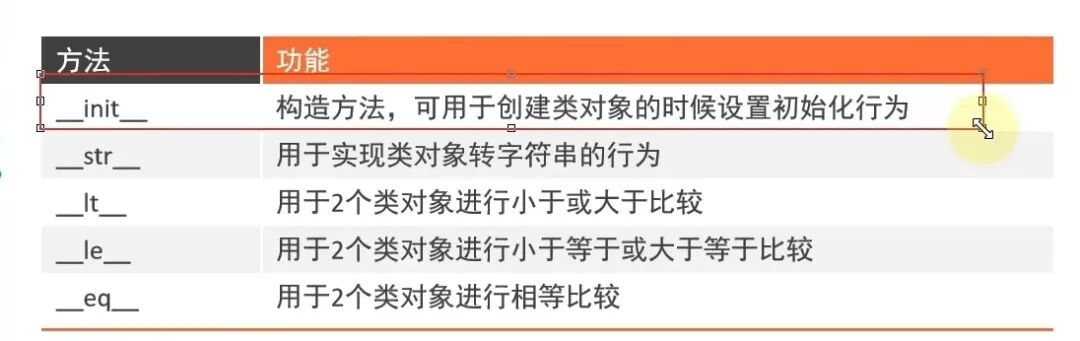
内容:私有成员变量,私有成员方法 定义方法: 变量名加__开头(两个下划线) classphone: __current_V=None def__keep_single_core(self): print("让cpu以单核运行") phone=phone() phone.__keep_single_core() Python 使用私有方法会报错 
classphone: __current_V=None def__keep_single_core(self): print("让cpu以单核运行") phone=phone() print(phone.__current_V) Python 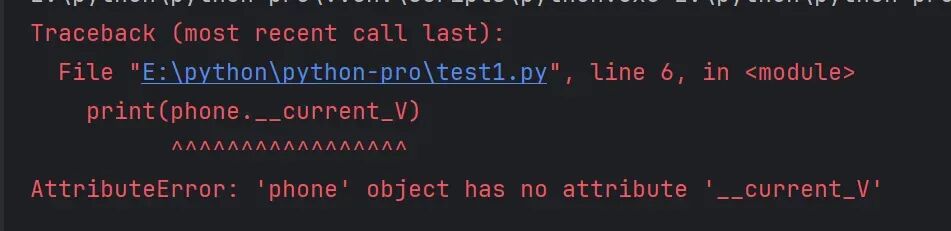
使用私有成员也同理 作用: 私有成员无法被类对象使用,但是可以被类中的其它成员使用 classphone: __current_V=0.5 def__keep_single_core(self): print("让cpu以单核运行") defcall_by(self): ifself.__current_V>=1: print("打电话") else: self.__keep_single_core() print("电量不足") phone=phone() phone .call_by() Python class 类名(父类名): 类内容体 classphone: IMEI=None producer="HM" defcall_by_4g(self): print("calling by 4g") classphone2022(phone): face_id="10001" defcall_by_5g(self): print("calling by 5g") phone=phone2022() print(phone.producer) phone.call_by_5g() Python 一个类可以继承好多个父类 classphone: IMEI=None producer="HM" defcall(self): print("正在打电话") classNFCReader: nfc_type="第五代" producer="HM" defread_card(self): print("正在读取NFC卡") defwrite_card(self): print("正在写入NFC卡") classremotocontrol: rc_type="遥控器" defcontrol(self): print("正在控制") classmyphone(phone,NFCReader,remotocontrol): pass phone=myphone() phone.call() phone.read_card() phone.write_card() phone.control() Python 多继承中,如果有同名父类属性,先继承的优先级高于后继承 如类中没有想要书写的语句,但是不书写会有语法报错,使用pass可以进行替代,表示空。 classphone: IMEI=None producer="SHA" defcall(self): print("正在打电话") classMyphone( phone): producer = "SXU" defcall(self): print("正在使用手机") phone=Myphone() phone.call() Python 方式一:使用父类名调用 使用成员变量:父类名.成员变量 使用成员方法: 父类名.成员方法(self) classphone: IMEI=None producer="SHA" defcall_1(self): print("正在打电话") classMyphone( phone): producer = "SXU" defcall(self): print("正在使用手机") phone.call_1(self) my_phone=Myphone() my_phone.call() Python 使用成员变量:super().成员变量 使用成员方法:super().成员方法() classMyphone( phone): producer = "SXU" defcall(self): print("正在使用手机") print(f"父类的属性为{super().producer}") super().call_1() phone=Myphone() phone.call() Python 指的是多种状态:完成某个行为时,使用不同的对象会得到的不同状态 同样的行为(函数),传入不同的对象,得到不同的状态 以父类作定义,子类做工作,从而得到不同的工作状态 classAnimal: defspeak(self): pass classDog(Animal): defspeak(self): print("Woof!") classCat(Animal): defspeak(self): print("Meow!") defmake_noise(animal): animal.speak() dog=Dog() cat=Cat() make_noise(dog) make_noise(cat) Python 包含抽象方法的类,没有具体的实现方法(pass)跳过 作用:用于做顶层设计,子类做具体实现 也是对子类的软性约束,要求子类必须复写(实现)父类的一些方法来配合使用 classAC: defcool_wind(self): pass defhot_wind(self): pass defswing_1_r(self): pass classMidea_AC(AC): defcool_wind(self): print("Midea_AC: 冷风") defhot_wind(self): print("Midea_AC: TestHot") defswing_1_r(self): print("Midea_AC: 1_r") classGeili_AC(AC): defcool_wind(self): print("Geili_AC: 冷风") defhot_wind(self): print("Geili_AC: TestHot") defswing_1_r(self): print("Geili_AC: 1_r") defmake_cool(ac): ac.cool_wind() medeia_ac = Midea_AC() geili_ac = Geili_AC() make_cool(medeia_ac) make_cool(geili_ac) Python 在代码中设计数据交互的地方,提供数据类型注解(显示说明) 功能: 1帮助第三方IDE工具(如pycharm)对代码进行类型推断,协助做代码提示 2帮助开发自身对变量进行类型注释 1基础语法: 变量:类型 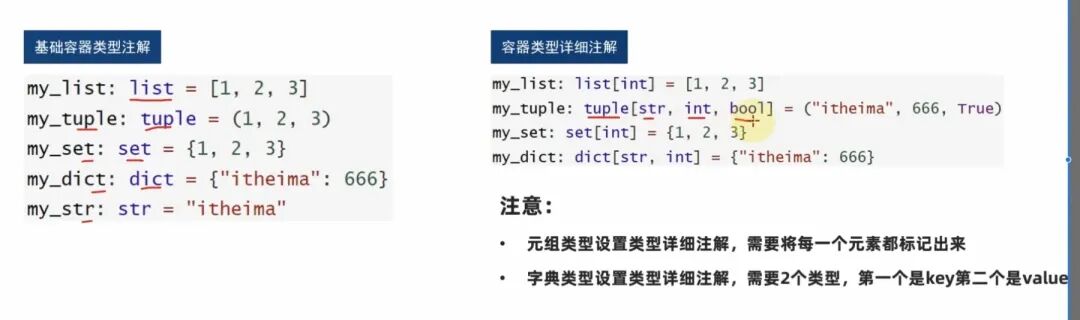
2注释中进行类型注解:#type:类型 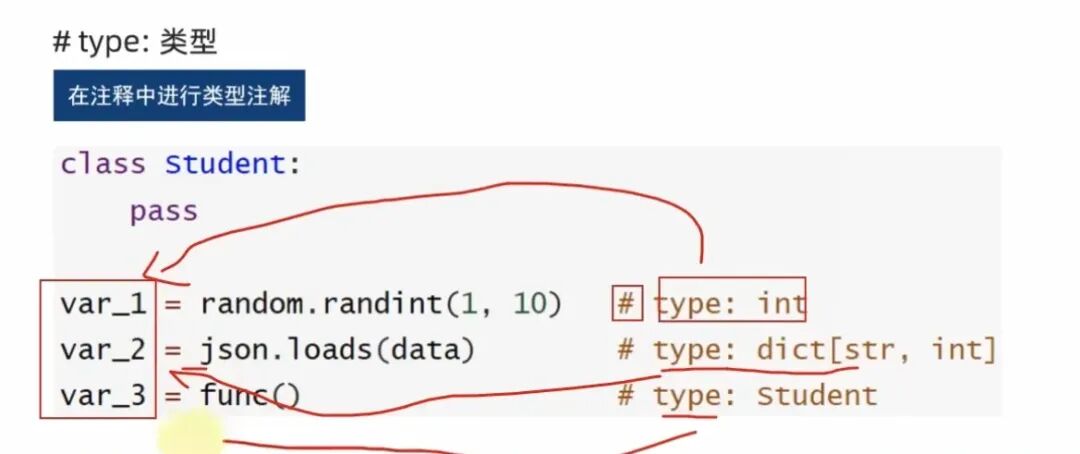
但以上都为较为直观,在实际写程序中无需编写,但是以下情况是重要的运用场景 var_1:int=random.randint(0, 100) var_2:dict=json.loads(data) var_3:stuent=func() Python var_1:int="itheima" var_2:str=123 Python 语法: 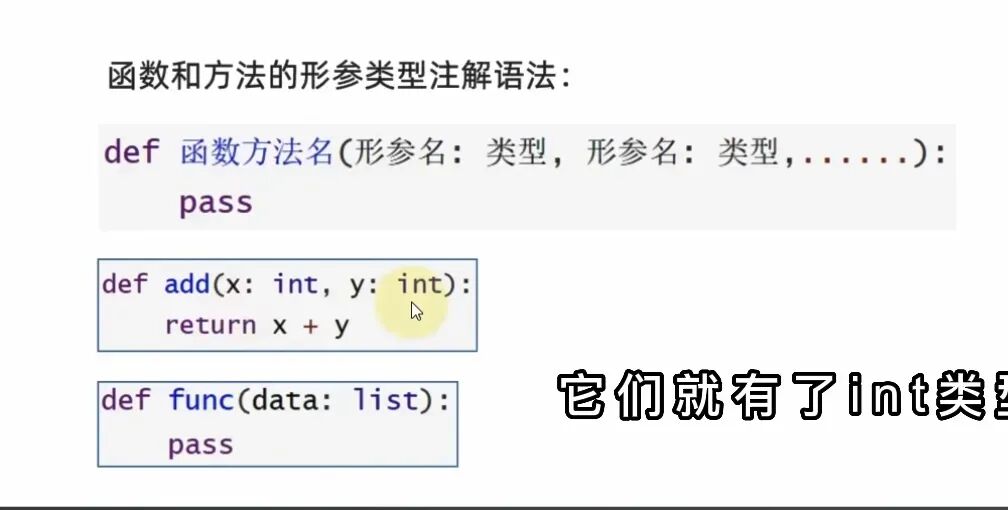
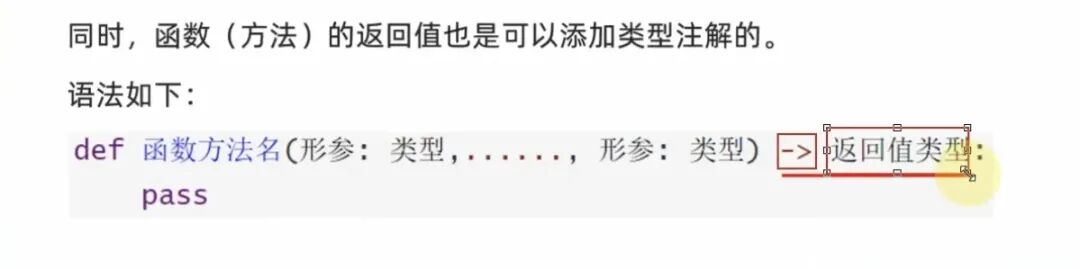
deffunc(data:list)->list: return data Python 需要先导包 from typing import Union 作用:包含多个类型时,进行联合注解 变量语法: 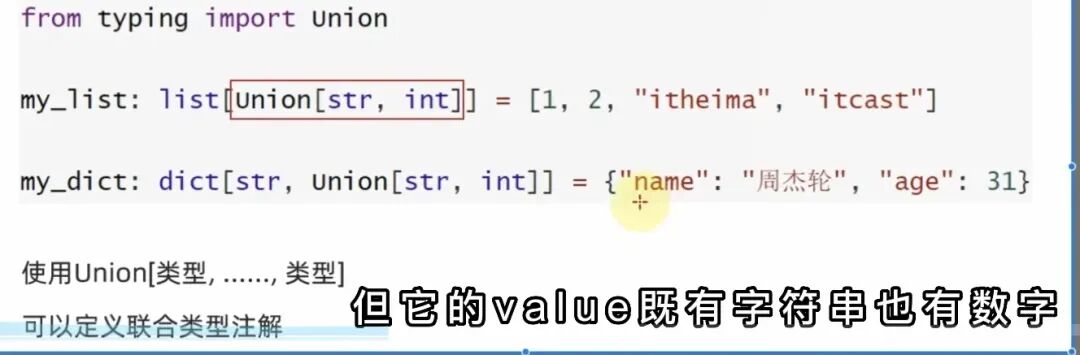
函数(方法)语法 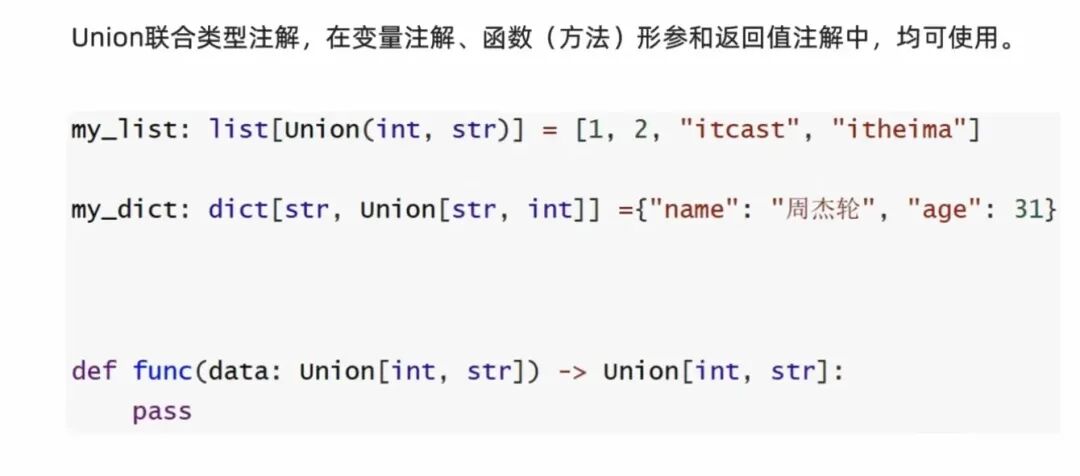
eg: from typing importUnion my_list:list[Union[int,str]]=[1,2,3,"a","b","c"] deffunc(data:Union[int,str])->Union[int,str]: psss func() Python 步骤 1设计一个类,可以完成数据的封装 单独建立一个datadfine的文件 """ 数据定义的类 """ classRecord: def__init__(self,data,order_id,money,province): self.date=data self.order_id=order_id self.money=money self.province=province#省份 def__str__(self): returnf"{self.date},{self.order_id},{self.money},{self.province}" Python 2设计一个抽象类,定义文件读取的相关功能,并使用子类实现具体运用 单独建立一个file_define的文件 """ 和文件相关的类定义 """ #定义一个抽象类做顶层设计,确定有哪些功能需要实现 from date_define import Record from typing importList import json """ 定义一个抽象类做顶层设计,确定有哪些功能需要实现 """ classFileReader: defread_date(self)->List[Record]: pass classTextFileReader(FileReader): def__init__(self,path): self.path =path defread_date(self) ->List[Record]: f=open(self.path,"r",encoding="utf-8") record_list=[] for line in f.readlines(): line=line.strip() data_list=line.split(",") record=Record(data_list[0],data_list[1],int(data_list[2]),data_list[3]) record_list.append(record) f.close() return record_list classJsonFileReader(FileReader): def__init__(self,path): self.path =path defread_date(self) ->List[Record]: f=open(self.path,"r",encoding="utf-8") record_list=[] for line in f.readlines(): data_dict=json.loads(line) record=Record(data_dict["date"],data_dict["order_id"],int(data_dict["money"]),data_dict["province"]) record_list.append(record) f.close() return record_list if __name__ == "__main__": text_file_reader=TextFileReader("D:/2011年1月销售数据.txt") json_file_reader=JsonFileReader("D:/2011年2月销售数据JSON.txt") list1=text_file_reader.read_date() list2=json_file_reader.read_date() for l in list1: print(l) for l in list2: print(l) Python 3在主文件中进行数据的整合 在main文件中 from file_define import FileReader,TextFileReader,JsonFileReader from data_define import Record text_file_reader=TextFileReader("D:/2011年1月销售数据.txt") json_file_reader=JsonFileReader("D:/2011年2月销售数据JSON.txt") jan_data:list[ Record]=text_file_reader.read_date() feb_data:list[ Record]=json_file_reader.read_date() all_date:list[ Record]=jan_data+feb_data Python 4数据计算 data_dict={} for record in all_data: if record.date in data_dict: data_dict[record.date]+=record.money else: data_dict[record.date]=record.money print(data_dict) Python 可以对每日的数据进行一个累加 4可视化表达 bar=Bar(init_opts=InitOpts(theme=ThemeType.LIGHT)) bar.add_xaxis(list(data_dict.keys())) bar.add_yaxis("销售额",list(data_dict.values()),label_opts=LabelOpts(is_show=False)) bar.set_global_opts(title_opts=TitleOpts(title="每日销售数据")) bar.render("每日销售数据.html") Python 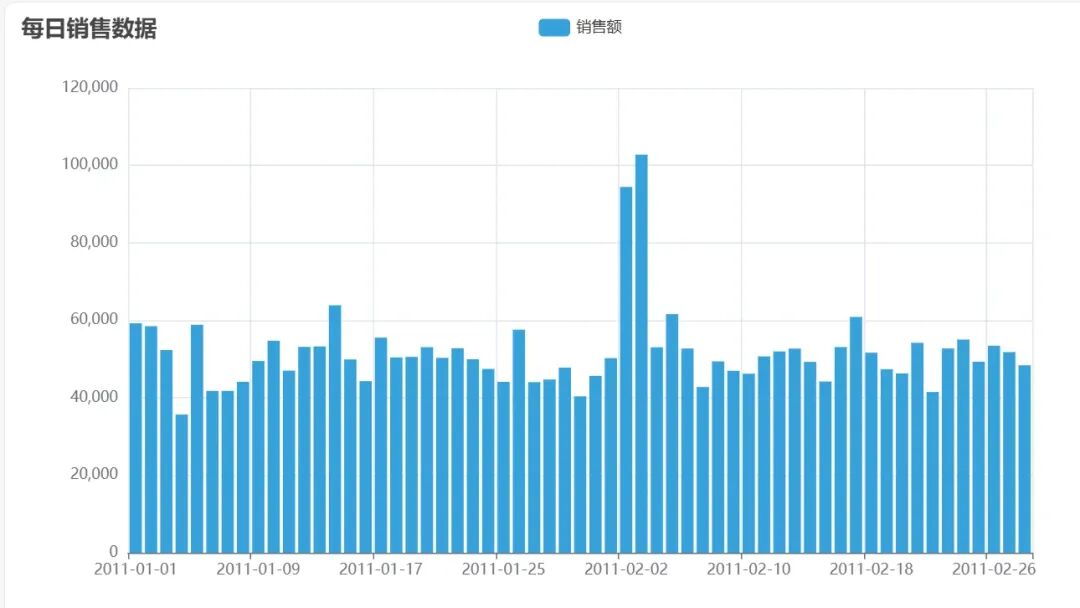
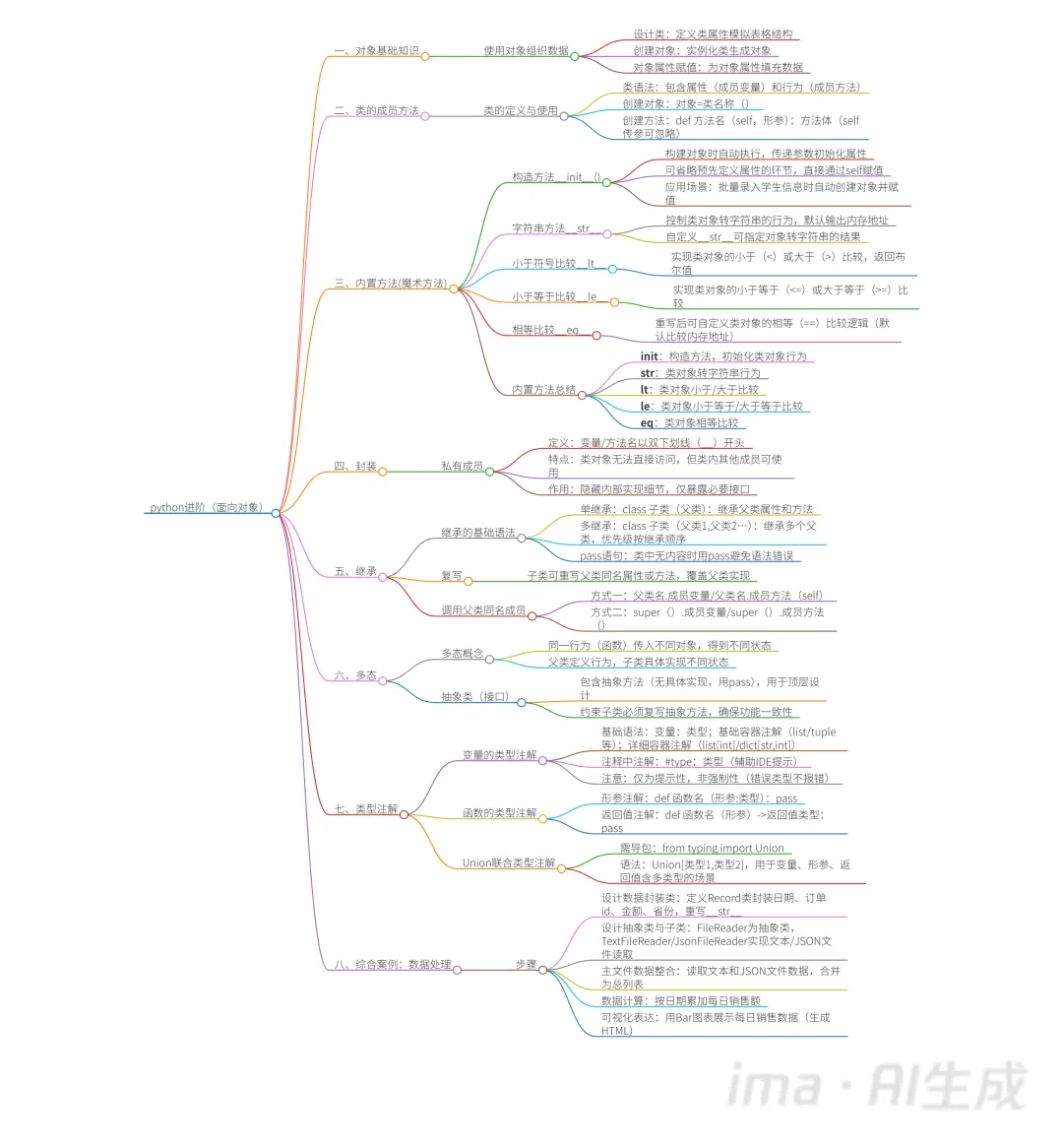
一,对象基础知识
1使用对象组织数据
二,类的成员方法
1类的定义与使用class
三,内置方法(魔术方法)
1.构造方法__init__()
2字符串方法__str__
3.小于符号的比较__it __
4.小于等于比较符号方法__le__
5.比较运算符实现__eq__
总结
四,封装
私有成员
五,继承
(1)继承的基础语法
1单继承
2多继承
3 pass语句
(2)复写
(3)调用父类同名成员
方式二:使用super()调用父类成员
六,多态
1抽象类(接口)
七,类型注解
1变量的类型注解
注意:类型注解仅仅是提示性的,不是决定性的。下面明显的错误也不会报错
2.函数(方法)类型注解
2.1形参类型注解
2.2返回值类型注解
注意:类型注解仅仅是提示性的,不是决定性的。
3Union联合类型注解
八,综合案例:数据处理
日期
订单id
金额
本文来自网友投稿或网络内容,如有侵犯您的权益请联系我们删除,联系邮箱:596563534@qq.com 。
