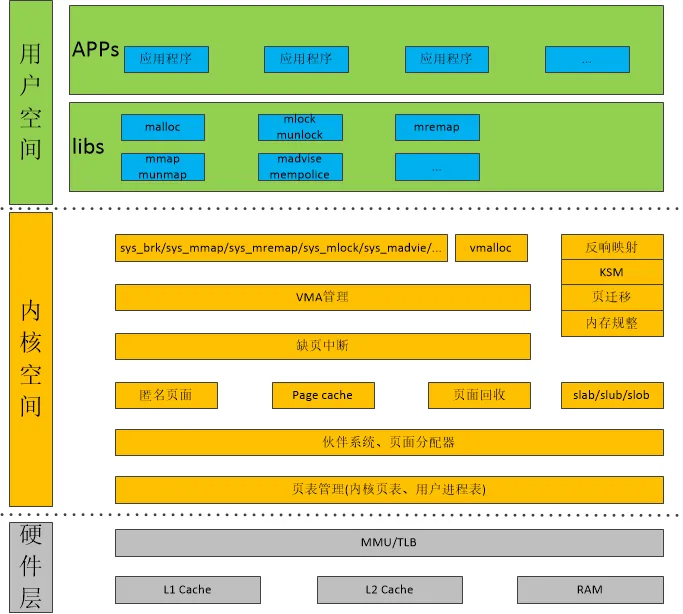
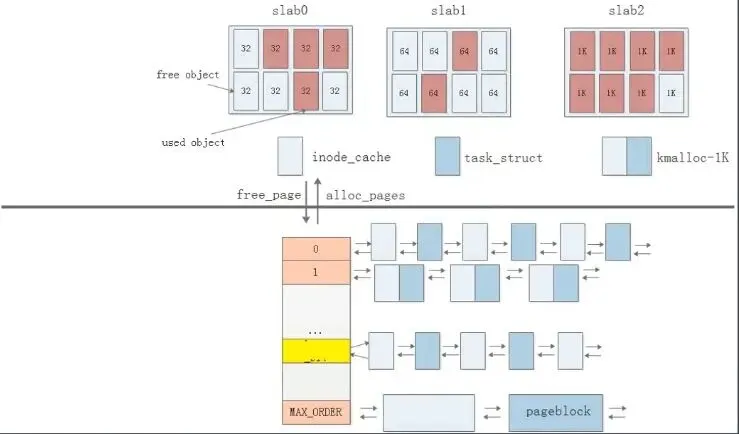
从Linux内存管理框架图可以知道:slab/slub/slob都是基于伙伴系统。伙伴系统是以page为单位进行操作的。但是很多场景并不需要如此大的内存分配,slab就是用在这种场景的。
本章节主要内容:从slab相关数据结构讲起,对slab有一个静态的认识;然后介绍slab从创建描述符->分配缓存->释放缓存->销毁描述符介绍整个slab生命周;最后介绍基于slab分配器的kmalloc的运行原理。
slab分配器最终还是由伙伴系统来分配出实际的物理页面,只不过slab分配器在这些连续的物理页面上实现了自己的算法,以此来对小内存块进行管理。
slab分配器相关重要函数有:
struct kmem_cache *kmem_cache_create(const char *, size_t, size_t,---------创建slab描述符kmem_cache,此时并没有真正分配内存 unsigned long, void (*)(void *));void *kmem_cache_alloc(struct kmem_cache *, gfp_t flags);------------------分配slab缓存对象voidkmem_cache_free(struct kmem_cache *, void *);-------------------------释放slab缓存对象voidkmem_cache_destroy(struct kmem_cache *);-----------------------------销毁slab描述符
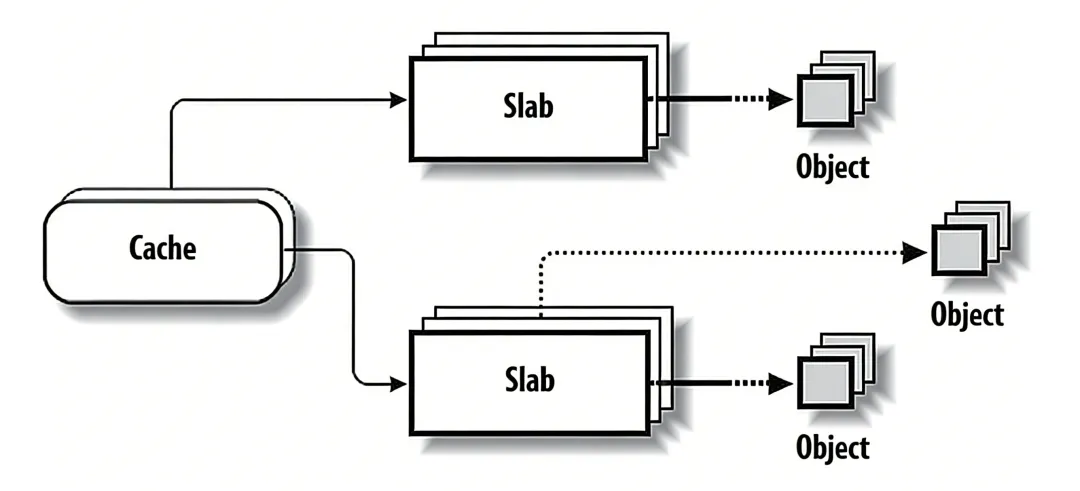
那每个slab由多少个页面组成?
每个slab由一个或多个连续页面组成,最低一个,物理连续。
slab需要的物理内存在什么时候分配?
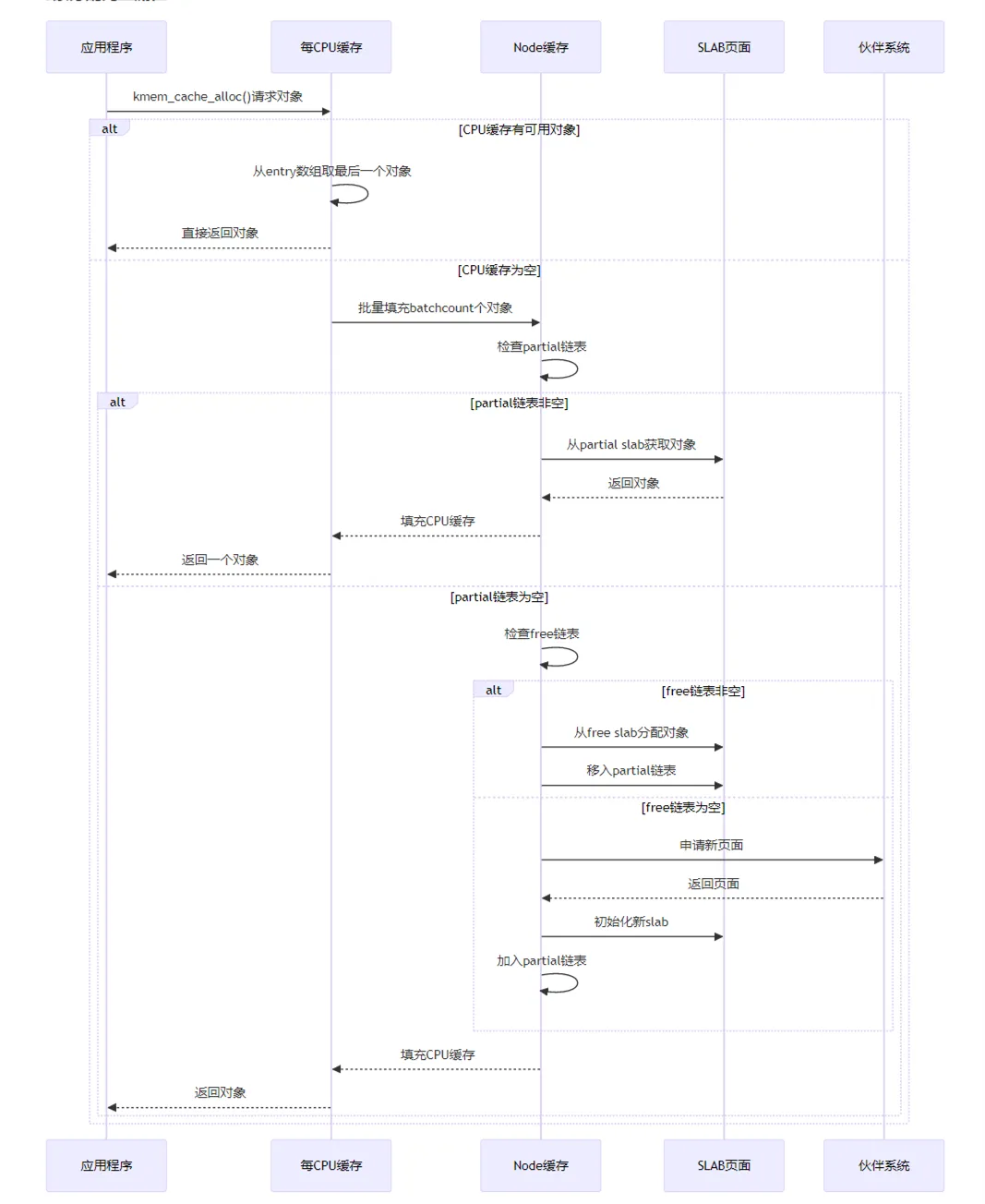
首先kmem_cache_create是并不分配页面,等到kmem_cache_alloc时才有可能分配页面。首先从本地缓冲池和共享缓冲池、三大链表都没有空闲对象时,才会去分配2^gfporder个页面,然后挂入到slabs_free中。
slab描述符中空闲对象过多,是否要回收?
有两种方式回收空闲对象:
(1)使用kmem_cache_free释放对象,当本地和共享对象缓冲池中空闲对象数目ac->avail大于ac->limit时,系统会主动脂肪batchcount个对象。当所有空闲数目大于系统空闲对象数目极限值,并且slab没有活跃对象时,可以销毁此slab,回收内存。
(2)系统注册了delayed_work,定时扫描slab描述符,回收一部分空闲对象,在cache_reap中实现。
slab的cache colour着色区作用?
使不同slab上同一个相对位置slab对象的起始地址在高速缓存中相互错开,有利于改善高速缓存的行能。
另一个利用cache场景是Per-CPU类型本地对象缓冲池。两个优点:让一个对象尽可能地运行在同一个CPU上;访问Per-CPU类型本地对象缓冲池不需要获取额外自选锁。
一、slab相关数据结构
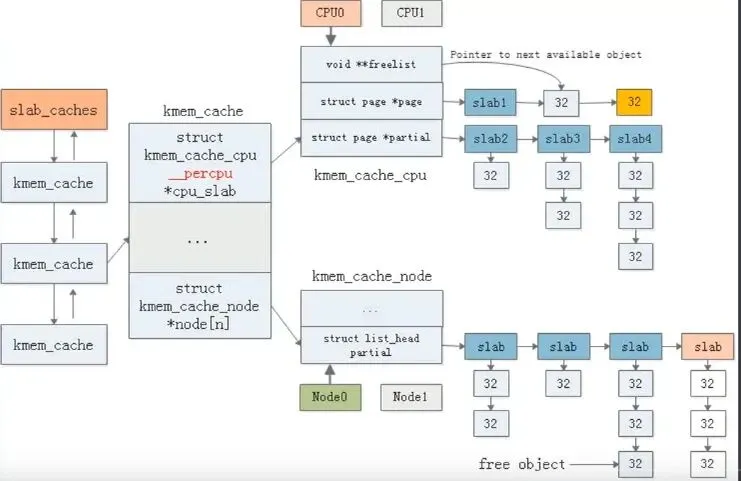
slab对象的描述符struct kmem_cache:
struct kmem_cache { struct array_cache __percpu *cpu_cache;/* 1) Cache tunables. Protected by slab_mutex */ unsigned int batchcount;-----------------------------------表示当前CPU本地缓冲池array_cache为空时,从共享缓冲池或者slabs_partial/slabs_free列表中获取对象的数目。 unsigned int limit;----------------------------------------表示当本地对象缓冲池空闲对象数目大于limit时就会主动释放batchcount个对象,便于内核回收和销毁slab。 unsigned int shared; unsigned int size;-----------------------------------------align过后的对象长度 struct reciprocal_value reciprocal_buffer_size;/* 2) touched by every alloc & free from the backend */ unsigned int flags; /* constant flags */------------分配掩码 unsigned int num; /* # of objs per slab */----------slab中有多少个对象/* 3) cache_grow/shrink */ /* order of pgs per slab (2^n) */ unsigned int gfporder;------------------------------------此slab占用z^gfporder个页面 /* force GFP flags, e.g. GFP_DMA */ gfp_t allocflags; size_t colour; /* cache colouring range */----一个slab有几个不同的cache line unsigned int colour_off; /* colour offset */----------一个cache order的长度,和L1 Cache Line长度相同 struct kmem_cache *freelist_cache; unsigned int freelist_size; /* constructor func */ void (*ctor)(void *obj);/* 4) cache creation/removal */ const char *name;----------------------------------------slab描述符的名称 struct list_head list; int refcount;--------------------------------------------被引用的次数,供slab描述符销毁参考 int object_size;-----------------------------------------对象的实际大小 int align;-----------------------------------------------对齐的大小/* 5) statistics */#ifdef CONFIG_DEBUG_SLAB unsigned long num_active; unsigned long num_allocations; unsigned long high_mark; unsigned long grown; unsigned long reaped; unsigned long errors; unsigned long max_freeable; unsigned long node_allocs; unsigned long node_frees; unsigned long node_overflow; atomic_t allochit; atomic_t allocmiss; atomic_t freehit; atomic_t freemiss; /* * If debugging is enabled, then the allocator can add additional * fields and/or padding to every object. size contains the total * object size including these internal fields, the following two * variables contain the offset to the user object and its size. */ int obj_offset;#endif/* CONFIG_DEBUG_SLAB */#ifdef CONFIG_MEMCG_KMEM struct memcg_cache_params memcg_params;#endif struct kmem_cache_node *node[MAX_NUMNODES];-------slab对应的节点的struct kmem_cache_node数据结构}
本地CPU缓冲池struct array_cache:
struct array_cache { unsigned int avail;-------------对象缓冲池中可用的对象数目 unsigned int limit; unsigned int batchcount; unsigned int touched;----------从缓冲池移除一个对象时,touched置1;收缩缓存时,touched置0。 void *entry[];-----------------保存对象的实体};
内存节点的slab列表:
/* * The slab lists for all objects. */struct kmem_cache_node { spinlock_t list_lock;#ifdef CONFIG_SLAB struct list_head slabs_partial; /* partial list first, better asm code */----slab链表中部分对象空闲 struct list_head slabs_full;----------------------------------------------------slab链表中没有对象空闲 struct list_head slabs_free;----------------------------------------------------slab链表中所有对象空闲 unsigned long free_objects;-----------------------------------------------------三个链表中空闲对象数目 unsigned int free_limit;--------------------------------------------------------slab中可容许的空闲对象数目最大阈值。 unsigned int colour_next; /* Per-node cache coloring */ struct array_cache *shared; /* shared per node */----------------------------多核CPU公用的共享对象缓冲池 struct alien_cache **alien; /* on other nodes */ unsigned long next_reap; /* updated without locking */ int free_touched; /* updated without locking */#endif#ifdef CONFIG_SLUB unsigned long nr_partial; struct list_head partial;#ifdef CONFIG_SLUB_DEBUG atomic_long_t nr_slabs; atomic_long_t total_objects; struct list_head full;#endif#endif};
SLAB Flags
/* * Flags to pass to kmem_cache_create(). * The ones marked DEBUG are only valid if CONFIG_SLAB_DEBUG is set. */#define SLAB_DEBUG_FREE 0x00000100UL /* DEBUG: Perform (expensive) checks on free */#define SLAB_RED_ZONE 0x00000400UL /* DEBUG: Red zone objs in a cache */#define SLAB_POISON 0x00000800UL /* DEBUG: Poison objects */#define SLAB_HWCACHE_ALIGN 0x00002000UL /* Align objs on cache lines */#define SLAB_CACHE_DMA 0x00004000UL /* Use GFP_DMA memory */#define SLAB_STORE_USER 0x00010000UL /* DEBUG: Store the last owner for bug hunting */#define SLAB_PANIC 0x00040000UL /* Panic if kmem_cache_create() fails */
二、创建slab描述符
kmem_cache_create的最主要功能就是填充struct kmem_cache,主要参数有:
name:slab描述符的名称
size:缓存对象的大小
align:对齐的大小
flags:分配掩码
ctor:对象的构造函数
kmem_cache_create函数调用核心流程是:
kmem_cache_create-----------------------------进行合法性检查,以及是否有现成slab描述符可用 do_kmem_cache_create----------------------将主要参数配置到slab描述符,然后将得到的描述符加入slab_caches全局链表中。 __kmem_cache_create-------------------是创建slab描述符的核心进行对齐操作,计算需要页面,对象数目,对slab着色等等操作。 calculate_slab_order--------------计算slab对象需要的大小,以及一个slab描述符需要多少page setup_cpu_cache-------------------继续配置slab描述符
struct kmem_cache *kmem_cache_create(const char *name, size_t size, size_t align, unsigned long flags, void (*ctor)(void *)){... s = __kmem_cache_alias(name, size, align, flags, ctor);----------------检查是否有现成的slab描述符可用,有即跳转到out_unlock。 if (s) goto out_unlock; cache_name = kstrdup_const(name, GFP_KERNEL); if (!cache_name) { err = -ENOMEM; goto out_unlock; } s = do_kmem_cache_create(cache_name, size, size,----------------------调用do_kmem_cache_create创建slab描述符 calculate_alignment(flags, align, size), flags, ctor, NULL, NULL);... return s;}
static struct kmem_cache *do_kmem_cache_create(const char *name, size_t object_size, size_t size, size_t align, unsigned long flags, void (*ctor)(void *), struct mem_cgroup *memcg, struct kmem_cache *root_cache){ struct kmem_cache *s; int err; err = -ENOMEM; s = kmem_cache_zalloc(kmem_cache, GFP_KERNEL);-----------------------分配一个struct kmem_cache结构体 if (!s) goto out; s->name = name; s->object_size = object_size; s->size = size; s->align = align; s->ctor = ctor;-----------------------------------------------------将参数填入struct kmem_cache结构体... err = __kmem_cache_create(s, flags);-------------------------------... s->refcount = 1; list_add(&s->list, &slab_caches);----------------------------------将创建的slab描述符加入到全局变量slab_caches中...}
__kmem_cache_create是创建slab描述符的核心:
int__kmem_cache_create (struct kmem_cache *cachep, unsigned long flags){ size_t left_over, freelist_size; size_t ralign = BYTES_PER_WORD; gfp_t gfp; int err; size_t size = cachep->size;... /* * Check that size is in terms of words. This is needed to avoid * unaligned accesses for some archs when redzoning is used, and makes * sure any on-slab bufctl's are also correctly aligned. */ if (size & (BYTES_PER_WORD - 1)) { size += (BYTES_PER_WORD - 1); size &= ~(BYTES_PER_WORD - 1);----------------------4字节对齐 } if (flags & SLAB_RED_ZONE) { ralign = REDZONE_ALIGN; /* If redzoning, ensure that the second redzone is suitably * aligned, by adjusting the object size accordingly. */ size += REDZONE_ALIGN - 1; size &= ~(REDZONE_ALIGN - 1); } /* 3) caller mandated alignment */ if (ralign < cachep->align) { ralign = cachep->align; } /* disable debug if necessary */ if (ralign > __alignof__(unsigned long long)) flags &= ~(SLAB_RED_ZONE | SLAB_STORE_USER); /* * 4) Store it. */ cachep->align = ralign;------------------------------对齐大小设置到struct kmem_cache if (slab_is_available())-----------------------------slab_state>=UP时,可以使用GFP_KERNEL分配,否则只能使用GFP_NOWAIT gfp = GFP_KERNEL; else gfp = GFP_NOWAIT;... /* * Determine if the slab management is 'on' or 'off' slab. * (bootstrapping cannot cope with offslab caches so don't do * it too early on. Always use on-slab management when * SLAB_NOLEAKTRACE to avoid recursive calls into kmemleak) */ if ((size >= (PAGE_SIZE >> 5)) && !slab_early_init && !(flags & SLAB_NOLEAKTRACE)) /* * Size is large, assume best to place the slab management obj * off-slab (should allow better packing of objs). */ flags |= CFLGS_OFF_SLAB; size = ALIGN(size, cachep->align);------------------按照cachep->align对size进行对齐 /* * We should restrict the number of objects in a slab to implement * byte sized index. Refer comment on SLAB_OBJ_MIN_SIZE definition. */ if (FREELIST_BYTE_INDEX && size < SLAB_OBJ_MIN_SIZE) size = ALIGN(SLAB_OBJ_MIN_SIZE, cachep->align); left_over = calculate_slab_order(cachep, size, cachep->align, flags); if (!cachep->num) return -E2BIG; freelist_size = calculate_freelist_size(cachep->num, cachep->align); /* * If the slab has been placed off-slab, and we have enough space then * move it on-slab. This is at the expense of any extra colouring. */ if (flags & CFLGS_OFF_SLAB && left_over >= freelist_size) { flags &= ~CFLGS_OFF_SLAB; left_over -= freelist_size; } if (flags & CFLGS_OFF_SLAB) { /* really off slab. No need for manual alignment */ freelist_size = calculate_freelist_size(cachep->num, 0);#ifdef CONFIG_PAGE_POISONING /* If we're going to use the generic kernel_map_pages() * poisoning, then it's going to smash the contents of * the redzone and userword anyhow, so switch them off. */ if (size % PAGE_SIZE == 0 && flags & SLAB_POISON) flags &= ~(SLAB_RED_ZONE | SLAB_STORE_USER);#endif } cachep->colour_off = cache_line_size();----------------------------------------L1 Cache line大小,由CONFIG_ARM_L1_CACHE_SHIFT配置,此处为64B。 /* Offset must be a multiple of the alignment. */ if (cachep->colour_off < cachep->align) cachep->colour_off = cachep->align; cachep->colour = left_over / cachep->colour_off; cachep->freelist_size = freelist_size; cachep->flags = flags; cachep->allocflags = __GFP_COMP; if (CONFIG_ZONE_DMA_FLAG && (flags & SLAB_CACHE_DMA)) cachep->allocflags |= GFP_DMA; cachep->size = size; cachep->reciprocal_buffer_size = reciprocal_value(size); if (flags & CFLGS_OFF_SLAB) { cachep->freelist_cache = kmalloc_slab(freelist_size, 0u); /* * This is a possibility for one of the kmalloc_{dma,}_caches. * But since we go off slab only for object size greater than * PAGE_SIZE/8, and kmalloc_{dma,}_caches get created * in ascending order,this should not happen at all. * But leave a BUG_ON for some lucky dude. */ BUG_ON(ZERO_OR_NULL_PTR(cachep->freelist_cache)); } err = setup_cpu_cache(cachep, gfp);-------------------------------------根据slab_state状态进行不同处理,计算limit/batchcount,分配本地对象缓冲池,共享对象缓冲池 if (err) { __kmem_cache_shutdown(cachep); return err; } return 0;}
slab_state用于表示slab分配器的状态:
/* * State of the slab allocator. * * This is used to describe the states of the allocator during bootup. * Allocators use this to gradually bootstrap themselves. Most allocators * have the problem that the structures used for managing slab caches are * allocated from slab caches themselves. */enum slab_state { DOWN, /* No slab functionality yet */ PARTIAL, /* SLUB: kmem_cache_node available */ PARTIAL_NODE, /* SLAB: kmalloc size for node struct available */ UP, /* Slab caches usable but not all extras yet */ FULL /* Everything is working */------------------------完全初始化};
calculate_slab_order计算slab的大小,返回值是page order。同时也计算此slab中可以容纳多少个同样大小的对象。
staticsize_tcalculate_slab_order(struct kmem_cache *cachep, size_t size, size_t align, unsigned long flags){ unsigned long offslab_limit; size_t left_over = 0; int gfporder; for (gfporder = 0; gfporder <= KMALLOC_MAX_ORDER; gfporder++) {------从gfporder=0开始,直到KMALLOC_MAX_ORDER=10,即从4KB到4MB大小。 unsigned int num; size_t remainder; cache_estimate(gfporder, size, align, flags, &remainder, &num); if (!num)---------------------------------------------------------不等于0则表示gfporder已经满足条件,最低分配到一个size大小的对象。等于0则继续下一次for循环。 continue; /* Can't handle number of objects more than SLAB_OBJ_MAX_NUM */ if (num > SLAB_OBJ_MAX_NUM)--------------------------------------slab中对象最大数目,SLAB_OBJ_MAX_NUM为255,所以所有的slab对象不超过255 break; if (flags & CFLGS_OFF_SLAB) { size_t freelist_size_per_obj = sizeof(freelist_idx_t); /* * Max number of objs-per-slab for caches which * use off-slab slabs. Needed to avoid a possible * looping condition in cache_grow(). */ if (IS_ENABLED(CONFIG_DEBUG_SLAB_LEAK)) freelist_size_per_obj += sizeof(char); offslab_limit = size; offslab_limit /= freelist_size_per_obj; if (num > offslab_limit) break; } /* Found something acceptable - save it away */ cachep->num = num; cachep->gfporder = gfporder; left_over = remainder;-------------------------------------------确定对象个数和需要的页面数... if (left_over * 8 <= (PAGE_SIZE << gfporder))-------------------满足着色条件,退出for循环。 break; }return left_over; }
cache_eastimate根据当前大小2^gfporder来计算可以容纳多少个对象,以及剩下多少空间用于着色。
staticvoidcache_estimate(unsignedlong gfporder, size_t buffer_size, size_t align, int flags, size_t *left_over, unsigned int *num){ int nr_objs; size_t mgmt_size; size_t slab_size = PAGE_SIZE << gfporder;... if (flags & CFLGS_OFF_SLAB) { mgmt_size = 0; nr_objs = slab_size / buffer_size; } else { nr_objs = calculate_nr_objs(slab_size, buffer_size,--------------可以容纳对象数 sizeof(freelist_idx_t), align); mgmt_size = calculate_freelist_size(nr_objs, align); } *num = nr_objs; *left_over = slab_size - nr_objs*buffer_size - mgmt_size;------------除去对象大小和管理slab额外开销外,剩余部分}
三、分配slab对象
kmem_cache_alloc是slab分配缓存对象的核心函数,在slab分配缓存过程中是全程关闭本地中断的。
kmem_cache_alloc-->slab_alloc-->__do_cache_alloc是关中断的。
static __always_inline void *slab_alloc(struct kmem_cache *cachep, gfp_t flags, unsignedlong caller){... local_irq_save(save_flags); objp = __do_cache_alloc(cachep, flags);-------------------------全程关本地中断 local_irq_restore(save_flags);...}
由于没有定义NUMA,所以do_cache_alloc就仅通过_cache_alloc来分配缓存。
static inline void *____cache_alloc(struct kmem_cache *cachep, gfp_t flags){ void *objp; struct array_cache *ac; bool force_refill = false; check_irq_off(); ac = cpu_cache_get(cachep);----------------------------------------获取本地对象缓冲池 if (likely(ac->avail)) {-------------------------------------------本地对象缓冲池是否有空闲对象 ac->touched = 1; objp = ac_get_obj(cachep, ac, flags, false);-------------------从本地对象缓冲池中分配一个对象 /* * Allow for the possibility all avail objects are not allowed * by the current flags */ if (objp) { STATS_INC_ALLOCHIT(cachep); goto out;-------------------------------------------------如果成功获得objp,那么直接返回指针。 } force_refill = true; } STATS_INC_ALLOCMISS(cachep); objp = cache_alloc_refill(cachep, flags, force_refill);------------是slab分配缓存的核心 /* * the 'ac' may be updated by cache_alloc_refill(), * and kmemleak_erase() requires its correct value. */ ac = cpu_cache_get(cachep);out: /* * To avoid a false negative, if an object that is in one of the * per-CPU caches is leaked, we need to make sure kmemleak doesn't * treat the array pointers as a reference to the object. */ if (objp) kmemleak_erase(&ac->entry[ac->avail]); return objp;}
cache_alloc_refill是slab分配缓存的核心:
staticvoid *cache_alloc_refill(struct kmem_cache *cachep, gfp_t flags, bool force_refill){ int batchcount; struct kmem_cache_node *n; struct array_cache *ac; int node; check_irq_off(); node = numa_mem_id(); if (unlikely(force_refill)) goto force_grow;retry: ac = cpu_cache_get(cachep);-----------------------------------------获取本地对象缓冲池ac batchcount = ac->batchcount; if (!ac->touched && batchcount > BATCHREFILL_LIMIT) { /* * If there was little recent activity on this cache, then * perform only a partial refill. Otherwise we could generate * refill bouncing. */ batchcount = BATCHREFILL_LIMIT; } n = get_node(cachep, node);-----------------------------------------找到对应的slab节点 BUG_ON(ac->avail > 0 || !n); spin_lock(&n->list_lock); /* See if we can refill from the shared array */ if (n->shared && transfer_objects(ac, n->shared, batchcount)) {----判断共享对象缓冲池(n->shared)是否有空想对象。tansfer_objects尝试迁移batchcount个空闲对象到ac中。 n->shared->touched = 1; goto alloc_done; } while (batchcount > 0) {---------------------------------尝试从slabs_partial/slabs_free中分配对象 struct list_head *entry; struct page *page; /* Get slab alloc is to come from. */ entry = n->slabs_partial.next; if (entry == &n->slabs_partial) { n->free_touched = 1; entry = n->slabs_free.next; if (entry == &n->slabs_free) goto must_grow;-----------------------------如果slabs_partial/slabs_free都为空,则跳到must_grow分配对象。 } page = list_entry(entry, struct page, lru); check_spinlock_acquired(cachep); /* * The slab was either on partial or free list so * there must be at least one object available for * allocation. */ BUG_ON(page->active >= cachep->num); while (page->active < cachep->num && batchcount--) { STATS_INC_ALLOCED(cachep); STATS_INC_ACTIVE(cachep); STATS_SET_HIGH(cachep); ac_put_obj(cachep, ac, slab_get_obj(cachep, page, node));---------------------ac_put_obj将slab_get_obj获取到的对象迁移到ac中。 } /* move slabp to correct slabp list: */ list_del(&page->lru); if (page->active == cachep->num)------------------------将获取到的slab挂到合适的链表。 list_add(&page->lru, &n->slabs_full); else list_add(&page->lru, &n->slabs_partial); }must_grow: n->free_objects -= ac->avail;alloc_done: spin_unlock(&n->list_lock); if (unlikely(!ac->avail)) {--------------------------------ac->avail为0表示从共享对象缓冲池、slabs_free/slabs_partial都失败了。 int x;force_grow: x = cache_grow(cachep, flags | GFP_THISNODE, node, NULL);---在cachep中创建一个slab,并挂到slabs_free链表中。 /* cache_grow can reenable interrupts, then ac could change. */ ac = cpu_cache_get(cachep); node = numa_mem_id(); /* no objects in sight? abort */ if (!x && (ac->avail == 0 || force_refill)) return NULL; if (!ac->avail) /* objects refilled by interrupt? */ goto retry; } ac->touched = 1; return ac_get_obj(cachep, ac, flags, force_refill);}
四、释放slab对象
slab释放对象通过kmem_cache_free进行,在释放过程中也是全程关中断的。
一个slab描述符中可能有多个对象,因此释放对象需要两个参数才能确定释放内容。
voidkmem_cache_free(struct kmem_cache *cachep, void *objp){ unsigned long flags; cachep = cache_from_obj(cachep, objp);-----------------------------通过对象找到slab描述符 if (!cachep) return; local_irq_save(flags); debug_check_no_locks_freed(objp, cachep->object_size); if (!(cachep->flags & SLAB_DEBUG_OBJECTS)) debug_check_no_obj_freed(objp, cachep->object_size); __cache_free(cachep, objp, _RET_IP_);-------------------------------关本地中断 local_irq_restore(flags); trace_kmem_cache_free(_RET_IP_, objp);}
cache_from_obj通过要释放对象虚拟地址,找到所在页面,继而找到对应的struct kmem_cache结构体。
然后将转换得到的slab描述符和入参描述符对比,即可判断两者是否有效。
static inline struct kmem_cache *cache_from_obj(struct kmem_cache *s, void *x){... page = virt_to_head_page(x);-----------由virt_to_page找到对应的page,再找到first_page。 cachep = page->slab_cache;-------------first_page中有指向slab描述符的slab_cache if (slab_equal_or_root(cachep, s))-----判断两者是否吻合 return cachep;... return s;}
__cache_free是释放slab对象的核心:
首先通过slab描述符找到本地对象缓冲池;
然后判断ac->avail和ac->limit大小,如果avail超过limit,则需要cache_flusharray去回收空闲对象;
最后ac_put_obj将对象释放到本地对象缓冲池ac中,释放过程结束。
static inline void __cache_free(struct kmem_cache *cachep, void *objp, unsigned long caller){ struct array_cache *ac = cpu_cache_get(cachep);----------------找到本地对象缓冲池 check_irq_off(); kmemleak_free_recursive(objp, cachep->flags); objp = cache_free_debugcheck(cachep, objp, caller); kmemcheck_slab_free(cachep, objp, cachep->object_size); /* * Skip calling cache_free_alien() when the platform is not numa. * This will avoid cache misses that happen while accessing slabp (which * is per page memory reference) to get nodeid. Instead use a global * variable to skip the call, which is mostly likely to be present in * the cache. */ if (nr_online_nodes > 1 && cache_free_alien(cachep, objp)) return; if (ac->avail < ac->limit) { STATS_INC_FREEHIT(cachep); } else { STATS_INC_FREEMISS(cachep); cache_flusharray(cachep, ac);---------------------------------尝试回收空闲对象 } ac_put_obj(cachep, ac, objp);-------------------------------------将对象释放到本地对象缓冲池ac中}
五、kmalloc分配函数
kmalloc函数基于slab机制,分配的内存大小也是对齐到2^order个字节。
分配的时候是从kmalloc-xxx的slab描述符种分配一个对象。
这些kmalloc-xxx的slab描述符是由create_kmalloc_caches在系统初始换的时候创建的。
PS:下面代码根据slub进行分析。
5.1 kmalloc slab描述符创建
create_kmalloc_caches的调用路径是start_kernel-->mm_init-->kmem_cache_init-->create_kmalloc_caches。
再初始化之前,弄明白这三个参数KMALLOC_SHIFT_LOW, KMALLOC_SHIFT_HIGH, KMALLOC_SHIFT_MAX很重要。
#define CONFIG_ARM_L1_CACHE_SHIFT 6----------------------------------------6,对应64B=================================================#define L1_CACHE_SHIFT CONFIG_ARM_L1_CACHE_SHIFT#define L1_CACHE_BYTES (1 << L1_CACHE_SHIFT)------------------------即为64B/* * Memory returned by kmalloc() may be used for DMA, so we must make * sure that all such allocations are cache aligned. Otherwise, * unrelated code may cause parts of the buffer to be read into the * cache before the transfer is done, causing old data to be seen by * the CPU. */#define ARCH_DMA_MINALIGN L1_CACHE_BYTES-------------------------------和L1 Cache对齐,即64B对齐=================================================#define ARCH_KMALLOC_MINALIGN ARCH_DMA_MINALIGN---------------------------即为64B#define KMALLOC_MIN_SIZE ARCH_DMA_MINALIGN--------------------------------即为64B#define KMALLOC_SHIFT_LOW ilog2(ARCH_DMA_MINALIGN)------------------------位移量为6,对应64B=================================================/* * SLUB directly allocates requests fitting in to an order-1 page * (PAGE_SIZE*2). Larger requests are passed to the page allocator. */#define KMALLOC_SHIFT_HIGH (PAGE_SHIFT + 1)---------------------------位移量为13,对应8KB大小#define KMALLOC_SHIFT_MAX (MAX_ORDER + PAGE_SHIFT)--------------------位移量为23,对应8MB大小
所以:
KMALLOC_MIN_SIZE=64 KMALLOC_SHIFT_LOW=6 KMALLOC_SHIFT_HIGH=13 KMALLOC_SHIFT_MAX=23
对于kmalloc尺寸小于192B从哪个slab描述符中分配缓存,进行了特殊的映射。
/* * Conversion table for small slabs sizes / 8 to the index in the * kmalloc array. This is necessary for slabs < 192 since we have non power * of two cache sizes there. The size of larger slabs can be determined using * fls. */static s8 size_index[24] = { 3, /* 8 */ 4, /* 16 */ 5, /* 24 */ 5, /* 32 */ 6, /* 40 */ 6, /* 48 */ 6, /* 56 */ 6, /* 64 */ 1, /* 72 */ 1, /* 80 */ 1, /* 88 */ 1, /* 96 */ 7, /* 104 */ 7, /* 112 */ 7, /* 120 */ 7, /* 128 */ 2, /* 136 */ 2, /* 144 */ 2, /* 152 */ 2, /* 160 */ 2, /* 168 */ 2, /* 176 */ 2, /* 184 */ 2 /* 192 */};
size_index的数值对应kmalloc_caches的下标,kmalloc_caches的内容由create_kmalloc_caches创建。
/* * Create the kmalloc array. Some of the regular kmalloc arrays * may already have been created because they were needed to * enable allocations for slab creation. */void __init create_kmalloc_caches(unsignedlong flags){ int i; /* * Patch up the size_index table if we have strange large alignment * requirements for the kmalloc array. This is only the case for * MIPS it seems. The standard arches will not generate any code here. * * Largest permitted alignment is 256 bytes due to the way we * handle the index determination for the smaller caches. * * Make sure that nothing crazy happens if someone starts tinkering * around with ARCH_KMALLOC_MINALIGN */ BUILD_BUG_ON(KMALLOC_MIN_SIZE > 256 || (KMALLOC_MIN_SIZE & (KMALLOC_MIN_SIZE - 1))); for (i = 8; i < KMALLOC_MIN_SIZE; i += 8) { int elem = size_index_elem(i); if (elem >= ARRAY_SIZE(size_index)) break; size_index[elem] = KMALLOC_SHIFT_LOW;---------------------------- } if (KMALLOC_MIN_SIZE >= 64) { /* * The 96 byte size cache is not used if the alignment * is 64 byte. */ for (i = 64 + 8; i <= 96; i += 8) size_index[size_index_elem(i)] = 7; } if (KMALLOC_MIN_SIZE >= 128) { /* * The 192 byte sized cache is not used if the alignment * is 128 byte. Redirect kmalloc to use the 256 byte cache * instead. */ for (i = 128 + 8; i <= 192; i += 8) size_index[size_index_elem(i)] = 8; } for (i = KMALLOC_SHIFT_LOW; i <= KMALLOC_SHIFT_HIGH; i++) {------------------------从order=8开始到order=13,这里创建kmalloc-64/kmalloc-128/kmalloc-256/kmalloc-512/kmalloc-1024/kmalloc-2048/kmalloc-4096/kmalloc-8192 if (!kmalloc_caches[i]) { kmalloc_caches[i] = create_kmalloc_cache(NULL, 1 << i, flags); } /* * Caches that are not of the two-to-the-power-of size. * These have to be created immediately after the * earlier power of two caches */ if (KMALLOC_MIN_SIZE <= 32 && !kmalloc_caches[1] && i == 6)----------------KMALLOC_MIN_SIZE为64,跳过 kmalloc_caches[1] = create_kmalloc_cache(NULL, 96, flags); if (KMALLOC_MIN_SIZE <= 64 && !kmalloc_caches[2] && i == 7)----------------创建kmalloc-192 kmalloc_caches[2] = create_kmalloc_cache(NULL, 192, flags); } /* Kmalloc array is now usable */ slab_state = UP; for (i = 0; i <= KMALLOC_SHIFT_HIGH; i++) { struct kmem_cache *s = kmalloc_caches[i]; char *n; if (s) { n = kasprintf(GFP_NOWAIT, "kmalloc-%d", kmalloc_size(i));--------------修改slab描述符名称 BUG_ON(!n); s->name = n; } }...}
其中size_index经过重映射之后变成了如下。
所以8B/16B/24B/32B/40B/48B/56B/64B都使用kmalloc-64;
72B/80B/88B/96B/104B/112B/120B/128B都是用kmalloc-128;
136B/144B/152B/160B/168B/176B/184B/192B都使用kmalloc-192。
size_index[0]=6 /*8*/size_index[1]=6 /*16*/size_index[2]=6 /*24*/size_index[3]=6 /*32*/size_index[4]=6 /*40*/size_index[5]=6 /*48*/size_index[6]=6 /*56*/size_index[7]=6 /*64*/size_index[8]=7 /*72*/size_index[9]=7 /*80*/size_index[10]=7 /*88*/size_index[11]=7 /*96*/size_index[12]=7 /*104*/size_index[13]=7 /*112*/size_index[14]=7 /*120*/size_index[15]=7 /*128*/size_index[16]=2 /*136*/size_index[17]=2 /*144*/size_index[18]=2 /*152*/size_index[19]=2 /*160*/size_index[20]=2 /*168*/size_index[21]=2 /*176*/size_index[22]=2 /*184*/size_index[23]=2 /*192*/
看看/proc/slabinfo中的最终结果如何?
kmalloc-8192 12 12 8192 4 8 : tunables 0 0 0 : slabdata 3 3 0kmalloc-4096 61 88 4096 8 8 : tunables 0 0 0 : slabdata 11 11 0kmalloc-2048 48 48 2048 16 8 : tunables 0 0 0 : slabdata 3 3 0kmalloc-1024 96 96 1024 16 4 : tunables 0 0 0 : slabdata 6 6 0kmalloc-512 384 384 512 16 2 : tunables 0 0 0 : slabdata 24 24 0kmalloc-256 208 208 256 16 1 : tunables 0 0 0 : slabdata 13 13 0kmalloc-192 441 441 192 21 1 : tunables 0 0 0 : slabdata 21 21 0kmalloc-128 1280 1280 128 32 1 : tunables 0 0 0 : slabdata 40 40 0kmalloc-64 4416 4416 64 64 1 : tunables 0 0 0 : slabdata 69 69 0
5.2 kmalloc
kmalloc是按字节分配内存的接口,针对不同大小采取了不同的操作。
KMALLOC_MAX_CACHE_SIZE是一个分界线,大于8KB的内存分配需要kmalloc_large进行处理。
另外对于小于等于192B,通过size_index映射到不同kmalloc-xxx slab描述符。
大于192B小于KMALLOC_MAX_CACHE_SIZE,通过fls找到对应的kmalloc_caches索引号。
static __always_inline void *kmalloc(size_t size, gfp_t flags){ if (__builtin_constant_p(size)) { if (size > KMALLOC_MAX_CACHE_SIZE)---------------------------------大于8KB内存使用kmalloc_large来分配 return kmalloc_large(size, flags);#ifndef CONFIG_SLOB if (!(flags & GFP_DMA)) { int index = kmalloc_index(size);-------------------------------找到slab描述符 if (!index) return ZERO_SIZE_PTR; return kmem_cache_alloc_trace(kmalloc_caches[index],-----------调用slab_alloc分配缓存 flags, size); }#endif } return __kmalloc(size, flags);-----------------------------------------另一种情况分支}不同分配器分支,这里取slub:void *__kmalloc(size_t size, gfp_t flags){ struct kmem_cache *s; void *ret; if (unlikely(size > KMALLOC_MAX_CACHE_SIZE))--------------------------再一次检查8KB这个大小,kmalloc_large分配8KB+缓存 return kmalloc_large(size, flags); s = kmalloc_slab(size, flags);----------------------------------------从预分配slab描述符中找到struct kmem_cache。 if (unlikely(ZERO_OR_NULL_PTR(s))) return s; ret = slab_alloc(s, flags, _RET_IP_);---------------------------------调用slab_alloc分配缓存 trace_kmalloc(_RET_IP_, ret, size, s->size, flags); kasan_kmalloc(s, ret, size); return ret;}/* * Find the kmem_cache structure that serves a given size of * allocation */struct kmem_cache *kmalloc_slab(size_t size, gfp_t flags){ int index; if (unlikely(size > KMALLOC_MAX_SIZE)) { WARN_ON_ONCE(!(flags & __GFP_NOWARN)); return NULL; } if (size <= 192) { if (!size) return ZERO_SIZE_PTR; index = size_index[size_index_elem(size)];------------------小于等于192B大小通过size_index得出slab描述符索引 } else index = fls(size - 1);--------------------------------------fls根据大小计算most-significant位索引,范围从192B~8KB。#ifdef CONFIG_ZONE_DMA if (unlikely((flags & GFP_DMA))) return kmalloc_dma_caches[index];#endif return kmalloc_caches[index];}
为了提高分配缓存的速度,降低函数调用路径。关键函数进行了__always_inline修饰。
kmem_cache_alloc slab_alloc--> slab_alloc_node-->static __always_inline void *slab_alloc(struct kmem_cache *s, gfp_t gfpflags, unsigned long addr){ return slab_alloc_node(s, gfpflags, NUMA_NO_NODE, addr);}static __always_inline void *slab_alloc_node(struct kmem_cache *s, gfp_t gfpflags, int node, unsigned long addr)
六、创建slab描述符实验
通过这个实验,可以直观地理解 slab 分配器的生命周期。
6.1 实验代码
slab_demo.c:
#include<linux/module.h>#include<linux/kernel.h>#include<linux/slab.h>#include<linux/init.h>/* 自定义一个用于slab分配的对象结构 */struct my_object { int id; char name[32];};/* 全局的slab描述符指针 */static struct kmem_cache *my_cachep;/* 可选:对象的构造函数,在创建slab时自动调用 */staticvoidmy_obj_ctor(void *obj){ struct my_object *my_obj = (struct my_object *)obj; /* 初始化对象成员 */ my_obj->id = 0; memset(my_obj->name, 0, sizeof(my_obj->name)); pr_info("slab_demo: Object constructed\n");}/* 模块初始化函数 */staticint __init slab_demo_init(void){ struct my_object *obj1, *obj2; pr_info("slab_demo: Module init\n"); /* 1. 创建slab描述符 * 参数说明: * - "my_slab_cache": slab描述符的名称(在/proc/slabinfo中可见) * - sizeof(struct my_object): 每个对象的大小 * - 0: 对齐方式(0表示默认对齐) * - SLAB_HWCACHE_ALIGN: 标志位(这里表示按硬件缓存行对齐) * - my_obj_ctor: 构造函数(可以为NULL) */ my_cachep = kmem_cache_create("my_slab_cache", sizeof(struct my_object), 0, SLAB_HWCACHE_ALIGN, my_obj_ctor); if (!my_cachep) { pr_err("slab_demo: Failed to create slab cache\n"); return -ENOMEM; } pr_info("slab_demo: Slab cache created successfully\n"); /* 2. 分配两个slab对象 * 参数说明: * - my_cachep: 从哪个slab描述符分配 * - GFP_KERNEL: 分配掩码(可能会睡眠) */ obj1 = kmem_cache_alloc(my_cachep, GFP_KERNEL); if (!obj1) { pr_err("slab_demo: Failed to allocate obj1\n"); kmem_cache_destroy(my_cachep); return -ENOMEM; } obj2 = kmem_cache_alloc(my_cachep, GFP_KERNEL); if (!obj2) { pr_err("slab_demo: Failed to allocate obj2\n"); kmem_cache_free(my_cachep, obj1); kmem_cache_destroy(my_cachep); return -ENOMEM; } /* 使用对象 */ obj1->id = 1; strncpy(obj1->name, "Object 1", sizeof(obj1->name) - 1); pr_info("slab_demo: Obj1: id=%d, name=%s\n", obj1->id, obj1->name); obj2->id = 2; strncpy(obj2->name, "Object 2", sizeof(obj2->name) - 1); pr_info("slab_demo: Obj2: id=%d, name=%s\n", obj2->id, obj2->name); /* 3. 释放对象 */ kmem_cache_free(my_cachep, obj1); kmem_cache_free(my_cachep, obj2); pr_info("slab_demo: Objects freed\n"); return 0;}/* 模块退出函数 */staticvoid __exit slab_demo_exit(void){ pr_info("slab_demo: Module exit\n"); /* 4. 销毁slab描述符 * 注意:必须确保所有对象都已释放,否则会报错 */ if (my_cachep) { kmem_cache_destroy(my_cachep); pr_info("slab_demo: Slab cache destroyed\n"); }}module_init(slab_demo_init);module_exit(slab_demo_exit);MODULE_LICENSE("GPL");MODULE_AUTHOR("Slab Demo");MODULE_DESCRIPTION("A simple demo for kmem_cache creation");
6.2 编写 Makefile
为了编译上述内核模块,创建一个 Makefile:
obj-m += slab_demo.o# 内核源码路径,这里使用当前运行内核的源码KDIR := /lib/modules/$(shell uname -r)/buildPWD := $(shell pwd)all: make -C $(KDIR) M=$(PWD) modulesclean: make -C $(KDIR) M=$(PWD) clean
6.3 步骤
1. 编译模块
在代码所在目录下执行:
如果编译成功,会生成 slab_demo.ko 文件。
2. 加载模块
使用 root 权限加载模块:
3. 查看内核日志
通过 dmesg 查看模块的输出信息:
日志:
slab_demo: Module initslab_demo: Object constructedslab_demo: Object constructedslab_demo: Slab cache created successfullyslab_demo: Obj1: id=1, name=Object 1slab_demo: Obj2: id=2, name=Object 2slab_demo: Objects freed
4. 查看 /proc/slabinfo
我们创建的 slab 描述符会出现在 /proc/slabinfo 中:
cat /proc/slabinfo | grep my_slab_cache
输出示例:
my_slab_cache 2 2 64 64 1 : tunables 0 0 0 : slabdata 1 1 0
这表明我们的 slab 缓存中有 2 个对象,每个对象大小 64 字节(对齐后),占用 1 个页面。
5. 卸载模块
再次查看 dmesg,会看到:
slab_demo: Module exitslab_demo: Slab cache destroyed
此时再查看 /proc/slabinfo,my_slab_cache 应该已经消失。
七、slab分配器相关调试接口
解读/proc/slabinfo
/proc/slabinfo是slab分配器的统计信息,打开CONFIG_DEBUG_SLAB可以获取更多信息。
slabinfo - version: 2.1 (statistics)# name <active_objs> <num_objs> <objsize> <objperslab> <pagesperslab> : tunables <limit> <batchcount> <sharedfactor> : slabdata <active_slabs> <num_slabs> <sharedavail> : globalstat <listallocs> <maxobjs> <grown> <reaped> <error> <maxfreeable> <nodeallocs> <remotefrees> <alienoverflow> : cpustat <allochit> <allocmiss> <freehit> <freemiss>...kmalloc-4194304 0 0 4194304 1 1024 : tunables 1 1 0 : slabdata 0 0 0 : globalstat 0 0 0 0 0 0 0 0 0 : cpustat 0 0 0 0kmalloc-2097152 0 0 2097152 1 512 : tunables 1 1 0 : slabdata 0 0 0 : globalstat 0 0 0 0 0 0 0 0 0 : cpustat 0 0 0 0kmalloc-1048576 0 0 1048576 1 256 : tunables 1 1 0 : slabdata 0 0 0 : globalstat 0 0 0 0 0 0 0 0 0 : cpustat 0 0 0 0kmalloc-524288 0 0 524288 1 128 : tunables 1 1 0 : slabdata 0 0 0 : globalstat 0 0 0 0 0 0 0 0 0 : cpustat 0 0 0 0kmalloc-262144 1 1 262144 1 64 : tunables 1 1 0 : slabdata 1 1 0 : globalstat 1 1 1 0 0 0 0 0 0 : cpustat 0 1 0 0kmalloc-131072 0 0 131072 1 32 : tunables 8 4 0 : slabdata 0 0 0 : globalstat 0 0 0 0 0 0 0 0 0 : cpustat 0 0 0 0kmalloc-65536 1 1 65536 1 16 : tunables 8 4 0 : slabdata 1 1 0 : globalstat 2 2 2 1 0 0 0 0 0 : cpustat 0 2 1 0kmalloc-32768 1 1 32768 1 8 : tunables 8 4 0 : slabdata 1 1 0 : globalstat 2 2 2 1 0 0 0 0 0 : cpustat 0 2 1 0kmalloc-16384 3 3 16384 1 4 : tunables 8 4 0 : slabdata 3 3 0 : globalstat 4 3 3 0 0 0 0 0 0 : cpustat 0 4 1 0kmalloc-8192 7 7 8192 1 2 : tunables 8 4 0 : slabdata 7 7 0 : globalstat 9 8 8 1 0 0 0 0 0 : cpustat 0 9 2 0kmalloc-4096 29 78 4096 1 1 : tunables 24 12 8 : slabdata 29 78 0 : globalstat 105 105 105 10 0 20 0 0 0 : cpustat 878 139 974 34kmalloc-2048 18 18 4096 1 1 : tunables 24 12 8 : slabdata 18 18 0 : globalstat 19 18 19 1 0 0 0 0 0 : cpustat 4 19 5 0kmalloc-1024 135 135 4096 1 1 : tunables 24 12 8 : slabdata 135 135 0 : globalstat 135 135 135 0 0 0 0 0 0 : cpustat 42 135 43 0kmalloc-512 425 425 4096 1 1 : tunables 24 12 8 : slabdata 425 425 0 : globalstat 425 425 425 0 0 0 0 0 0 : cpustat 137 425 137 0kmalloc-256 112 112 4096 1 1 : tunables 24 12 8 : slabdata 112 112 0 : globalstat 121 119 120 8 0 0 0 0 0 : cpustat 608 121 619 0kmalloc-192 248 248 4096 1 1 : tunables 24 12 8 : slabdata 248 248 0 : globalstat 248 248 248 0 0 0 0 0 0 : cpustat 11 248 11 0kmalloc-128 977 977 4096 1 1 : tunables 24 12 8 : slabdata 977 977 0 : globalstat 981 977 981 4 0 0 0 0 0 : cpustat 437 981 443 0kmalloc-64 26746 26838 64 63 1 : tunables 32 16 8 : slabdata 426 426 48 : globalstat 26845 26838 426 0 0 0 0 0 0 : cpustat 27112 2168 2589 23kmem_cache 142 142 4096 1 2 : tunables 24 12 8 : slabdata 142 142 0 : globalstat 142 142 142 0 0 0 0 0 0 : cpustat 0 142 0 0
八、kmem相关Tracepoint
kmem跟踪事件主要跟踪内核slab和page的分配和释放行为,主要可以分为5大部分。
这些events的详细解释参考:Documentation/trace/events-kmem.txt。
8.1 Slab allocation of small objects of unknown type (kmalloc)
那些函数调用?Trace什么样子?有什么用途?
kfree---------------------------kfreekmalloc-------------------------kmalloc/__kmalloc等类kmalloc函数kmalloc_node--------------------kmalloc_node/__kmalloc_node等类kmalloc_node函数
kmalloc_node和kmalloc的区别是多了个node参数,对NUMA系统来说需要node进行区分。在非NUMA系统,意义不大。
相关Log如下,从中可以看出调用者call_site,分配内存地址ptr,请求分配大小bytes_req,实际分配大小bytes_alloc,分配掩码gfp_flags。
bytes_alloc>=bytes_req,并且进行了2^order对齐;但是call_site是个地址,可读性较差。
# tracer: nop## entries-in-buffer/entries-written: 14/14 #P:4## _-----=> irqs-off# / _----=> need-resched# | / _---=> hardirq/softirq# || / _--=> preempt-depth# ||| / delay# TASK-PID CPU# |||| TIMESTAMP FUNCTION# | | | |||| | | sh-647 [001] .... 843.814154: kmalloc: call_site=c012fbec ptr=ee042600 bytes_req=200 bytes_alloc=256 gfp_flags=GFP_KERNEL|GFP_ZERO sh-647 [001] .... 843.815146: kmalloc: call_site=c0175e4c ptr=eeab2580 bytes_req=104 bytes_alloc=128 gfp_flags=GFP_KERNEL sh-647 [001] .... 843.815185: kmalloc: call_site=c0174818 ptr=ee042a00 bytes_req=224 bytes_alloc=256 gfp_flags=GFP_KERNEL sh-647 [001] .... 843.816017: kfree: call_site=c0176744 ptr= (null) sh-647 [001] .... 843.816029: kfree: call_site=c017674c ptr=ee042a00 sh-647 [001] .... 843.816129: kfree: call_site=c0175eb4 ptr=eeab2580 sh-647 [001] .... 843.816143: kfree: call_site=c012ebdc ptr=ee042600 sh-647 [001] .... 843.816149: kfree: call_site=c01300e0 ptr= (null) sh-647 [001] .... 843.816776: kmalloc: call_site=c0184928 ptr=ee9994c0 bytes_req=12 bytes_alloc=64 gfp_flags=GFP_KERNEL sh-647 [001] .... 843.816868: kfree: call_site=c014ff80 ptr=ee9994c0...
对call_site进行一下简单的改造,使其可以直接打印字符串:
diff --git a/include/trace/events/kmem.h b/include/trace/events/kmem.hold mode 100644new mode 100755index 4ad10ba..5c404bb--- a/include/trace/events/kmem.h+++ b/include/trace/events/kmem.h@@ -34,7 +34,7 @@ DECLARE_EVENT_CLASS(kmem_alloc, __entry->gfp_flags = gfp_flags; ),- TP_printk("call_site=%lx ptr=%p bytes_req=%zu bytes_alloc=%zu gfp_flags=%s",+ TP_printk("call_site=%pf ptr=%p bytes_req=%zu bytes_alloc=%zu gfp_flags=%s", __entry->call_site, __entry->ptr, __entry->bytes_req,@@ -87,7 +87,7 @@ DECLARE_EVENT_CLASS(kmem_alloc_node, __entry->node = node; ),- TP_printk("call_site=%lx ptr=%p bytes_req=%zu bytes_alloc=%zu gfp_flags=%s node=%d",+ TP_printk("call_site=%pf ptr=%p bytes_req=%zu bytes_alloc=%zu gfp_flags=%s node=%d", __entry->call_site, __entry->ptr, __entry->bytes_req,@@ -130,7 +130,7 @@ DECLARE_EVENT_CLASS(kmem_free, __entry->ptr = ptr; ),- TP_printk("call_site=%lx ptr=%p", __entry->call_site, __entry->ptr)+ TP_printk("call_site=%pf ptr=%p", __entry->call_site, __entry->ptr) ); DEFINE_EVENT(kmem_free, kfree,
修改后的结果如下,ptr是kmalloc和kfree的联系枢纽,两者必须成对,不然就可能存在内存泄露。
同时可以看到同一个ptr的kmalloc和kfree的call_site,对此内存的申请释放路径就有个大概的了解。
# tracer: nop## entries-in-buffer/entries-written: 15/15 #P:4## _-----=> irqs-off# / _----=> need-resched# | / _---=> hardirq/softirq# || / _--=> preempt-depth# ||| / delay# TASK-PID CPU# |||| TIMESTAMP FUNCTION# | | | |||| | | sh-640 [000] .... 97.451247: kmalloc: call_site=tracepoint_probe_register ptr=ee3ef400 bytes_req=24 bytes_alloc=64 gfp_flags=GFP_KERNEL sh-646 [001] .... 102.511304: kmalloc: call_site=do_execveat_common ptr=ee0dd400 bytes_req=200 bytes_alloc=256 gfp_flags=GFP_KERNEL|GFP_ZERO sh-646 [001] .... 102.513041: kmalloc: call_site=load_elf_binary ptr=eead9880 bytes_req=104 bytes_alloc=128 gfp_flags=GFP_KERNEL sh-646 [001] .... 102.513149: kmalloc: call_site=load_elf_phdrs ptr=ee0dd000 bytes_req=224 bytes_alloc=256 gfp_flags=GFP_KERNEL sh-646 [001] .... 102.513831: kfree: call_site=load_elf_binary ptr= (null) sh-646 [001] .... 102.513878: kfree: call_site=load_elf_binary ptr=ee0dd000 sh-646 [001] .... 102.513981: kfree: call_site=load_elf_binary ptr=eead9880 sh-646 [001] .... 102.513996: kfree: call_site=free_bprm ptr=ee0dd400 sh-646 [001] .... 102.514002: kfree: call_site=do_execveat_common ptr= (null) sh-646 [001] .... 102.514629: kmalloc: call_site=proc_self_follow_link ptr=ed4aaf80 bytes_req=12 bytes_alloc=64 gfp_flags=GFP_KERNEL sh-646 [001] .... 102.514721: kfree: call_site=kfree_put_link ptr=ed4aaf80...
所以基于kmalloc/kmalloc_node/kfree这几个events,可以判断一个进程分配了多少内存;在运行过程中是否存在内存泄露,即kmalloc没有对应的kfree。
8.2 Slab allocation of small objects of known type
kmem_cache_alloc/kmem_cache_alloc_node/kmem_cache_free基本上和类kmalloc函数一一对应,两者的使用和表达的含义基本一致。只是对应的分配函数不一样。
kmem_cache_alloc------------------------kmem_cache_allockmem_cache_alloc_node-------------------kmem_cache_alloc_nodekmem_cache_free-------------------------kmem_cache_free
kmem_cache_alloc类事件的用途和kmalloc类基本差不多,可以通过call_site找到调用者;可以通过kmem_cache_alloc和kmem_cache_free是否成对出现而判断内存泄露问题。
实例如下:
# tracer: nop## entries-in-buffer/entries-written: 80/80 #P:4## _-----=> irqs-off# / _----=> need-resched# | / _---=> hardirq/softirq# || / _--=> preempt-depth# ||| / delay# TASK-PID CPU# |||| TIMESTAMP FUNCTION# | | | |||| | | sh-640 [000] .... 598.446568: kmem_cache_alloc: call_site=getname_flags ptr=ed4af000 bytes_req=4096 bytes_alloc=4096 gfp_flags=GFP_KERNEL sh-640 [000] .... 598.446611: kmem_cache_alloc: call_site=get_empty_filp ptr=eeb17ac0 bytes_req=192 bytes_alloc=192 gfp_flags=GFP_KERNEL|GFP_ZERO sh-640 [000] .... 598.446673: kmem_cache_alloc: call_site=__d_alloc ptr=ee445660 bytes_req=136 bytes_alloc=136 gfp_flags=GFP_KERNEL sh-640 [000] .... 598.446751: kmem_cache_free: call_site=putname ptr=ed4af000 sh-640 [000] .... 598.446808: kmem_cache_alloc: call_site=SyS_getcwd ptr=ed4af000 bytes_req=4096 bytes_alloc=4096 gfp_flags=GFP_KERNEL sh-640 [000] .... 598.446839: kmem_cache_free: call_site=SyS_getcwd ptr=ed4af000 sh-640 [000] .... 601.702831: kmem_cache_alloc: call_site=getname_flags ptr=ed4af000 bytes_req=4096 bytes_alloc=4096 gfp_flags=GFP_KERNEL sh-640 [000] .... 601.702884: kmem_cache_alloc: call_site=get_empty_filp ptr=eeb17ac0 bytes_req=192 bytes_alloc=192 gfp_flags=GFP_KERNEL|GFP_ZERO sh-640 [000] .... 601.703028: kmem_cache_free: call_site=putname ptr=ed4af000 sh-640 [000] .... 601.703560: kmem_cache_alloc: call_site=copy_process.part.12 ptr=ee9af080 bytes_req=1280 bytes_alloc=1280 gfp_flags=GFP_KERNEL...
8.3 Page allocation
mm_page_allocmm_page_alloc_zone_lockedmm_page_freemm_page_free_batched
8.4 Per-CPU Allocator Activity
mm_page_alloc_zone_lockedmm_page_pcpu_drain
8.5 External Fragmentation
原作者:ArnoldLu
原文地址:
https://www.cnblogs.com/arnoldlu/p/8215414.html
 10个月宝宝每天需要喝多少奶粉?