简介
西太平洋副热带高压(简称西太副高)是影响东亚地区天气气候最重要的环流系统之一。它的位置、强度和形态变化,直接决定着我国夏季雨带的分布、台风的路径,甚至高温热浪的持续时间。而副高脊线,作为描述副高位置特征的关键指标,一直以来都是学者研究的重点。
在传统研究中,副高脊线的定义主要有两种思路:其一是基于位势高度场的方法——在500hPa位势高度场上,沿着副高区域(通常以5880gpm等值线为界),寻找每个经度上位势高度的最大值点,将这些点连接起来就构成了副高脊线。其二是基于风场的动力学定义,即寻找纬向风u=0且经向切变∂u/∂y>0的点。从物理意义上讲,这对应着副热带高压脊线附近从偏东风转为偏西风的关键区域,更能反映副高的动力学特征。
那么,这两种方法定义的脊线到底有多大差异?本文以2020年7月为例,将两条脊线绘制在同一张图上进行直观对比。
代码
import numpy as npimport xarray as xrimport matplotlib.pyplot as pltimport cartopy.crs as ccrsimport cartopy.feature as cfeaturefrom scipy.ndimage import gaussian_filterfrom scipy import interpolateimport pandas as pdimport warningswarnings.filterwarnings('ignore')def read_data(hgt_file_path, uwnd_file_path):""" Read 500hPa geopotential height and u-wind data """print("Reading data...")# Read geopotential height ds_hgt = xr.open_dataset(hgt_file_path) hgt_500 = ds_hgt['hgt'].sel(level=500)# Read u-wind ds_uwnd = xr.open_dataset(uwnd_file_path) uwnd_500 = ds_uwnd['uwnd'].sel(level=500)print(f"Data dimensions: {hgt_500.dims}")print(f"Time range: {hgt_500.time.values[0]} to {hgt_500.time.values[-1]}")print(f"Longitude range: {hgt_500.lon.values[0]:.1f}°E - {hgt_500.lon.values[-1]:.1f}°E")print(f"Latitude range: {hgt_500.lat.values[0]:.1f}°N - {hgt_500.lat.values[-1]:.1f}°N")return hgt_500, uwnd_500def calculate_hgt_ridge(hgt_data, threshold=5880, lon_range=(90, 180), lat_range=(10, 50)):""" Calculate subtropical high ridge line based on geopotential height maximum """ lats = hgt_data.lat.values lons = hgt_data.lon.valuesif hasattr(hgt_data, 'values'): hgt_values = hgt_data.valueselse: hgt_values = hgt_data lon_indices = np.where((lons >= lon_range[0]) & (lons <= lon_range[1]))[0] lat_indices = np.where((lats >= lat_range[0]) & (lats <= lat_range[1]))[0] ridge_lons = [] ridge_lats = []for i in lon_indices: lon = lons[i] hgt_profile = hgt_values[lat_indices, i] profile_lats = lats[lat_indices]if np.any(hgt_profile > threshold): max_idx = np.argmax(hgt_profile) max_lat = profile_lats[max_idx] max_hgt = hgt_profile[max_idx]if max_hgt > threshold: ridge_lons.append(lon) ridge_lats.append(max_lat)return {'lons': ridge_lons,'lats': ridge_lats }def calculate_wind_shear_ridge(uwnd_data, hgt_data, threshold=5880, lat_range=(10, 50), lon_range=(90, 180)):""" Calculate subtropical high ridge line based on wind shear definition: u=0 and ∂u/∂y > 0, only within areas where hgt >= threshold """ lats = uwnd_data.lat.values lons = uwnd_data.lon.valuesif hasattr(uwnd_data, 'values'): uwnd_values = uwnd_data.valueselse: uwnd_values = uwnd_dataif hasattr(hgt_data, 'values'): hgt_values = hgt_data.valueselse: hgt_values = hgt_data lon_indices = np.where((lons >= lon_range[0]) & (lons <= lon_range[1]))[0] lat_indices = np.where((lats >= lat_range[0]) & (lats <= lat_range[1]))[0] lats_region = lats[lat_indices]if lats_region[0] > lats_region[-1]: lat_indices = lat_indices[::-1] lats_region = lats[lat_indices] ridge_lons = [] ridge_lats = [] dy = np.abs(lats_region[1] - lats_region[0]) * 111000for i in lon_indices: lon = lons[i] u_profile = uwnd_values[lat_indices, i] hgt_profile = hgt_values[lat_indices, i]# Create mask for points where hgt >= threshold hgt_mask = hgt_profile >= threshold# If no points meet the hgt threshold, skip this longitudeif not np.any(hgt_mask):continue zero_crossings = []for j in range(len(u_profile) - 1):# Only consider points where both points are within hgt threshold regionif hgt_mask[j] and hgt_mask[j + 1]:if u_profile[j] * u_profile[j + 1] <= 0:if u_profile[j + 1] != u_profile[j]: lat_zero = lats_region[j] + (lats_region[j + 1] - lats_region[j]) * \ (0 - u_profile[j]) / (u_profile[j + 1] - u_profile[j])else: lat_zero = (lats_region[j] + lats_region[j + 1]) / 2 zero_crossings.append((j, lat_zero))for j, lat_zero in zero_crossings:if j > 0 and j < len(u_profile) - 1: du_dy = (u_profile[j + 1] - u_profile[j - 1]) / (2 * dy)elif j == 0: du_dy = (u_profile[1] - u_profile[0]) / dyelse: du_dy = (u_profile[-1] - u_profile[-2]) / dyif du_dy > 0: ridge_lons.append(lon) ridge_lats.append(lat_zero)breakreturn {'lons': ridge_lons,'lats': ridge_lats }def smooth_line(lons, lats, sigma=1.0):""" Smooth ridge line using Gaussian filter """if len(lons) < 3:return lons, lats lats_array = np.array(lats) lats_smooth = gaussian_filter(lats_array, sigma=sigma)return lons, lats_smooth.tolist()def plot_dual_ridges(hgt_data, uwnd_data, hgt_ridge, wind_ridge, year=1979, month=7, threshold=5880):""" Plot subtropical high with both HGT-defined and wind-defined ridge lines """ fig = plt.figure(figsize=(15, 9)) ax = plt.axes(projection=ccrs.PlateCarree(central_longitude=180))# Set map extent (western Pacific region) ax.set_extent([100, 170, 5, 45], crs=ccrs.PlateCarree())# Add map features ax.add_feature(cfeature.COASTLINE, linewidth=0.8) ax.add_feature(cfeature.LAND, color='lightgray', alpha=0.5) ax.add_feature(cfeature.OCEAN, color='lightblue', alpha=0.3)# Add gridlines gl = ax.gridlines(draw_labels=True, linewidth=0.5, color='gray', alpha=0.5) gl.top_labels = False gl.right_labels = False# Prepare geopotential height dataif hasattr(hgt_data, 'values'): hgt_values = hgt_data.values lons = hgt_data.lon.values lats = hgt_data.lat.valueselse: hgt_values = hgt_data lons = hgt_data.lon.values lats = hgt_data.lat.values# Limit plotting region lon_mask = (lons >= 80) & (lons <= 180) lat_mask = (lats >= 0) & (lats <= 60) lons_plot = lons[lon_mask] lats_plot = lats[lat_mask] hgt_plot = hgt_values[np.ix_(lat_mask, lon_mask)]# Create meshgrid lons_2d, lats_2d = np.meshgrid(lons_plot, lats_plot)# Fill levels for contourf fill_levels = np.arange(threshold - 1, 6000, 10)# Plot subtropical high area (geopotential height >= threshold) cf = ax.contourf(lons_2d, lats_2d, hgt_plot, levels=fill_levels, cmap='YlOrRd', transform=ccrs.PlateCarree(), alpha=0.7, extend='max')# Plot threshold line cs = ax.contour(lons_2d, lats_2d, hgt_plot, levels=[threshold], colors='r', linewidths=2, transform=ccrs.PlateCarree()) ax.clabel(cs, inline=True, fontsize=9, fmt='%d')# Add colorbar plt.colorbar(cf, ax=ax, label=f'Geopotential height (gpm)', shrink=0.8, pad=0.05)# Plot HGT-defined ridge line (in blue)if len(hgt_ridge['lons']) > 0: lons_smooth, lats_smooth = smooth_line(hgt_ridge['lons'], hgt_ridge['lats'], sigma=1.0) ax.plot(lons_smooth, lats_smooth, 'b-', linewidth=4.5, transform=ccrs.PlateCarree(), label='HGT-defined ridge (max HGT)', zorder=10) ax.scatter(hgt_ridge['lons'], hgt_ridge['lats'], c='blue', s=30, transform=ccrs.PlateCarree(), zorder=11, edgecolors='white', linewidth=0.5, alpha=0.7)# Plot wind-defined ridge line (in green)if len(wind_ridge['lons']) > 0: lons_smooth, lats_smooth = smooth_line(wind_ridge['lons'], wind_ridge['lats'], sigma=1.0) ax.plot(lons_smooth, lats_smooth, 'g-', linewidth=4, transform=ccrs.PlateCarree(), label='Wind-defined ridge (u=0, ∂u/∂y>0, within HGT≥5880)', zorder=10) ax.scatter(wind_ridge['lons'], wind_ridge['lats'], c='green', s=30, transform=ccrs.PlateCarree(), zorder=11, edgecolors='white', linewidth=0.5, alpha=0.7)# Add legend plt.legend(loc='upper right', fontsize=11)# Add longitude labelsfor lon in [110, 120, 130, 140, 150, 160]: ax.axvline(x=lon, color='gray', linestyle='--', linewidth=0.5, alpha=0.3) ax.text(lon, 6, f'{lon}°E', transform=ccrs.PlateCarree(), ha='center', fontsize=8, color='gray')# Add latitude labelsfor lat in [10, 20, 30, 40]: ax.axhline(y=lat, color='gray', linestyle='--', linewidth=0.5, alpha=0.3) ax.text(102, lat, f'{lat}°N', transform=ccrs.PlateCarree(), va='center', fontsize=8, color='gray') plt.tight_layout()# Save figure output_file = f'wpsh_dual_ridges_{year}_{month:02d}.png' plt.savefig(output_file, dpi=300, bbox_inches='tight')print(f"Figure saved to: {output_file}") plt.show()return fig, axdef main():""" Main function: Calculate and plot both HGT-defined and wind-defined ridge lines """# Data file paths hgt_file_path = "hgt.mon.mean.nc" uwnd_file_path = "uwnd.mon.mean.nc"# Read data try: hgt_500, uwnd_500 = read_data(hgt_file_path, uwnd_file_path) except FileNotFoundError as e:print(f"Error: File not found - {e}")print("Please ensure both hgt.mon.mean.nc and uwnd.mon.mean.nc files are in the current directory")return except Exception as e:print(f"Error reading data: {e}")return# User input for year and monthprint("\n" + "=" * 50)print("Select year and month for analysis") years = pd.to_datetime(hgt_500.time.values).year unique_years = sorted(set(years))print(f"Available years: {min(unique_years)} - {max(unique_years)}") try: year = int(input("Enter year (e.g., 2020): ")) month = int(input("Enter month (1-12): "))if month < 1 or month > 12:print("Month must be between 1-12")return except ValueError:print("Please enter valid numbers")return# Find data for specified year and monthprint(f"\nSearching for {year}/{month:02d} data...") time_array = pd.to_datetime(hgt_500.time.values) mask = (time_array.year == year) & (time_array.month == month) matching_indices = np.where(mask)[0]if len(matching_indices) == 0:print(f"Error: No data found for {year}/{month:02d}")print(f"Available years: {min(unique_years)}-{max(unique_years)}")return idx = matching_indices[0] target_time = hgt_500.time.values[idx] target_hgt = hgt_500.isel(time=idx) target_uwnd = uwnd_500.isel(time=idx)print(f"Found data: {pd.to_datetime(target_time).strftime('%Y-%m')}")# Set subtropical high threshold threshold = 5880# Calculate HGT-defined ridge lineprint("\nCalculating HGT-defined ridge line (based on geopotential height maximum)...") hgt_ridge = calculate_hgt_ridge(target_hgt, threshold, lon_range=(90, 180), lat_range=(10, 50))# Calculate wind-defined ridge line (only within HGT≥5880 area)print("Calculating wind-defined ridge line (based on u=0 and ∂u/∂y>0, only within HGT≥5880 area)...") wind_ridge = calculate_wind_shear_ridge(target_uwnd, target_hgt, threshold, lon_range=(90, 180), lat_range=(10, 50))# Plot both ridge linesprint("\nPlotting both ridge lines for comparison...") plot_dual_ridges(target_hgt, target_uwnd, hgt_ridge, wind_ridge, year, month, threshold)print("\nDone!")if __name__ == "__main__": main()
结果
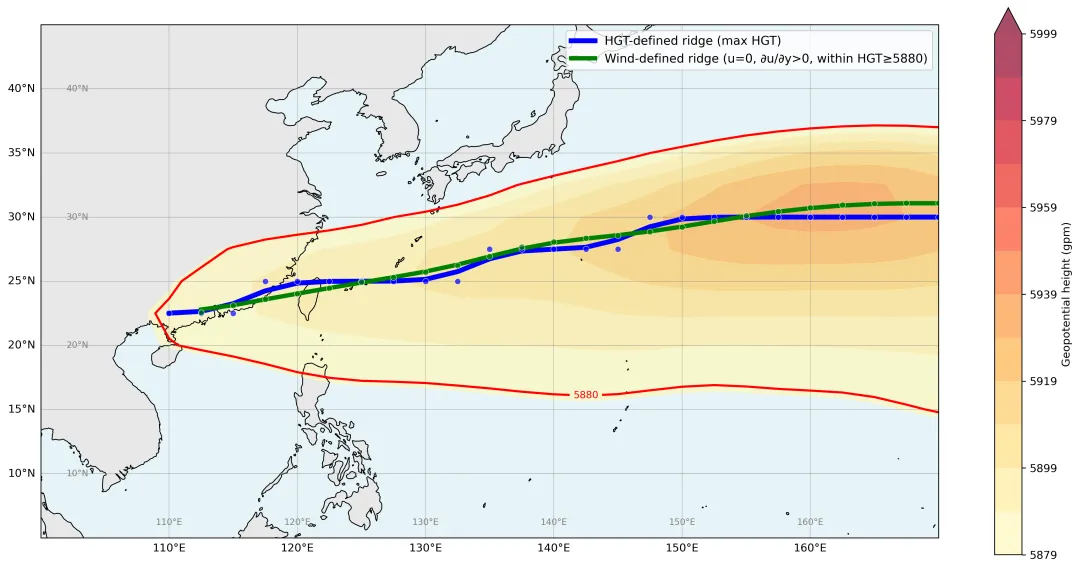 结果显示,两者差别不大,看起来基于风场的结果更平滑,这可能是数据分辨率和基于风场的计算方法综合影响的结果,例如线性插值与梯度计算的平滑作用。
 10个月宝宝每天需要喝多少奶粉?