这篇文章用"类 = 组件模板,实例 = 组件实例"的前端思维,带你彻底理解 Python OOP——类定义、构造函数、三种方法、继承、魔术方法,每个概念都有 JS 对照。
前言
进入第二阶段了!如果说基础篇是打地基,进阶篇就是开始建楼。
面向对象编程(OOP)是 Python 里绕不过去的一关。好消息是:你早就用过 OOP 了。
React 的 class 组件、JS 的 class 语法、new Date()、new Map()——这些都是面向对象编程。Python 的 class 和 JS 的 class 在概念上几乎一致,语法细节稍有不同。
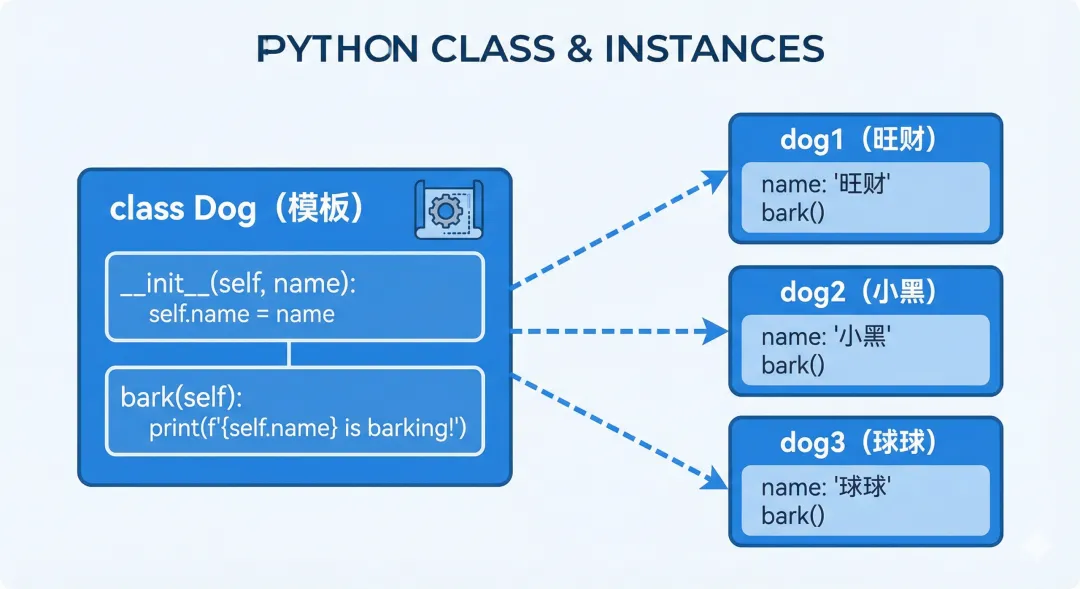
最有用的类比:类 = 组件模板,实例 = 挂载的组件。你写一个 <Button> 组件(类),页面上可以渲染出任意多个按钮(实例),每个按钮有自己的 props(属性)和 state(状态)。
这篇文章覆盖:
- 构造函数 __init__(对比 constructor)
- 常用魔术方法(__str__、__len__、__eq__)
一、定义类与创建实例
1.1 基本语法
# Python 类定义class Button: def __init__(self, label, color="blue"): self.label = label # 实例属性 self.color = color def click(self): print(f"点击了 [{self.label}] 按钮")# 创建实例(不需要 new 关键字!)btn1 = Button("确认")btn2 = Button("取消", color="red")btn1.click() # 点击了 [确认] 按钮btn2.click() # 点击了 [取消] 按钮print(btn1.label) # 确认print(btn2.color) # red
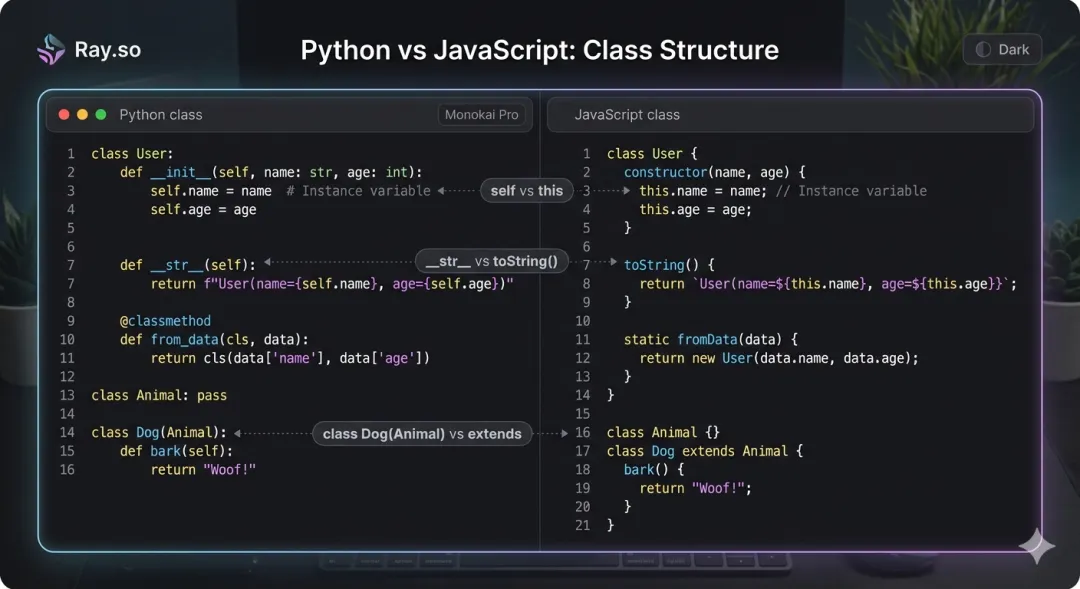
对比 JS:
class Button { constructor(label, color = "blue") { this.label = label this.color = color } click() { console.log(`点击了 [${this.label}] 按钮`) }}const btn1 = new Button("确认") // JS 需要 newconst btn2 = new Button("取消", "red")
核心差异对照:
| | |
|---|
| class MyClass: | class MyClass {} |
| def __init__(self): | constructor() {} |
| self | this |
| obj = MyClass() | const obj = new MyClass() |
最重要的区别:Python 的 self
Python 所有实例方法的第一个参数必须是 self,代表当前实例(等同于 JS 的 this)。self 是约定俗成的名字,理论上可以叫别的,但强烈不建议。
class Dog: def __init__(self, name): self.name = name # self.name 是实例属性 def bark(self): print(f"{self.name} 说:汪汪!") # 通过 self 访问实例属性dog = Dog("旺财")dog.bark() # 旺财 说:汪汪!
二、三种方法:实例方法 / 类方法 / 静态方法
Python 类中有三种不同类型的方法,这是 JS class 里没有直接对应的概念:
class Circle: pi = 3.14159 # 类属性(所有实例共享) def __init__(self, radius): self.radius = radius # 实例属性(每个实例独有) # 1. 实例方法(最常用):操作实例数据,第一个参数是 self def area(self): return self.pi * self.radius ** 2 # 2. 类方法:操作类本身,第一个参数是 cls(代表类) @classmethod def from_diameter(cls, diameter): """通过直径创建圆(替代构造函数)""" return cls(diameter / 2) # 3. 静态方法:和类相关但不需要访问类或实例,没有特殊第一参数 @staticmethod def is_valid_radius(radius): """验证半径是否合法""" return radius > 0
# 使用示例c1 = Circle(5)print(c1.area()) # 78.53975(实例方法)c2 = Circle.from_diameter(10) # 类方法(工厂方法模式)print(c2.radius) # 5.0print(Circle.is_valid_radius(-1)) # False(静态方法)
什么时候用哪种:
- 类方法:工厂方法(提供多种创建实例的方式)、操作类属性
- 静态方法:工具函数,逻辑上属于这个类,但不依赖实例或类的数据
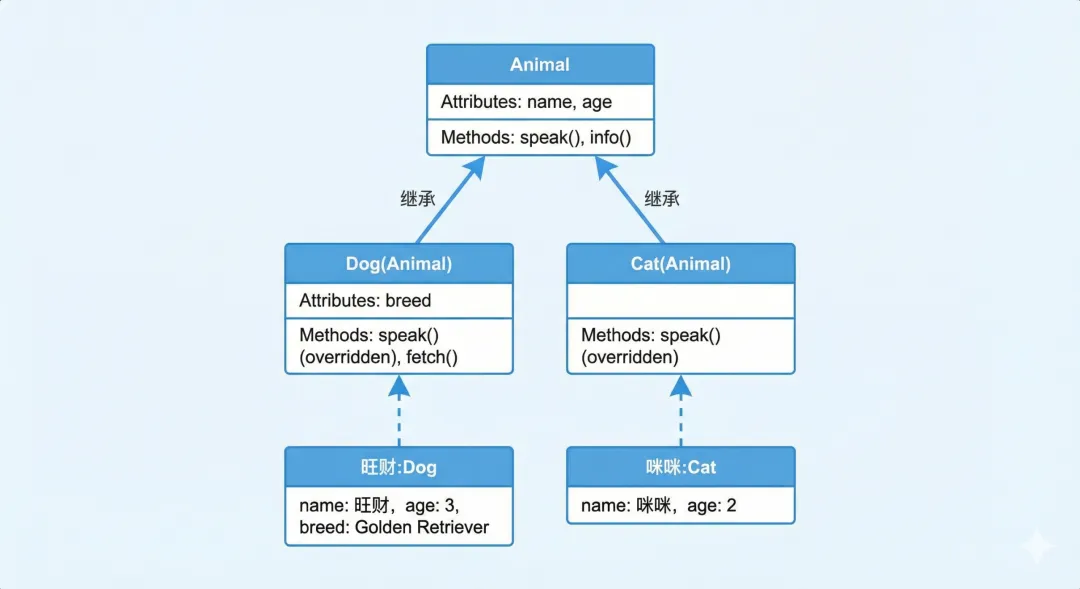
三、继承与 super()
class Animal: def __init__(self, name, age): self.name = name self.age = age def speak(self): print(f"{self.name} 发出了声音") def info(self): print(f"姓名:{self.name},年龄:{self.age}")class Dog(Animal): # 括号里写父类名 def __init__(self, name, age, breed): super().__init__(name, age) # 调用父类构造函数 self.breed = breed # 子类新增属性 def speak(self): # 覆盖父类方法 print(f"{self.name} 说:汪汪!") def fetch(self): # 子类新增方法 print(f"{self.name} 去捡球了!")class Cat(Animal): def speak(self): print(f"{self.name} 说:喵喵!")
dog = Dog("旺财", 3, "金毛")dog.speak() # 旺财 说:汪汪!(覆盖了父类方法)dog.info() # 姓名:旺财,年龄:3(继承自父类)dog.fetch() # 旺财 去捡球了!cat = Cat("咪咪", 2)cat.speak() # 咪咪 说:喵喵!# 检查继承关系print(isinstance(dog, Dog)) # Trueprint(isinstance(dog, Animal)) # True(也是 Animal 的实例)print(issubclass(Dog, Animal)) # True
对比 JS 继承:
class Animal { constructor(name, age) { this.name = name this.age = age } speak() { console.log(`${this.name} 发出了声音`) }}class Dog extends Animal { constructor(name, age, breed) { super(name, age) // 和 Python 完全一致 this.breed = breed } speak() { console.log(`${this.name} 说:汪汪!`) }}
继承语法对比:Python 用 class Dog(Animal),JS 用 class Dog extends Animal,其余几乎相同。
四、魔术方法(Dunder Methods)
魔术方法是 Python OOP 最有特色的部分,也是 JS 里没有直接对应物的特性。
魔术方法名称前后各有两个下划线(__method__),Python 在特定情况下会自动调用它们。
4.1 __str__:对象的字符串表示
class User: def __init__(self, name, email): self.name = name self.email = email def __str__(self): """print() 时调用,面向用户的友好描述""" return f"用户:{self.name} ({self.email})" def __repr__(self): """调试时显示,面向开发者的精确描述""" return f"User(name='{self.name}', email='{self.email}')"user = User("Alice", "alice@example.com")print(user) # 用户:Alice (alice@example.com) ← __str__print(repr(user)) # User(name='Alice', email='alice@example.com') ← __repr__
没有 __str__ 时,print(user) 输出的是 <__main__.User object at 0x10f3a2d90> 这样的内存地址,完全不友好。
4.2 __len__:支持 len() 函数
class Playlist: def __init__(self, name): self.name = name self.songs = [] def add(self, song): self.songs.append(song) def __len__(self): return len(self.songs)playlist = Playlist("我的歌单")playlist.add("稻香")playlist.add("晴天")playlist.add("七里香")print(len(playlist)) # 3
4.3 __eq__:自定义相等比较
class Point: def __init__(self, x, y): self.x = x self.y = y def __eq__(self, other): return self.x == other.x and self.y == other.y def __str__(self): return f"Point({self.x}, {self.y})"p1 = Point(1, 2)p2 = Point(1, 2)p3 = Point(3, 4)print(p1 == p2) # True(使用了 __eq__)print(p1 == p3) # False
没有 __eq__ 时,p1 == p2 比较的是内存地址,两个内容相同的对象也会返回 False。
4.4 常用魔术方法速查
| | |
|---|
__init__ | | constructor |
__str__ | print() | toString() |
__repr__ | | |
__len__ | len() | |
__eq__ | == | |
__lt__ | < | |
__add__ | + | |
__getitem__ | obj[key] | |
__iter__ | for ... in | [Symbol.iterator] |
__enter__ | with | |
五、综合实战:购物车类
把本篇所有知识点融合到一个真实场景里:
"""购物车系统示例---本模块实现了一个简易的电商购物车功能,包含: - Product 类:商品模型,表示单个商品的信息(名称、价格、库存) - Cart 类:购物车模型,支持添加、移除商品,并计算总价"""class Product: """ 商品类(Product) 用于表示商城中的单个商品,包含商品名称、价格和库存数量。 """ def __init__(self, name: str, price: float, stock: int = 0): """ 初始化商品实例。 :param name: 商品名称 :param price: 商品单价(元) :param stock: 库存数量,默认为 0 """ self.name = name # 商品名称 self.price = price # 商品单价 self.stock = stock # 当前库存数量 def __str__(self): """ 魔术方法:定义对象的字符串表示形式。 当使用 print() 或 str() 时调用,返回 "商品名 ¥价格" 格式。 """ return f"{self.name} ¥{self.price:.2f}" def __eq__(self, other): """ 魔术方法:定义相等比较(==)的行为。 两个商品若名称相同则视为同一商品(用于购物车中判断是否重复添加)。 """ return self.name == other.nameclass Cart: """ 购物车类(Cart) 代表某个用户的购物车,支持添加商品、移除商品、查看总价等操作。 """ def __init__(self, user: str): """ 初始化购物车。 :param user: 购物车所属用户的名称 """ self.user = user # 购物车商品列表,每项为字典:{"product": 商品对象, "qty": 数量} self.items: list[dict] = [] def add(self, product: Product, qty: int = 1) -> None: """ 将商品加入购物车。 :param product: 要添加的商品对象 :param qty: 添加数量,默认为 1 :raises ValueError: 当请求数量超过库存时抛出 """ # 库存校验:请求数量不能超过当前库存 if product.stock < qty: raise ValueError(f"库存不足,{product.name} 仅剩 {product.stock} 件") # 若该商品已在购物车中,则增加数量而非新增一项 for item in self.items: if item["product"] == product: item["qty"] += qty return # 新商品则追加到列表末尾 self.items.append({"product": product, "qty": qty}) def remove(self, product: Product) -> None: """ 从购物车中移除指定商品(不论数量多少,全部移除)。 :param product: 要移除的商品对象 """ # 使用列表推导式过滤掉与 product 相同的商品项 self.items = [i for i in self.items if i["product"] != product] @property def total(self) -> float: """ 计算购物车中所有商品的总价(只读属性)。 @property 装饰器使方法可以像属性一样访问,如 cart.total 而非 cart.total() :return: 总价(元) """ return sum(i["product"].price * i["qty"] for i in self.items) def __len__(self): """ 魔术方法:定义 len() 的返回值。 返回购物车中商品种类数(不同商品的个数)。 """ return len(self.items) def __str__(self): """ 魔术方法:定义购物车的字符串表示。 返回格式化的购物车清单及合计金额。 """ if not self.items: return f"{self.user} 的购物车(空)" lines = [f"{self.user} 的购物车:"] for item in self.items: lines.append(f" · {item['product']} × {item['qty']}") lines.append(f" 合计:¥{self.total:.2f}") return "\n".join(lines)# ==================== 示例使用 ====================# 创建两个商品实例:Python编程书(89.9元,库存10)和机械键盘(299元,库存3)p1 = Product("Python编程书", 89.9, stock=10)p2 = Product("机械键盘", 299.0, stock=3)# 为用户 Alice 创建购物车,并添加商品cart = Cart("Alice")cart.add(p1, 2) # 添加 2 本 Python 编程书cart.add(p2, 1) # 添加 1 个机械键盘# 打印购物车内容(会调用 Cart 的 __str__ 方法)print(cart)# 预期输出:# Alice 的购物车:# · Python编程书 ¥89.90 × 2# · 机械键盘 ¥299.00 × 1# 合计:¥478.80# 使用 __len__ 获取商品种类数;使用 total 属性获取总价print(f"共 {len(cart)} 种商品") # 输出:共 2 种商品print(f"总价:¥{cart.total:.2f}") # 输出:总价:¥478.80
小结
| | |
|---|
| class Foo: | class Foo {} |
| def __init__(self): | constructor() {} |
| self | this |
| class Dog(Animal): | class Dog extends Animal |
| super().__init__() | super() |
| __str__ | toString() |
| __add__ | |
3 个容易踩的坑:
- 实例方法忘写 self 参数——Python 不会自动补,会报 TypeError
- 子类 __init__ 里忘记调用 super().__init__()——父类属性不会被初始化
- 修改类属性时直接 self.class_attr = x 实际上是创建了实例属性,没有修改类属性
下篇预告
第 10 篇:Python 装饰器:前端最陌生但最值得学的语法糖
你刚刚见到了 @classmethod、@staticmethod、@property ——这些都是装饰器。下一篇我们深入讲装饰器的原理和自定义写法,理解了它,FastAPI 的路由代码就再也不神秘了。