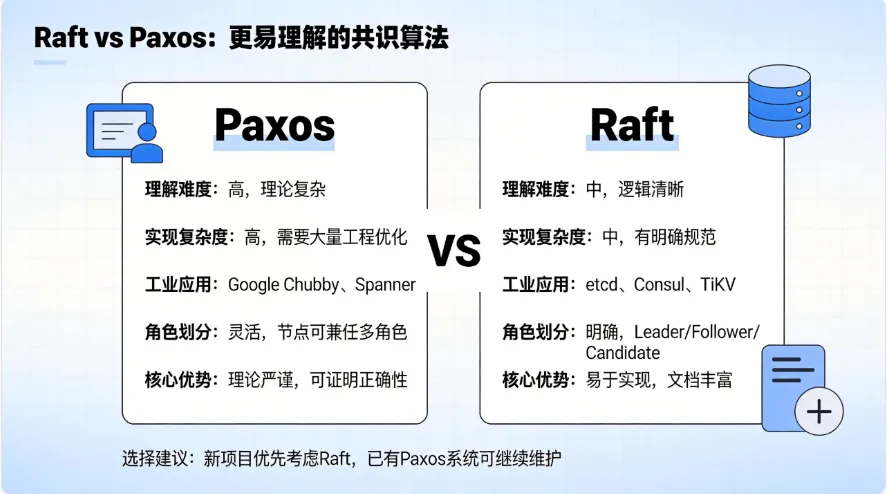
在分布式系统中,最核心的挑战就是如何让多个节点对同一个值达成一致。想象一下,你和几个朋友要在不同城市同时决定晚上吃什么,怎么确保大家最后决定的是同一家餐厅?这就是分布式一致性问题。
Paxos算法由Leslie Lamport在1990年提出,是解决分布式共识问题的经典算法。虽然理论有些复杂,但咱们可以通过一个简单的例子来理解。
- • Proposer(提案者):提出具体的值(比如"晚上吃火锅")
import random
import time
from typing importList, Optional, Tuple

classPaxosNode:
"""Paxos算法节点实现"""

def__init__(self, node_id: int, all_nodes: List[int]):
self.node_id = node_id
self.all_nodes = all_nodes
self.current_term = 0
self.promised_proposal_id = 0
self.accepted_proposal_id = 0
self.accepted_value = None
self.is_leader = False

defprepare_phase(self, proposal_id: int) -> List[Tuple[int, Optional[str]]]:
"""准备阶段:获取多数派承诺"""
print(f"节点{self.node_id}: 开始准备阶段,提案ID={proposal_id}")

        responses = []
for node_id inself.all_nodes:
if node_id == self.node_id:
continue

# 模拟网络请求
if proposal_id > self.promised_proposal_id:
self.promised_proposal_id = proposal_id
                response = (self.accepted_proposal_id, self.accepted_value)
                responses.append(response)
print(f"节点{self.node_id}: 承诺提案{proposal_id},返回历史({self.accepted_proposal_id}, {self.accepted_value})")
else:
print(f"节点{self.node_id}: 拒绝提案{proposal_id},已承诺更高ID={self.promised_proposal_id}")

return responses

defaccept_phase(self, proposal_id: int, value: str, responses: List[Tuple[int, Optional[str]]]) -> bool:
"""接受阶段:尝试让多数派接受提案"""
print(f"节点{self.node_id}: 开始接受阶段,提案({proposal_id}, {value})")

        accept_count = 1# 自己的一票

# 分析响应,决定最终值
        highest_proposal_id = 0
        chosen_value = None

for accepted_id, accepted_val in responses:
if accepted_id > highest_proposal_id and accepted_val isnotNone:
                highest_proposal_id = accepted_id
                chosen_value = accepted_val

# 如果已经有被接受的值,必须使用那个值
        final_value = chosen_value if chosen_value else value

# 尝试获得多数派接受
for node_id inself.all_nodes:
if node_id == self.node_id:
continue

# 模拟接受请求
if proposal_id >= self.promised_proposal_id:
self.accepted_proposal_id = proposal_id
self.accepted_value = final_value
                accept_count += 1
print(f"节点{self.node_id}: 接受提案({proposal_id}, {final_value})")

if accept_count > len(self.all_nodes) // 2:
print(f"节点{self.node_id}: 提案({proposal_id}, {final_value})获得多数派接受!")
returnTrue

returnFalse


# 模拟一个简单的Paxos集群
defsimulate_paxos():
    nodes = [PaxosNode(i, [0, 1, 2, 3, 4]) for i inrange(5)]

# 节点2尝试成为leader并提议一个值
    proposer = nodes[2]
    proposal_id = 100# 假设这是全局唯一的提案ID

print("=== Paxos算法模拟开始 ===\n")

# 准备阶段
    responses = proposer.prepare_phase(proposal_id)

# 接受阶段
    success = proposer.accept_phase(proposal_id, "order_123:减库存", responses)

if success:
print(f"\n✓ 共识达成:所有节点一致同意对order_123减库存")
else:
print(f"\n✗ 共识失败:需要重试或等待")

print("\n=== Paxos算法模拟结束 ===")


# 运行模拟
if __name__ == "__main__":
    simulate_paxos()
- 1. 多数派原则:必须获得超过半数节点的同意才能形成决议
- 2. 提案编号唯一性:每个提案有全局唯一的ID,保证优先级
- 3. 安全性:一旦一个值被选定,后续所有提案都必须使用这个值
Raft算法由Diego Ongaro和John Ousterhout在2014年提出,相比Paxos更易于理解和实现。Raft将共识问题分解为三个子问题:
- • Leader选举:选出一个leader节点负责协调
- • 日志复制:leader将操作日志复制到其他节点
import asyncio
import random
import time
from enum import Enum
from typing importList, Optional, Dict
import logging

logging.basicConfig(level=logging.INFO, format='%(asctime)s - %(message)s')

classState(Enum):
"""节点状态枚举"""
    FOLLOWER = "follower"
    CANDIDATE = "candidate"
    LEADER = "leader"


classRaftNode:
"""Raft节点实现"""

def__init__(self, node_id: int, all_nodes: List[int]):
self.node_id = node_id
self.all_nodes = all_nodes

# Raft状态
self.state = State.FOLLOWER
self.current_term = 0
self.voted_for: Optional[int] = None
self.log: List[Dict] = []
self.commit_index = 0
self.last_applied = 0

# 选举相关
self.election_timeout = random.uniform(1.5, 3.0)
self.last_heartbeat = time.time()
self.votes_received = 0

# Leader状态(仅Leader有效)
self.next_index: Dict[int, int] = {}
self.match_index: Dict[int, int] = {}

asyncdeffollower_loop(self):
"""Follower主循环:等待心跳,超时则发起选举"""
        logging.info(f"节点{self.node_id}: 当前是follower,任期{self.current_term}")

whileself.state == State.FOLLOWER:
            elapsed = time.time() - self.last_heartbeat

if elapsed > self.election_timeout:
                logging.info(f"节点{self.node_id}: 心跳超时,转换为candidate")
self.state = State.CANDIDATE
break

await asyncio.sleep(0.1)

asyncdefcandidate_loop(self):
"""Candidate主循环:发起选举,争取成为leader"""
self.current_term += 1
self.voted_for = self.node_id
self.votes_received = 1# 自己的一票

        logging.info(f"节点{self.node_id}: 开始选举,任期{self.current_term}")

# 向其他节点请求投票
        vote_tasks = []
for node_id inself.all_nodes:
if node_id != self.node_id:
# 模拟发送RequestVote RPC
                task = self.request_vote_rpc(node_id)
                vote_tasks.append(task)

# 等待投票结果
if vote_tasks:
            results = await asyncio.gather(*vote_tasks, return_exceptions=True)

for result in results:
ifisinstance(result, bool) and result:
self.votes_received += 1

# 检查是否获得多数票
        majority = len(self.all_nodes) // 2 + 1
ifself.votes_received >= majority:
            logging.info(f"节点{self.node_id}: 获得{self.votes_received}票,当选leader")
self.state = State.LEADER
self.become_leader()
else:
            logging.info(f"节点{self.node_id}: 仅获得{self.votes_received}票,选举失败")
self.state = State.FOLLOWER
self.last_heartbeat = time.time()

asyncdefrequest_vote_rpc(self, target_node_id: int) -> bool:
"""模拟发送RequestVote RPC"""
# 模拟网络延迟
await asyncio.sleep(random.uniform(0.05, 0.15))

# 简单模拟:如果目标节点是follower且没有投过票,就同意
# 实际中需要比较日志的新旧程度
return random.random() > 0.3# 70%概率同意

defbecome_leader(self):
"""成为leader后的初始化"""
        logging.info(f"节点{self.node_id}: 成为leader,开始发送心跳")

# 初始化next_index和match_index
for node_id inself.all_nodes:
if node_id != self.node_id:
self.next_index[node_id] = len(self.log) + 1
self.match_index[node_id] = 0

asyncdefleader_loop(self):
"""Leader主循环:发送心跳,处理客户端请求"""
whileself.state == State.LEADER:
# 发送心跳
for node_id inself.all_nodes:
if node_id != self.node_id:
awaitself.send_heartbeat(node_id)

await asyncio.sleep(0.5)  # 心跳间隔

asyncdefsend_heartbeat(self, target_node_id: int):
"""发送心跳"""
# 模拟心跳发送
pass


asyncdefsimulate_raft():
"""模拟Raft集群"""
    node_ids = [1, 2, 3, 4, 5]
    nodes = [RaftNode(node_id, node_ids) for node_id in node_ids]

print("=== Raft算法模拟开始 ===\n")

# 启动所有节点
    tasks = []
for node in nodes:
if node.state == State.FOLLOWER:
            task = asyncio.create_task(node.follower_loop())
            tasks.append(task)

# 模拟运行一段时间
await asyncio.sleep(2)

# 取消所有任务
for task in tasks:
        task.cancel()

print("\n=== Raft算法模拟结束 ===")


# 运行模拟
if __name__ == "__main__":
    asyncio.run(simulate_raft())
| | |
| | |
| | |
| | |
| | 明确,Leader/Follower/Candidate |
在分布式系统中,当多个节点需要同时访问某个共享资源时,就需要分布式锁来保证互斥访问。比如电商系统中的库存扣减,如果多个订单同时扣减同一商品库存,没有锁保护就会导致超卖。
- • 避免死锁:锁必须有超时机制,防止客户端故障导致锁无法释放
Redis是分布式锁最常用的实现方案,咱们来看一个完整的Python实现:
import redis
import uuid
import time
import threading
from typing importOptional
from contextlib import contextmanager


classRedisDistributedLock:
"""Redis分布式锁实现"""

def__init__(self, redis_client, lock_key: str, expire_time: int = 30):
"""
        初始化分布式锁

        Args:
            redis_client: Redis客户端实例
            lock_key: 锁的键名
            expire_time: 锁的过期时间(秒)
        """
self.redis = redis_client
self.lock_key = lock_key
self.expire_time = expire_time
self.identifier = str(uuid.uuid4())  # 唯一标识锁持有者
self.renew_thread = None
self.stop_renew = threading.Event()

defacquire(self, timeout: float = 10.0, retry_interval: float = 0.1) -> bool:
"""
        获取分布式锁

        Args:
            timeout: 获取锁的超时时间(秒)
            retry_interval: 重试间隔(秒)

        Returns:
            bool: 是否成功获取锁
        """
        start_time = time.time()

while time.time() - start_time < timeout:
# 使用SET NX EX命令原子性地获取锁
            success = self.redis.set(
self.lock_key,
self.identifier,
                ex=self.expire_time,
                nx=True# 只在key不存在时设置
            )

if success:
print(f"✓ 成功获取锁 {self.lock_key},持有者: {self.identifier}")
self._start_renew_thread()
returnTrue

# 获取失败,等待后重试
            time.sleep(retry_interval)

print(f"✗ 获取锁 {self.lock_key} 超时")
returnFalse

defrelease(self) -> bool:
"""
        释放分布式锁

        Returns:
            bool: 是否成功释放锁
        """
self._stop_renew_thread()

# 使用Lua脚本保证原子性:先验证值再删除
        lua_script = """
        if redis.call("get", KEYS[1]) == ARGV[1] then
            return redis.call("del", KEYS[1])
        else
            return 0
        end
        """

        result = self.redis.eval(lua_script, 1, self.lock_key, self.identifier)

if result == 1:
print(f"✓ 成功释放锁 {self.lock_key}")
returnTrue
else:
print(f"✗ 释放锁失败:锁可能已被他人持有或已过期")
returnFalse

def_start_renew_thread(self):
"""启动锁续期线程"""
ifself.renew_thread isnotNone:
return

self.stop_renew.clear()

defrenew_lock():
            renew_interval = self.expire_time / 3# 每隔1/3过期时间续期一次

whilenotself.stop_renew.is_set():
                time.sleep(renew_interval)

ifself.stop_renew.is_set():
break

# 续期锁
                lua_script = """
                if redis.call("get", KEYS[1]) == ARGV[1] then
                    return redis.call("expire", KEYS[1], ARGV[2])
                else
                    return 0
                end
                """

                success = self.redis.eval(
                    lua_script,
1,
self.lock_key,
self.identifier,
self.expire_time
                )

if success:
print(f"🔁 锁 {self.lock_key} 续期成功")
else:
print(f"⚠️ 锁 {self.lock_key} 续期失败,可能已失去锁")
break

self.renew_thread = threading.Thread(target=renew_lock, daemon=True)
self.renew_thread.start()

def_stop_renew_thread(self):
"""停止锁续期线程"""
ifself.renew_thread isnotNone:
self.stop_renew.set()
self.renew_thread.join(timeout=1.0)
self.renew_thread = None

    @contextmanager
deflock(self, timeout: float = 10.0):
"""
        上下文管理器,方便使用with语句

        Example:
            with redis_lock.lock():
                # 临界区代码
                print("安全地操作共享资源")
        """
        acquired = self.acquire(timeout)

ifnot acquired:
raise TimeoutError(f"获取锁 {self.lock_key} 超时")

try:
yieldself
finally:
self.release()


# 使用示例
defdemo_distributed_lock():
"""分布式锁使用演示"""

# 创建Redis客户端
    r = redis.Redis(host='localhost', port=6379, db=0)

# 创建分布式锁实例
    stock_lock = RedisDistributedLock(r, "lock:product:1001", expire_time=10)

# 模拟多个线程同时扣减库存
defreduce_stock(thread_id: int):
"""扣减库存函数"""
with stock_lock.lock():
print(f"线程{thread_id}: 开始扣减库存")

# 模拟耗时操作
            time.sleep(1)

            current_stock = r.get("stock:product:1001")
if current_stock:
                new_stock = int(current_stock) - 1
                r.set("stock:product:1001", new_stock)
print(f"线程{thread_id}: 库存扣减完成,剩余{new_stock}")
else:
print(f"线程{thread_id}: 库存不存在")

# 初始化库存
    r.set("stock:product:1001", 100)

# 启动多个线程模拟并发扣减
    threads = []
for i inrange(5):
        t = threading.Thread(target=reduce_stock, args=(i,))
        threads.append(t)
        t.start()

# 等待所有线程完成
for t in threads:
        t.join()

# 打印最终库存
    final_stock = r.get("stock:product:1001")
print(f"\n最终库存: {final_stock.decode() if final_stock else'无库存'}")


if __name__ == "__main__":
    demo_distributed_lock()
| | |
| 死锁 | | |
| 锁误删 | 客户端A的锁过期后,客户端B获取锁,然后A又误删B的锁 | |
| 锁续期 | | |
| 脑裂问题 | | |
分布式缓存是提升系统性能的利器,但设计不当会导致缓存穿透、雪崩、击穿等问题。咱们来一一拆解这些挑战。
这是最常用的缓存模式,应用代码直接控制缓存的读写:
import redis
import json
from typing importOptional, Any
import hashlib
import time


classCacheAsidePattern:
"""Cache-Aside模式实现"""

def__init__(self, redis_client):
self.redis = redis_client

defget_user(self, user_id: int) -> Optional[dict]:
"""
        获取用户信息,使用Cache-Aside模式

        Args:
            user_id: 用户ID

        Returns:
            用户信息字典,如果不存在则返回None
        """
        cache_key = f"user:{user_id}"

# 1. 先查缓存
        cached_data = self.redis.get(cache_key)
if cached_data:
print(f"缓存命中 user:{user_id}")
return json.loads(cached_data)

# 2. 缓存未命中,查询数据库
print(f"缓存未命中,查询数据库 user:{user_id}")
        user_data = self._query_database(user_id)

if user_data:
# 3. 将查询结果写入缓存
self.redis.setex(
                cache_key,
3600,  # 1小时过期
                json.dumps(user_data)
            )
print(f"数据写入缓存 user:{user_id}")

return user_data

defupdate_user(self, user_id: int, user_data: dict):
"""
        更新用户信息

        Args:
            user_id: 用户ID
            user_data: 新的用户数据
        """
# 1. 先更新数据库
self._update_database(user_id, user_data)

# 2. 删除缓存(而不是更新)
        cache_key = f"user:{user_id}"
self.redis.delete(cache_key)
print(f"数据库更新完成,缓存已删除 user:{user_id}")

# 可选:延迟双删,解决并发问题
        time.sleep(0.1)
self.redis.delete(cache_key)

def_query_database(self, user_id: int) -> Optional[dict]:
"""模拟数据库查询"""
# 模拟数据库查询延迟
        time.sleep(0.05)

# 模拟数据库数据
        mock_db = {
1: {"id": 1, "name": "张三", "email": "zhangsan@example.com"},
2: {"id": 2, "name": "李四", "email": "lisi@example.com"},
        }
return mock_db.get(user_id)

def_update_database(self, user_id: int, user_data: dict):
"""模拟数据库更新"""
        time.sleep(0.03)
print(f"数据库更新: user:{user_id} -> {user_data}")

defsearch_products(self, keyword: str, page: int = 1, page_size: int = 20) -> dict:
"""
        商品搜索,演示缓存键的设计

        Args:
            keyword: 搜索关键词
            page: 页码
            page_size: 每页大小

        Returns:
            搜索结果
        """
# 构建缓存键:包含所有影响结果的参数
        cache_key = self._build_cache_key("search", {
"keyword": keyword,
"page": page,
"page_size": page_size
        })

# 尝试从缓存获取
        cached_result = self.redis.get(cache_key)
if cached_result:
print(f"搜索缓存命中: {keyword}")
return json.loads(cached_result)

# 缓存未命中,执行搜索
print(f"搜索缓存未命中,执行搜索: {keyword}")
        result = self._execute_search(keyword, page, page_size)

# 写入缓存,设置较短的过期时间(搜索数据变化较快)
self.redis.setex(cache_key, 300, json.dumps(result))

return result

def_build_cache_key(self, prefix: str, params: dict) -> str:
"""
        构建缓存键,避免键冲突

        Args:
            prefix: 键前缀
            params: 参数字典

        Returns:
            缓存键字符串
        """
# 对参数排序,确保相同的参数生成相同的键
        sorted_params = sorted(params.items())
        param_str = json.dumps(sorted_params, sort_keys=True)

# 使用MD5生成固定长度的键
        hash_str = hashlib.md5(param_str.encode()).hexdigest()

returnf"{prefix}:{hash_str}"

def_execute_search(self, keyword: str, page: int, page_size: int) -> dict:
"""模拟搜索执行"""
        time.sleep(0.1)

# 模拟搜索结果
        offset = (page - 1) * page_size
        products = [
            {"id": i, "name": f"{keyword}商品{i}", "price": 100 + i}
for i inrange(offset, offset + page_size)
        ]

return {
"total": 1000,
"page": page,
"page_size": page_size,
"products": products
        }


# 使用布隆过滤器防止缓存穿透
classBloomFilter:
"""简易布隆过滤器实现"""

def__init__(self, size: int = 10000, hash_functions: int = 3):
self.size = size
self.hash_functions = hash_functions
self.bit_array = [0] * size

defadd(self, item: str):
"""添加元素"""
for i inrange(self.hash_functions):
            hash_val = self._hash(item, i) % self.size
self.bit_array[hash_val] = 1

defcontains(self, item: str) -> bool:
"""检查元素是否存在(可能有误判)"""
for i inrange(self.hash_functions):
            hash_val = self._hash(item, i) % self.size
ifself.bit_array[hash_val] == 0:
returnFalse
returnTrue

def_hash(self, item: str, seed: int) -> int:
"""简单的哈希函数"""
returnhash(f"{item}_{seed}") & 0xffffffff


defdemo_cache_patterns():
"""缓存模式演示"""
    r = redis.Redis(host='localhost', port=6379, db=0)
    cache_system = CacheAsidePattern(r)

print("=== Cache-Aside模式演示 ===\n")

# 第一次查询,缓存未命中
    user1 = cache_system.get_user(1)
print(f"查询结果: {user1}\n")

# 第二次查询,缓存命中
    user1_cached = cache_system.get_user(1)
print(f"缓存查询结果: {user1_cached}\n")

# 更新用户信息
    cache_system.update_user(1, {"name": "张三四", "email": "zhangsansi@example.com"})

# 再次查询,重新加载缓存
    user1_updated = cache_system.get_user(1)
print(f"更新后查询: {user1_updated}\n")

# 演示搜索缓存
    search_result = cache_system.search_products("手机")
print(f"搜索结果: {len(search_result['products'])} 条记录")


if __name__ == "__main__":
    demo_cache_patterns()
classWriteThroughCache:
"""Write-Through模式实现"""

def__init__(self, redis_client, db_adapter):
self.redis = redis_client
self.db = db_adapter

defupdate_product(self, product_id: int, product_data: dict):
"""
        更新商品信息(Write-Through模式)

        Args:
            product_id: 商品ID
            product_data: 商品数据
        """
# 原子性操作:同时更新缓存和数据库
        cache_key = f"product:{product_id}"

# 在事务中执行
        pipeline = self.redis.pipeline()

# 1. 更新缓存
        pipeline.setex(cache_key, 3600, json.dumps(product_data))

# 2. 更新数据库(这里简化处理)
        pipeline.execute()

# 3. 同步更新数据库
self.db.update_product(product_id, product_data)

print(f"Write-Through模式: 商品{product_id}更新完成(缓存+数据库)")
| | |
| 缓存穿透 | | 1. 缓存空值
2. 使用布隆过滤器
3. 接口层校验 |
| 缓存击穿 | | 1. 热点key永不过期
2. 使用互斥锁重建缓存
3. 逻辑过期 |
| 缓存雪崩 | | 1. 过期时间加随机值
2. 缓存集群高可用
3. 降级熔断机制 |
| 缓存一致性 | | 1. Cache-Aside模式
2. 订阅数据库变更日志
3. 延迟双删 |
在分布式系统中,故障不是例外而是常态。咱们需要有完善的容错机制来保证系统的可靠性。
classCrashRecovery:
"""崩溃恢复机制"""

def__init__(self):
self.heartbeat_interval = 1.0# 心跳间隔
self.timeout_threshold = 3.0# 超时阈值
self.last_heartbeat = {}

defstart_heartbeat(self, node_id: str):
"""启动心跳检测"""
self.last_heartbeat[node_id] = time.time()

# 模拟心跳线程
defheartbeat_loop():
whileTrue:
                time.sleep(self.heartbeat_interval)
self.last_heartbeat[node_id] = time.time()

        threading.Thread(target=heartbeat_loop, daemon=True).start()

defcheck_node_health(self, node_id: str) -> bool:
"""检查节点健康状态"""
if node_id notinself.last_heartbeat:
returnFalse

        elapsed = time.time() - self.last_heartbeat[node_id]
return elapsed < self.timeout_threshold

deffailover(self, primary_node: str, backup_nodes: list):
"""故障转移"""
ifnotself.check_node_health(primary_node):
print(f"节点 {primary_node} 故障,开始故障转移")

# 选择新的主节点
for backup in backup_nodes:
ifself.check_node_health(backup):
print(f"切换到备份节点 {backup}")
return backup

return primary_node
classPartitionTolerance:
"""分区容错处理"""

def__init__(self, nodes: list):
self.nodes = nodes

defhandle_partition(self, current_node: str, quorum_size: int):
"""
        处理网络分区

        Args:
            current_node: 当前节点ID
            quorum_size: 多数派大小

        Returns:
            bool: 当前分区是否允许提供服务
        """
# 模拟检测可达节点
        reachable_nodes = self._detect_reachable_nodes(current_node)

print(f"节点 {current_node} 检测到 {len(reachable_nodes)}/{len(self.nodes)} 个可达节点")

# 检查是否达到多数派
iflen(reachable_nodes) >= quorum_size:
print("✓ 达到多数派,允许提供服务")
returnTrue
else:
print("✗ 未达到多数派,停止提供服务以避免数据不一致")
returnFalse

def_detect_reachable_nodes(self, current_node: str) -> list:
"""检测可达节点"""
# 模拟网络检测
        reachable = [current_node]

for node inself.nodes:
if node != current_node:
# 模拟网络状况:70%概率可达
if random.random() < 0.7:
                    reachable.append(node)

return reachable
import time
from enum import Enum
from dataclasses import dataclass
from typing importCallable, Any, Optional


classCircuitState(Enum):
"""熔断器状态"""
    CLOSED = "closed"# 正常状态
    OPEN = "open"# 熔断状态
    HALF_OPEN = "half_open"# 半开状态


@dataclass
classCircuitBreakerConfig:
"""熔断器配置"""
    failure_threshold: int = 5# 失败阈值
    reset_timeout: float = 30.0# 重置超时时间
    half_open_max_calls: int = 3# 半开状态最大调用次数


classCircuitBreaker:
"""熔断器实现"""

def__init__(self, name: str, config: Optional[CircuitBreakerConfig] = None):
self.name = name
self.config = config or CircuitBreakerConfig()

# 状态
self.state = CircuitState.CLOSED
self.failure_count = 0
self.last_failure_time = None
self.half_open_success_count = 0

defcall(self, func: Callable, *args, **kwargs) -> Any:
"""
        调用受保护的方法

        Args:
            func: 要调用的函数
            *args, **kwargs: 函数参数

        Returns:
            函数执行结果

        Raises:
            CircuitBreakerOpenError: 熔断器开启时抛出
        """
# 检查熔断器状态
ifself.state == CircuitState.OPEN:
ifself._is_reset_timeout_elapsed():
self._transition_to_half_open()
else:
raise CircuitBreakerOpenError(f"熔断器 {self.name} 已开启")

elifself.state == CircuitState.HALF_OPEN:
ifself.half_open_success_count >= self.config.half_open_max_calls:
self._transition_to_closed()

# 尝试调用
try:
            result = func(*args, **kwargs)
self._on_success()
return result

except Exception as e:
self._on_failure()
raise e

def_on_success(self):
"""调用成功处理"""
ifself.state == CircuitState.HALF_OPEN:
self.half_open_success_count += 1

# 重置失败计数
self.failure_count = 0

def_on_failure(self):
"""调用失败处理"""
self.failure_count += 1
self.last_failure_time = time.time()

ifself.state == CircuitState.HALF_OPEN:
# 半开状态下失败,立即转为开启
self._transition_to_open()

elifself.state == CircuitState.CLOSED:
ifself.failure_count >= self.config.failure_threshold:
self._transition_to_open()

def_transition_to_open(self):
"""切换到开启状态"""
print(f"熔断器 {self.name}: CLOSED -> OPEN")
self.state = CircuitState.OPEN
self.last_failure_time = time.time()

def_transition_to_half_open(self):
"""切换到半开状态"""
print(f"熔断器 {self.name}: OPEN -> HALF_OPEN")
self.state = CircuitState.HALF_OPEN
self.half_open_success_count = 0

def_transition_to_closed(self):
"""切换到关闭状态"""
print(f"熔断器 {self.name}: HALF_OPEN -> CLOSED")
self.state = CircuitState.CLOSED
self.failure_count = 0

def_is_reset_timeout_elapsed(self) -> bool:
"""检查重置超时是否已过"""
ifnotself.last_failure_time:
returnFalse

        elapsed = time.time() - self.last_failure_time
return elapsed >= self.config.reset_timeout


classCircuitBreakerOpenError(Exception):
"""熔断器开启异常"""
pass


defdemo_circuit_breaker():
"""熔断器演示"""

defunstable_service(success_rate: float = 0.3) -> str:
"""模拟不稳定的服务"""
if random.random() < success_rate:
return"服务调用成功"
else:
raise Exception("服务调用失败")

# 创建熔断器
    cb = CircuitBreaker("unstable_service", CircuitBreakerConfig(
        failure_threshold=3,
        reset_timeout=5.0,
        half_open_max_calls=2
    ))

# 模拟调用
print("=== 熔断器演示开始 ===\n")

for i inrange(20):
try:
            result = cb.call(unstable_service, 0.3)
print(f"调用 {i+1}: {result}")
except CircuitBreakerOpenError as e:
print(f"调用 {i+1}: {e}")
except Exception as e:
print(f"调用 {i+1}: {e}")

        time.sleep(0.5)

print("\n=== 熔断器演示结束 ===")


if __name__ == "__main__":
    demo_circuit_breaker()
classRetryPolicy:
"""重试策略"""

def__init__(self, max_attempts: int = 3, base_delay: float = 0.1):
self.max_attempts = max_attempts
self.base_delay = base_delay

defexecute_with_retry(self, func: Callable, *args, **kwargs) -> Any:
"""
        执行带有重试的函数

        Args:
            func: 要执行的函数
            *args, **kwargs: 函数参数

        Returns:
            函数执行结果
        """
        last_exception = None

for attempt inrange(1, self.max_attempts + 1):
try:
return func(*args, **kwargs)

except Exception as e:
                last_exception = e

if attempt < self.max_attempts:
# 指数退避 + 随机抖动
                    delay = self.base_delay * (2 ** (attempt - 1))
                    jitter = random.uniform(0, delay * 0.1)  # 10%的抖动

print(f"尝试 {attempt} 失败,{delay + jitter:.2f}秒后重试: {e}")
                    time.sleep(delay + jitter)
else:
print(f"尝试 {attempt} 失败,达到最大重试次数")

raise last_exception
3. 混沌工程(Chaos Engineering)
classChaosMonkey:
"""混沌猴子实现"""

def__init__(self, enabled: bool = False):
self.enabled = enabled

definject_failure(self, failure_type: str, probability: float = 0.1):
"""
        注入故障

        Args:
            failure_type: 故障类型
            probability: 注入概率
        """
ifnotself.enabled or random.random() > probability:
return

        failure_handlers = {
"latency": self._inject_latency,
"exception": self._inject_exception,
"timeout": self._inject_timeout,
"memory": self._inject_memory_pressure,
        }

        handler = failure_handlers.get(failure_type)
if handler:
            handler()

def_inject_latency(self):
"""注入延迟"""
        delay = random.uniform(0.1, 2.0)
print(f"混沌猴子: 注入 {delay:.2f}秒延迟")
        time.sleep(delay)

def_inject_exception(self):
"""注入异常"""
print("混沌猴子: 注入随机异常")
raise Exception("混沌猴子注入的异常")

def_inject_timeout(self):
"""注入超时"""
print("混沌猴子: 注入超时")
        time.sleep(10)  # 模拟长时间阻塞

def_inject_memory_pressure(self):
"""注入内存压力"""
print("混沌猴子: 注入内存压力")
# 模拟内存分配(实际中应更谨慎)
        large_list = ["x" * 1024for _ inrange(1000)]
        time.sleep(0.5)
del large_list
| | |
| CAP定理 | 分布式系统中,一致性、可用性、分区容错性三者不可兼得 | |
| Paxos | | |
| Raft | 更易理解和实现的一致性算法,分解为领导选举、日志复制、安全性 | |
| 分布式锁 | | |
| 缓存穿透 | | |
| 缓存击穿 | | |
| 熔断器 | | |