详解linux内核链表list_head及其接口应用
- 2026-08-23 06:02:17
Linux内核中的链表通常都组织成双向循环链表,不同于一般意义上的链表,这里的链表节点只含有链表指针(next和prev),没有链表的数据。Linux内核中使用的链表源代码位于 include/linux/list.h中,下面详细叙述。
1. 链表数据结构 list_head 的定义:
struct list_head{
    structlist_head *next,*prev;
};
【注意】只有前后节点指针,没有数据 !
2. 链表的声明和初始化
2.1 静态方法——编译时
#define LIST_HEAD_INIT(name) { &(name), &(name) }
#define LIST_HEAD(name) \
	struct list_head name = LIST_HEAD_INIT(name)
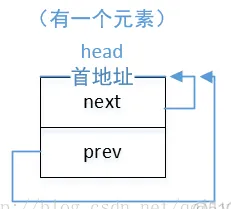
2.2 动态方法——运行时
static inline voidINIT_LIST_HEAD(structlist_head*list)
{
    list->next = list;
    list->prev = list;
}
图示:
3. 插入/删除/合并
3.1 插入
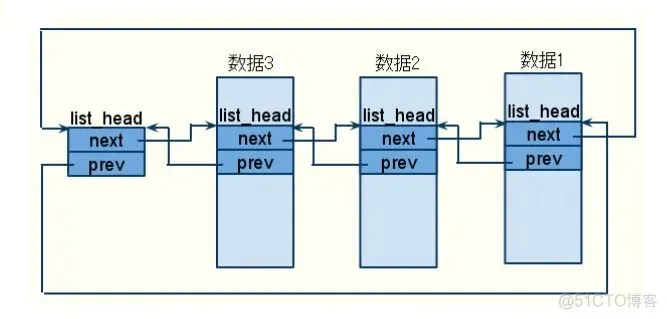
3.1.1 头插——list_add
static inline void list_add(struct list_head *new, struct list_head *head)
{
    __list_add(new, head, head->next);
}
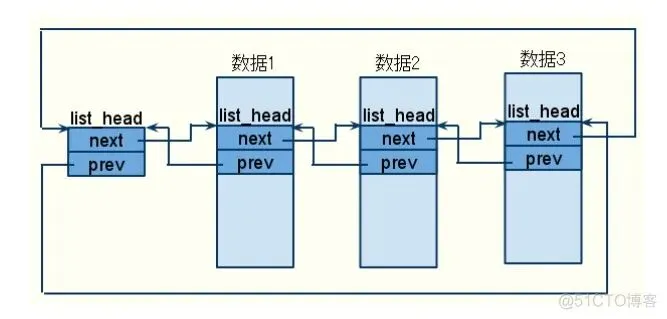
3.1.2 尾插—— list_add_tail
static inline void list_add_tail(struct list_head *new, struct list_head *head)
{
    __list_add(new, head->prev, head);
}
可以看到他们调用了相同的 __list_add函数:
//将链表节点new插在prev和next中间
static inline void __list_add(struct list_head*new, struct list_head *prev, struct list_head *next)
{
    next->prev = new;
    new->next = next;
    new->prev = prev;
    prev->next = new;
}
3.2 删除
对链表的删除操作函数有两种:list_del函数和list_del_init函数:
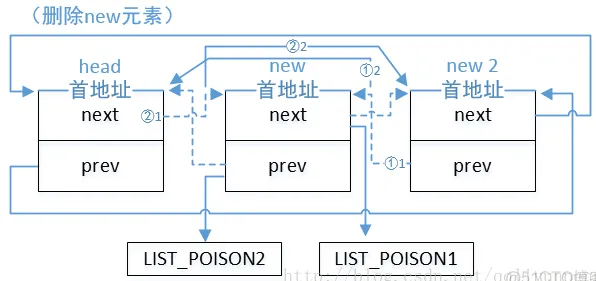
3.2.1 list_del
static inline void list_del(struct list_head *entry)// entry:要删除的链表的首地址
{
    __list_del(entry->prev, entry->next);
    entry->next = LIST_POISON1;
    entry->prev = LIST_POISON2;
}

/* 下面是LIST_POISON1和LIST_POISON2的出处:*/
#ifdef CONFIG_ILLEGAL_POINTER_VALUE
#define POISON_POINTER_DELTA_AC(CONFIG_ILLEGAL_POINTER_VALUE, UL)
#else
#define POISON_POINTER_DELTA0
#endif
/*
 * 通常情况下,非空指针会导致页错误,用于验证没有初始化的list元素。
 * These are non-NULL pointers that will result in page faults
 * under normal circumstances, used to verify that nobody uses
 * non-initialized list entries.
 */
#define LIST_POISON1((void*)0x100+ POISON_POINTER_DELTA)
#define LIST_POISON2((void*)0x200+ POISON_POINTER_DELTA)
将链表节点entry从链表中删除后,list_del函数中又将entry的next和prev指针指向了LIST_POISON1和LIST_POISON2位置,使得以后若再对他们进行访问都将引起页故障,以确保不在链表中的节点项不可访问。
3.2.2 list_del_init
static inline void list_del_init(struct list_head *entry)
{
    __list_del_entry(entry);
    INIT_LIST_HEAD(entry);// 运行中初始化链表节点
}

static inline void__list_del_entry(struct list_head *entry)
{
    __list_del(entry->prev, entry->next);
}
将链表节点entry从链表中删除后,list_del_init函数中又将entry重新初始化了(next和prev指针指向了自己)。在此不再画图,唯一的不同是把删除下来的图的next和prev指针指向了自己的首地址 他们调用了相同的 __list_del函数
static inline void __list_del(struct list_head* prev, struct list_head* next)
{
    next->prev = prev;
    prev->next = next;
}
3.3 替换
对链表的替换操作有两个:list_replace函数和list_replace_init函数:
3.3.1 list_replace
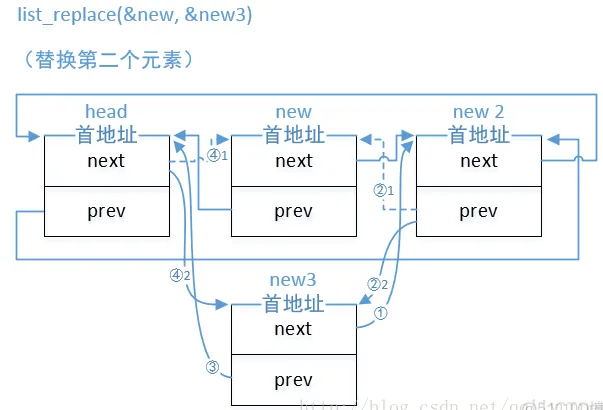
static inline void list_replace(struct list_head *old, struct list_head *new)
{
    new->next = old->next;
    new->next->prev = new;
    new->prev = old->prev;
    new->prev->next = new;
}
3.3.2 list_replace_init
static inline void list_replace_init(struct list_head *old, struct list_head *new)
{
    list_replace(old, new);
    INIT_LIST_HEAD(old);
}
list_replace_init函数的图形在此处也不再画,区别就是多了初始化换下来的old节点
3.4 搬移
搬移的含义是将原本属于一个链表的节点移动到另一个链表的操作,有两个函数:list_move函数和list_move_tail函数:
3.4.1 list_move
/*
 * list_move:把节点list从原先链表上搬移到另一个链表head的头部
 * @list: 我们要移动的节点
 * @head: 要移动到的另外的一个链表头
 */
static inline void list_move(struct list_head *list, struct list_head *head)
{
    __list_del_entry(list);
    list_add(list, head);
}
3.4.2 list_move_tail
/*
 * list_move_tail:把节点list从原先链表上搬移到另一个链表head的尾部
 * @list: the entry to move
 * @head: the head that will follow our entry
 */
static inline void list_move_tail(struct list_head *list, struct list_head *head)
{
    __list_del_entry(list);
    list_add_tail(list, head);
}
3.5 合并
合并在这里的意思就是合并了,是将两个独立的链表合并成为一个链表,合并的时候根据合并的位置的不同可以分为:
合并到头部的 list_splice函数 合并到尾部的 list_splice_tail函数
3.5.1 list_splice
/*
 * list_splice: join two lists, this is designed for stacks
 * @list: the new list to add.
 * @head: the place to add it in the first list.
 */
static inline void list_splice(const struct list_head *list, struct list_head *head){
    if(!list_empty(list))
        __list_splice(list, head, head->next);
}
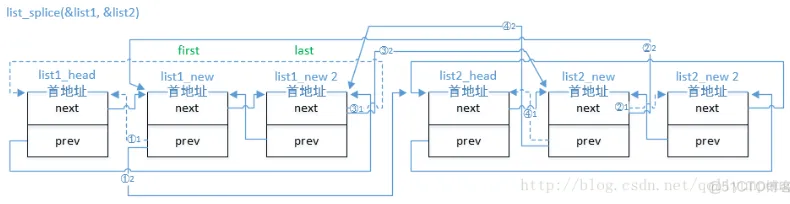
假设当前有两个链表,表头分别是list1和list2(都是struct list_head变量),当调用list_splice(&list1,&list2)时,只要list1非空,list1链表的内容将被挂接在list2链表上,位于list2和list2.next(原list2表的第一个节点)之间。新list2链表将以原list1表的第一个节点为首节点,而尾节点不变。
3.5.2 list_splice_tail
/*
 * list_splice_tail - join two lists, each list being a queue
 * @list: the new list to add.
 * @head: the place to add it in the first list.
 */
static inline void list_splice_tail(struct list_head *list, struct list_head *head)
{
    if(!list_empty(list))
        __list_splice(list, head->prev, head);
}
假设当前有两个链表,表头分别是list1和list2(都是struct list_head变量),当调用list_splice_tail(&list1,&list2)时,只要list1非空,list1链表的内容将被挂接在list2链表上,位于list2尾节点和list2(原list2头)之间。新list2链表将以原list1表的最后一个节点为尾节点,而头节点不变。
3.5.3 list_splice_init
static inline void list_splice_init(struct list_head *list, struct list_head *head)
{
    if(!list_empty(list)){
        __list_splice(list, head, head->next);
    INIT_LIST_HEAD(list);<--- 跟list_splice唯一的不同
    }
}
3.5.4 list_splice_tail_init
static inline void list_splice_tail_init(struct list_head *list, struct list_head *head)
{
    if(!list_empty(list)){
        __list_splice(list, head->prev, head);
    INIT_LIST_HEAD(list);<--- 跟list_splice_tail唯一的不同
    }
}
共同的函数 __list_splice和list_empty
//将链表list插入到另一个链表的prev和next节点之间
static inline void __list_splice(const struct list_head *list, struct list_head *prev, struct list_head *next)
{
    structlist_head*first = list->next;
    structlist_head*last = list->prev;

    first->prev = prev;
    prev->next = first;

    last->next = next;
    next->prev = last;
}

//判断链表head是否为空
static inline int list_empty(const struct list_head *head)
{
    return head->next == head;
}
4. 找到链表中的数据
前边提到的函数都是操作的链表节点的入口,但是对于我们真正有意义的是节点上的数据,链表的头上没有数据,其他的节点上都是带有数据的。如何从一个链表节点的入口得到节点的数据呢?要用到以下的函数
list_entry函数:
/*
 * list_entry - 通过链表地址获得包含该链表的结构体的地址
 * @ptr:    member的首地址
 * @type:   容器的类型
 * @member: 要得到他的容器的某个成员
 */
#define list_entry(ptr, type, member)\
                container_of(ptr, type, member)

#define container_of(ptr, type, member)({\
            consttypeof(((type *)0)->member )*__mptr =(ptr); \
            (type *)((char*)__mptr -offsetof(type,member));})

// 将数据结构体放到0地址处,天然的结构体中成员的首地址就是成员在结构体中的偏移量(字节)
#define offsetof(TYPE, MEMBER)((size_t)&((TYPE *)0)->MEMBER)
举例:
main.c
#include <stdio.h>
#include <linux/list.h>

LIST_HEAD(device_list);

typedef struct device_struct
{
    unsigned char* devname;
    struct list_head entry;
} device_struct_s;

int main(int argc, constchar*argv[])
{
    device_struct_s led;
    device_struct_s *ledp;
    led.devname ="led";

    /* 添加到链表的前边 */
    list_add(&led.entry,&device_list);

    /* 得到含有链表节点的数据结构体的首地址 */
    ledp =list_entry(device_list.next, device_struct_s, entry);
    printf("led.devname = %s\n", ledp->devname);
    return0;
}
5. 遍历链表
对linux内核的遍历可以分为遍历链表和遍历链表中的结构体:
从头开始遍历链表,list_for_each宏;
从头开始遍历链表中的结构体,list_for_each_entry宏;
5.1 遍历list_head链表
/*
 * list_for_each - 迭代/遍历 链表
 * @cursor: list_head链表指针.
 * @head:   要遍历的list_head链表的头
 */
#define list_for_each(cursor, head) \
        for(cursor =(head)->next; cursor !=(head); cursor = cursor->next)

/*
 *next: 指向当前crusor指向的结构体的下一个结构体
 */
#define list_for_each_safe(cursor, next, head) \
         for(cursor =(head)->next,next = cursor->next;\
         cursor !=(head);\
         cursor = next,next = cursor->next)
- 注意
:当我们采用 list__for_each()函数遍历list时,如果我们删除元素(即执行list_del(cursor);),就会导致cursor指向的元素的prev=LIST_POISON1,next=LIST_POISON2,当执行到cursor=cursor->next时,就会出现错误。 但是当我们使用 list_for_each_safe()函数遍历list时,如果我们也删除元素后,会执行cursor=next,而next=cursor->next(注意:next=cursor->next中的cursor是删除的那个元素),所以虽然删除了元素cursor,但是执行了cursor=next后,cursor指向了正确的遍历位置,所以使用list_for_each_safe()函数遍历list时并不会出现错误。list_for_each_safe()在遍历时之所以不会出现错误,是因为我们使用了next暂时保存了cursor(被删除元素所指向的下一个元素),所以用这个宏定义,不会出现遍历时删除元素的错误。
5.2 遍历“含有list_head项的结构体‘链表
/*
 * list_for_each_entry  - 遍历含链表节点入口的结构体
 * @cursor: 指向“含list_head结构的结构体”的指针.
 * @head:   要遍历的结构体链表的头节点中的list_head项的指针
 * @member: 结构体中list_head项的名字
 */
#define list_for_each_entry(cursor, head, member)\
    for(cursor =list_entry((head)->next,typeof(*cursor), member);\
    &cursor->member !=(head);\
    cursor =list_entry(cursor->member.next,typeof(*cursor), member))
/*
 *next: 指向当前crusor指向的结构体的下一个结构体;
 */
#define list_for_each_entry_safe(cursor, next, head, member)\
    for(cursor =list_entry((head)->next,typeof(*cursor), member),\
    next =list_entry(cursor->member.next,typeof(*cursor), member);\
    &cursor->member !=(head);\
    cursor = next, next =list_entry(next->member.next,typeof(*cursor), member))
相比于
list_for_each_entry,list_for_each_entry_safe用指针next对链表的下一个数据结构进行了临时存储,所以同理,如果在遍历链表的时候需要做删除链表中的当前项操作时,用list_for_each_entry_safe可以安全的删除,而不会影响接下来的遍历过程(用next指针可以继续完成接下来的遍历, 而list_for_each_entry则无法继续遍历,删除后会导致无法继续遍历)。举例
#include <stdio.h>
#include <linux/list.h>

LIST_HEAD(device_list);//定义并初始化了一个list_head类型的变量device_list

typedef struct device_struct
{
    unsigned char *devname;
    struct list_head entry;
} device_struct_s;

int main(int argc,constchar*argv[])
{
    device_struct_s led, gpio, beep,*tmp;

    led.devname ="led";
    gpio.devname ="gpio";
    beep.devname ="beep";

/* 一个一个往链表的头部添加 */
list_add(&led.entry,&device_list);// device_list——>led.entry
list_add(&gpio.entry,&device_list);// device_list——>gpio.entry——>led.entry
list_add(&beep.entry,&device_list);// device_list——>beep.entry——>gpio.entry——>led.entry

/* 1. 遍历链表 */
structlist_head*cursor;
list_for_each(cursor,&device_list)
{
    tmp =list_entry(cursor, device_struct_s, entry);
    printf("tmp.devname = %s\n", tmp->devname);
}

/* 2. 遍历含链表的结构体 */
device_struct_s *cursor2;
list_for_each_entry(cursor2,&device_list, entry)
{
    printf("cursor2.devname = %s\n", cursor2->devname);
}
return0;
}
输出结果
tmp.devname = beep
tmp.devname = gpio
tmp.devname = led
j.devname = beep
j.devname = gpio
j.devname = led
另外:
linux内核的链表中提供了反向遍历链表的宏 list_for_each_prev和list_for_each_entry_reverse,他们分别是list_for_each和list_for_each_entry的反方向的实现,使用方法完全一样。如果遍历不是从链表头开始,而是从已知的某个节点pos开始,则要使用 list_for_each_entry_continue宏(使用方法同list_for_each_entry宏)。如果想实现如果pos有值则从pos开始遍历,如果没有则从链表的头开始遍历,为此,Linux专门提供了一个 list_prepare_entry(pos,head,member)宏,将它的返回值作为list_for_each_entry_continue()的pos参数,就可以满足这一要求。
我们将list_for_each_prev和list_for_each_entry_reverse的代码和执行结果也写下来:
/* 3. 反向遍历链表的入口的首地值 */
printf("list_for_each_prev()\n");
struct list_head *cursor3;
list_for_each_prev(cursor3,&device_list)
{
    tmp =list_entry(cursor3, device_struct_s, entry);
    printf("tmp.devname = %s\n", tmp->devname);
}


/* 4. 反向遍历含链表的入口的结构体的首地值 */
printf("list_for_each_reverse()\n");
device_struct_s *cursor4;
list_for_each_entry_reverse(cursor4,&device_list, entry)
{
    printf("cursor4.devname = %s\n", g->evname);
}
结合上边代码的执行结果如下:
list_for_each_prev()<--- 可以看到遍历结果是从尾部遍历到头部
tmp.devname = led
tmp.devname = gpio
tmp.devname = beep
list_for_each_reverse()<--- 可以看到遍历结果是从尾部遍历到头部
cursor4.devname = led
cursor4.devname = gpio
cursor4.devname = beep
随机文章
-
 10个月宝宝每天需要喝多少奶粉?
- Linux 命令在网络安全场景中的核心应用
- 零基础入门 Python 的核心知识点!
- 【计算科普专栏】Linux下LDAP实践
- Python变量
- Java 近期资讯:Spring Vault、LangChain4j、Seed4J、Infinispan、Gradle
- Kali Linux常用命令(果断收藏)
- 六个步骤搞定python爬虫数据抓取的代码
- 【每周一读】别再苦练写代码了!工业机器人已学会“读心术”,Qwen模型这波在第五层!
- “营销吹上天,落地两行泪”,低代码平台避坑指南:5招看透产品真实力
- 0 基础普通人入局 Ai 也能告别代码恐惧:把Coze 这 7 个“逻辑零件”搞懂