
大家好,我是煜道。
今天我们一起来学习 Pythonic编程——编码规范、性能优化与最佳实践。
引言
Pythonic并非一个正式的技术术语,而是指遵循Python设计哲学和惯用写法的编程风格。编写Pythonic代码意味着充分利用Python的特性,写出简洁、优雅、可读性强的程序。 Python之禅(The Zen of Python)告诉我们:"Simple is better than complex"(简洁胜于复杂),"Readability counts"(可读性很重要)。
本文将系统介绍Pythonic编程的核心原则,包括PEP 8编码规范、常用惯用写法、性能优化技巧以及常见误区的规避。通过本文的学习,我们将能够写出更加地道的Python代码,提升代码质量和开发效率。

01 PEP 8编码规范
1.1 代码布局
# 缩进:使用4个空格defmy_function(): print("Hello")# 行长度:限制在79字符以内long_line = "This is a very long line that should be broken into multiple lines for readability"# 空白行:函数间两个空行,类间一个空行classMyClass:passclassAnotherClass:passdeffunction():pass# 导入:每个导入单独一行import osimport sysfrom collections import defaultdict# 避免尾随空格line = "No trailing spaces"# 好的# line = "Trailing spaces " # 不好的
1.2 命名规范
# 变量和函数:snake_caseuser_name = "Alice"defcalculate_total():pass# 常量:UPPER_SNAKE_CASEMAX_CONNECTIONS = 100DEFAULT_TIMEOUT = 30# 类:PascalCaseclassUserController:pass# 私有方法/变量:前导下划线classBankAccount:def__init__(self, balance): self._balance = balancedef_calculate_interest(self):pass# 避免的名称冲突:后置下划线class_ = "class"list_ = [1, 2, 3]
1.3 表达式与语句
# 链式比较# 不好的写法if x > 0and x < 10:pass# 好的写法if0 < x < 10:pass# 多变量赋值# 不好的写法temp = xx = yy = temp# 好的写法x, y = y, x# 条件表达式# 好的写法status = "active"if user.is_active else"inactive"

02 Pythonic惯用写法
2.1 条件判断
# 检查空值# 不好的写法if len(my_list) > 0:pass# 好的写法if my_list: # 空列表为Falsepass# 检查空字典if my_dict: # 空字典为Falsepass# 默认值# 不好的写法name = ""if user.name: name = user.name# 好的写法name = user.name or""# 或name = user.name if user.name else""# 字典访问# 不好的写法if key in my_dict: value = my_dict[key]else: value = None# 好的写法value = my_dict.get(key) # 默认Nonevalue = my_dict.get(key, default_value)
2.2 循环惯用写法
# 遍历枚举# 不好的写法for i in range(len(my_list)): print(i, my_list[i])# 好的写法for i, item in enumerate(my_list): print(i, item)# 并行遍历# 不好的写法for i in range(min(len(list1), len(list2))): print(list1[i], list2[i])# 好的写法for item1, item2 in zip(list1, list2): print(item1, item2)# 反向遍历for item in reversed(my_list): print(item)# 带索引的反向遍历for i, item in enumerate(reversed(my_list)): print(i, item)
2.3 列表操作
# 列表推导式# 不好的写法squares = []for x in range(10): squares.append(x ** 2)# 好的写法squares = [x ** 2for x in range(10)]# 条件过滤# 不好的写法evens = []for x in range(10):if x % 2 == 0: evens.append(x)# 好的写法evens = [x for x in range(10) if x % 2 == 0]# 字典推导式squares_dict = {x: x ** 2for x in range(5)}# {0: 0, 1: 1, 2: 4, 3: 9, 4: 16}# 集合推导式unique_squares = {x ** 2for x in range(-3, 4)}# {0, 1, 4, 9}
2.4 打开文件
# 不好的写法f = open("file.txt", "r")try: content = f.read()finally: f.close()# 好的写法(使用with语句)with open("file.txt", "r") as f: content = f.read()# 多文件with open("input.txt") as infile, open("output.txt", "w") as outfile: outfile.write(infile.read())
2.5 交换变量
# 交换两个变量a, b = b, a# 交换多个变量a, b, c = c, a, b
2.6 使用生成器
# 不好的写法:一次性读取大文件with open("large_file.txt") as f: lines = f.readlines()# 好的写法:惰性读取with open("large_file.txt") as f:for line in f: process(line)# 使用生成器表达式# 不好的写法total = sum([x for x in range(1000000) if x % 2 == 0])# 好的写法total = sum(x for x in range(1000000) if x % 2 == 0)

03 常见反模式与规避
3.1 避免过度使用类
# 不好的写法:简单功能过度封装classStringFormatter: @staticmethoddefformat(s):return s.strip().lower()# 好的写法:使用函数defformat_string(s):return s.strip().lower()# 什么时候使用类# 1. 需要维护状态# 2. 需要多个方法# 3. 需要继承或多态classConfig:def__init__(self, values): self._values = valuesdefget(self, key, default=None):return self._values.get(key, default)defset(self, key, value): self._values[key] = value
3.2 避免魔法数字
# 不好的写法for i in range(7):if i == 3: # 什么是3?pass# 好的写法DAYS_IN_WEEK = 7SPECIAL_DAY = 3for i in range(DAYS_IN_WEEK):if i == SPECIAL_DAY:pass
3.3 避免深层嵌套
# 不好的写法:深层嵌套defprocess(data):if data:if data.get('status'):if data['status'] == 'valid':if data.get('items'):for item in data['items']:if item.get('price') > 100: process_item(item)# 好的写法:提前返回/卫语句defprocess(data):ifnot data:returnifnot data.get('status') or data['status'] != 'valid':return items = data.get('items', [])for item in items:if item.get('price', 0) > 100: process_item(item)
3.4 避免可变默认参数
# 不好的写法defadd_item(item, item_list=[]): item_list.append(item)return item_list# 每次调用共享默认列表!add_item("a") # ['a']add_item("b") # ['a', 'b']# 好的写法defadd_item(item, item_list=None):if item_list isNone: item_list = [] item_list.append(item)return item_list
3.5 正确比较
# 使用==比较值# 使用is比较身份# 不好的写法if value == None: # 应该使用is Nonepassif value == True: # 应该使用is True或直接if valuepass# 好的写法if value isNone:passif value isTrue:passif value: # 真值判断pass

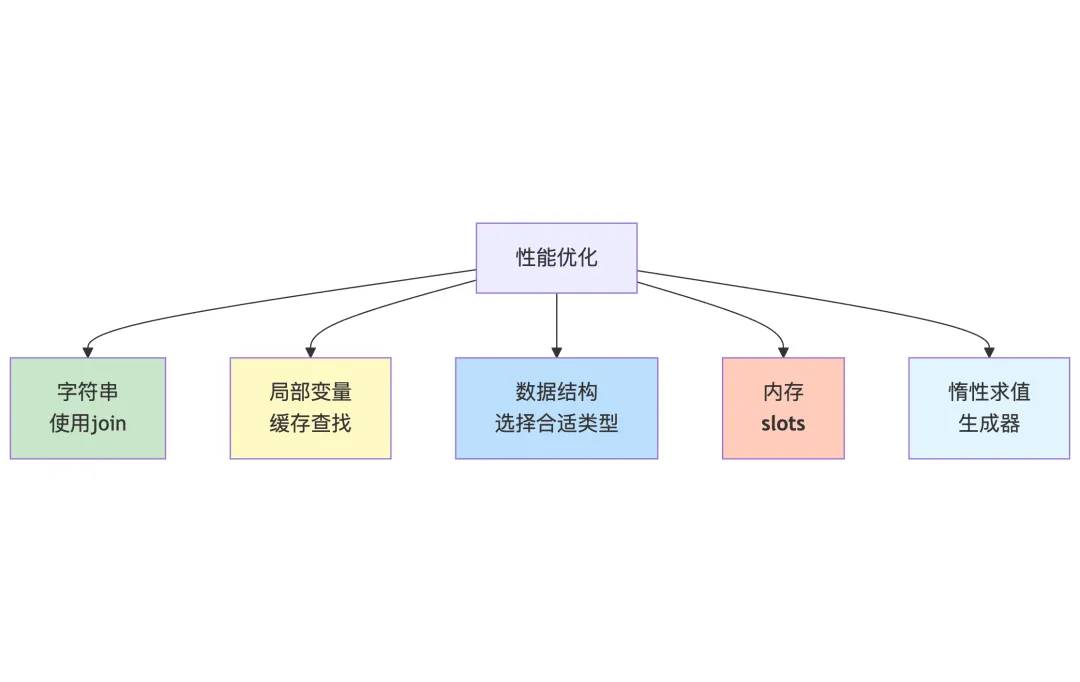
04 性能优化
4.1 字符串拼接
# 不好的写法:频繁拼接result = ""for i in range(1000): result += str(i)# 好的写法1:使用joinparts = []for i in range(1000): parts.append(str(i))result = "".join(parts)# 好的写法2:列表推导式result = "".join(str(i) for i in range(1000))
4.2 使用局部变量
# 不好的写法:频繁全局查找defprocess():for i in range(10000): result = math.sqrt(i) # math是全局变量return result# 好的写法:使用局部变量defprocess(): sqrt = math.sqrt # 局部引用for i in range(10000): result = sqrt(i)return result
4.3 使用slots
# 减少内存占用classPoint: __slots__ = ('x', 'y')def__init__(self, x, y): self.x = x self.y = y# __slots__禁止__dict__,节省内存import sysp1 = Point(1, 2)p2 = Point(3, 4)print(sys.getsizeof(p1)) # 比普通类小
4.4 使用适当的数据结构
# 频繁查找使用set# 不好的写法defcheck_exists(items, target):for item in items:if item == target:returnTruereturnFalse# 好的写法defcheck_exists(items, target): item_set = set(items)return target in item_set# 频繁尾部添加使用dequefrom collections import deque# 不好的写法my_list = []for i in range(10000): my_list.append(i)# pop(0)是O(n)操作# 好的写法my_deque = deque()for i in range(10000): my_deque.append(i)# popleft()是O(1)操作
4.5 使用生成器表达式
# 不好的写法:一次性生成列表total = sum([x ** 2for x in range(1000000)])# 好的写法:使用生成器表达式total = sum(x ** 2for x in range(1000000))
4.6 使用itertools
import itertools# 笛卡尔积for x, y in itertools.product(range(3), range(3)): print(f"({x}, {y})")# 组合for combo in itertools.combinations([1, 2, 3, 4], 2): print(combo) # (1, 2), (1, 3), ...# 排列for perm in itertools.permutations([1, 2, 3], 2): print(perm) # (1, 2), (1, 3), (2, 1), ...# 链式迭代for item in itertools.chain(list1, list2, list3): print(item)

05 代码组织与重构
5.1 函数设计原则
# 单一职责# 不好的写法defprocess_user(user): validate(user) # 验证 save_to_database(user) # 保存 send_notification(user) # 通知# 好的写法defvalidate_user(user):passdefsave_user(user):passdefnotify_user(user):passdefprocess_user(user): validate_user(user) save_user(user) notify_user(user)
5.2 使用上下文管理器
# 自定义上下文管理器classTimer:def__enter__(self): self.start = time.time()return selfdef__exit__(self, exc_type, exc_val, exc_tb): self.end = time.time() print(f"Elapsed: {self.end - self.start:.4f}s")with Timer():# 代码块计时 time.sleep(1)
5.3 错误处理
# 使用特定异常# 不好的写法try: process()except Exception:pass# 好的写法try: process()except (ValueError, TypeError) as e: print(f"Error: {e}")except KeyboardInterrupt: print("User interrupted")except:raise# 重新抛出未知异常
5.4 使用with语句
# 自定义上下文管理器from contextlib import contextmanager@contextmanagerdeffile_lock(filename):# 获取锁 print(f"Locking {filename}")try:yieldfinally: print(f"Unlocking {filename}")with file_lock("data.txt"): print("Processing file")

06 测试与文档
6.1 单元测试
import unittestclassTestStringMethods(unittest.TestCase):deftest_upper(self): self.assertEqual('foo'.upper(), 'FOO')deftest_isupper(self): self.assertTrue('FOO'.isupper()) self.assertFalse('Foo'.isupper())deftest_split(self): s = 'hello world' self.assertEqual(s.split(), ['hello', 'world'])if __name__ == '__main__': unittest.main()
6.2 类型注解
# Python 3.5+ 类型注解from typing import List, Dict, Optional, Uniondefgreet(name: str, age: int) -> str:returnf"Hello, {name}! You are {age} years old."defprocess_items(items: List[int]) -> int:return sum(items)defget_value(data: Dict[str, int], key: str) -> Optional[int]:return data.get(key)# Python 3.12+ 泛型语法defprocess_items[T](items: list[T]) -> list[T]:return items
6.3 文档字符串
defcalculate_area(radius: float) -> float:"""Calculate the area of a circle. Args: radius: The radius of the circle. Returns: The area of the circle. Raises: ValueError: If radius is negative. """if radius < 0:raise ValueError("Radius cannot be negative")import mathreturn math.pi * radius ** 2

07 调试与profiling
7.1 调试技巧
# 使用pdb调试import pdbdefbuggy_function(x): pdb.set_trace() # 设置断点return x * 2# 使用日志调试import logginglogging.basicConfig(level=logging.INFO)logger = logging.getLogger(__name__)defprocess(data): logger.debug(f"Processing: {data}") result = data * 2 logger.info(f"Result: {result}")return result
7.2 性能分析
import cProfileimport pstatsdefprofile_function():# 分析函数 cProfile.run("main()", "profile_stats") p = pstats.Stats("profile_stats") p.sort_stats('cumulative').print_stats(10)

08 小结
本文系统介绍了Pythonic编程的各个方面:
- 惯用写法:条件判断、循环、列表推导式的Pythonic写法。
编写Pythonic代码是一个持续学习的过程。遵循Python的设计哲学,写出简洁、可读、高效的代码,是每个Python开发者的追求。

