在前几节中,我们已经建立了完整的统计推断体系:
现在进入一个核心应用:
如何刻画变量之间的关系?
1问题提出
给定数据:
我们希望回答:
当 变化时, 如何变化?
👉 一个自然假设:
2模型解释
👉 核心假设:
3直觉理解
可以理解为:
观测值 = 规律 + 噪声
👉 目标:
找到“最合适”的直线
4最小二乘法(Least Squares)
定义损失函数:
👉 结果:
5Python实现
# file: regression_manual.py

import numpy as np
import matplotlib.pyplot as plt

defmain():
    np.random.seed(0)

    x = np.linspace(0, 10, 100)
    y = 2 + 3*x + np.random.normal(0, 2, 100)

    beta1 = np.cov(x, y)[0,1] / np.var(x)
    beta0 = np.mean(y) - beta1 * np.mean(x)

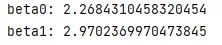
    print("beta0:", beta0)
    print("beta1:", beta1)

    y_pred = beta0 + beta1 * x

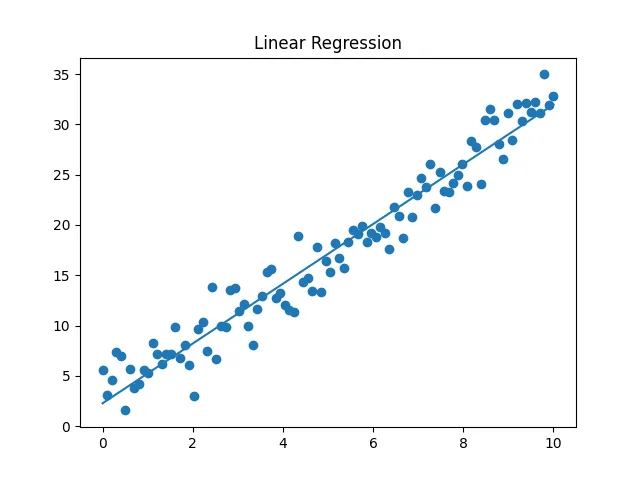
    plt.scatter(x, y)
    plt.plot(x, y_pred)
    plt.title("Linear Regression")
    plt.show()

if __name__ == "__main__":
    main()
结果解释
6MLE视角
假设:
则:
👉 最大化似然:
等价于:
👉 结论:
最小二乘 = 最大似然估计
7参数分布(推断基础)
在一定条件下:
👉 这使得:
8系数显著性检验
假设:
统计量:
# file: regression_ttest.py

import numpy as np
from scipy import stats

defmain():
    np.random.seed(0)

    x = np.linspace(0,10,100)
    y = 2 + 3*x + np.random.normal(0,2,100)

    beta1 = np.cov(x,y)[0,1] / np.var(x)
    beta0 = np.mean(y) - beta1*np.mean(x)

    y_pred = beta0 + beta1*x
    residuals = y - y_pred

    s2 = np.sum(residuals**2) / (len(x)-2)
    se_beta1 = np.sqrt(s2 / np.sum((x-np.mean(x))**2))

    t_stat = beta1 / se_beta1
    p_value = 2*(1 - stats.t.cdf(abs(t_stat), df=len(x)-2))

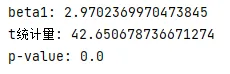
    print("beta1:", beta1)
    print("t统计量:", t_stat)
    print("p-value:", p_value)

if __name__ == "__main__":
    main()
结果解释
9拟合优度(R²)
定义:
# file: regression_r2.py

import numpy as np

defmain():
    np.random.seed(0)

    x = np.linspace(0,10,100)
    y = 2 + 3*x + np.random.normal(0,2,100)

    beta1 = np.cov(x,y)[0,1] / np.var(x)
    beta0 = np.mean(y) - beta1*np.mean(x)

    y_pred = beta0 + beta1*x

    ss_res = np.sum((y - y_pred)**2)
    ss_tot = np.sum((y - np.mean(y))**2)

    r2 = 1 - ss_res/ss_tot

    print("R^2:", r2)

if __name__ == "__main__":
    main()
执行结果如下: