通过网盘分享的文件:hamlet.txt
链接: https://pan.baidu.com/s/14ub6O90xKNpo19p2VP0ZHA?pwd=dkzx 提取码: dkzx
f=open("hamlet.txt","r") #创建文件操作对象fprint(f)txt=f.read() #调用read方法读取文本内容,返回字符串print(txt)
(2)字符方法处理:将文本中的大写字母转换为小写,去除标点符号,并按空格拆分字符串f=open("hamlet.txt","r") #创建文件操作对象fprint(f)txt=f.read() #调用read方法读取文本内容,返回字符串print(txt)txt=txt.lower() #将字符中的大写字母转换为小写print(txt)for i in "~!@#$%^&*()_+<>?:\"{}|[]\;\',./\\'-": txt=txt.replace(i," ") #用空格替换字符串中标点符号lst=txt.split() #默认按空格分隔字符串,返回列表print(lst)
f=open("hamlet.txt","r") #创建文件操作对象fprint(f)txt=f.read() #调用read方法读取文本内容,返回字符串print(txt)txt=txt.lower() #将字符中的大写字母转换为小写print(txt)for i in "~!@#$%^&*()_+<>?:\"{}|[]\;\',./\\'-": txt=txt.replace(i," ") #用空格替换字符串中标点符号lst=txt.split() #默认按空格分隔字符串,返回列表print(lst)counts={} #空字典for word in lst: counts[word]=counts.get(word,0)+1 #单词出现一次,数量加1print(counts)items=list(counts.items()) #将字典中的键值对转换为元组,并以列表形式返回print(items)
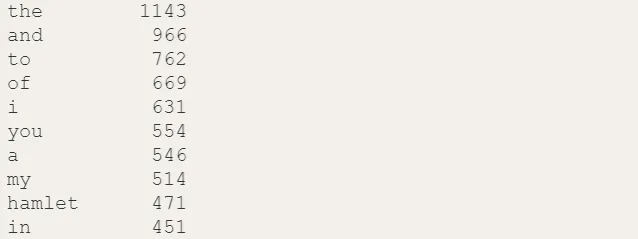
(4)利用lambda匿名函数对单词数量进行从大到小排序,并遍历排序后的前10个元素f=open("hamlet.txt","r") #创建文件操作对象fprint(f)txt=f.read() #调用read方法读取文本内容,返回字符串print(txt)txt=txt.lower() #将字符中的大写字母转换为小写print(txt)for i in "~!@#$%^&*()_+<>?:\"{}|[]\;\',./\\'-": txt=txt.replace(i," ") #用空格替换字符串中标点符号lst=txt.split() #默认按空格分隔字符串,返回列表print(lst)counts={} #空字典for word in lst: counts[word]=counts.get(word,0)+1 #单词出现一次,数量加1print(counts)items=list(counts.items()) #将字典中的键值对转换为元组,并以列表形式返回print(items)items.sort(key=lambda x:x[1],reverse=True) #按单词出现次数排序print(items)for i in range(10): word,count=items[i] #序列解包 print(f"{word:<10}{count:>5}") #格式化输出
 10个月宝宝每天需要喝多少奶粉?