在版图设计中,总线连接是常见但繁琐的任务。如何让数百条平行走线优雅地连接在一起,同时保持布局的美观和电气性能?今天分享AI辅助的解决方案。背景来源技术群中的讨论:网友木棉有开发分享了这个需求脚本,用45度斜边走线连接连接两组bus代码。 征得同意我尝试porting到Custom Compiler上使用。
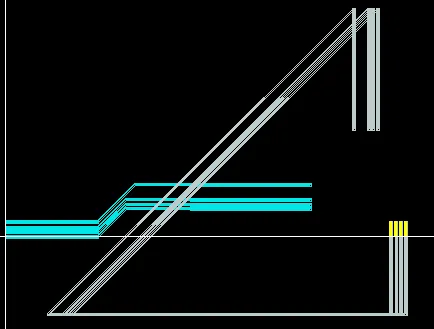
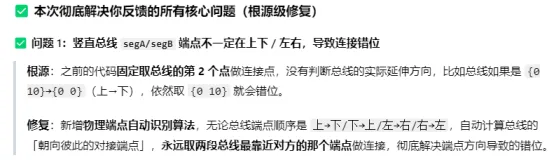
初步想法是用AI 直接porting到Tcl 脚本。但是初步porting的效果并不理想,出现如下异常情况。在豆包上多次提示连接异常情况后仍没有优化出想要的效果。但它每次都很自信的告诉我是最终完美版版本。
不纠结让AI 重新写一个这样需求的脚本,主要代码均为AI生成,我手工添加了个简单的GUI 部分代码方便使用。(我的目前的经验是可以先给一些示例比如坐标信息,需要连接的坐标信息等让AI了解最终需求。这样生成的代码往往更接近需求。)
还是让豆包和Deepseek自己帮写出这样的需要。在DeepSeek的上得到了较好的效果,但是语法正确率上没有豆包生成的好。最终两个结合使用。最终得到想要的功能,大约用时1.5小时。
为了快速实现,这里的GUI 界面和使用方式没有过多优化。
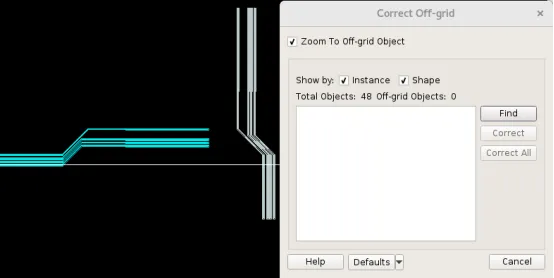
Custom Compiler有自带修正offgrid的功能,当然脚本中也可以带上自带修正格点的function.欢迎关注我的公众号,获取更多IC设计自动化技巧和工具分享。如果你有特定的设计挑战,也欢迎留言讨论!
#!/usr/bin/tclsh# =============================================================# 功能:水平/竖直平行BUS总线 顺序一对一45°斜线连接# 适配场景:A/B组均为平行线、严格顺序配对、无交叉无重叠、45°等宽斜线# 输入格式:每组走线 = {{{x1 y1} {x2 y2}} {{x1 y1} {x2 y2}} ...}# 核心保证:① 顺序不变 ② 纯45°斜线(|Δx|=|Δy|) ③ 无重叠交叉 ④ 连线最短# =============================================================proc connect_bus_45 {busA busB} { set connect_all [list] set pair_num [llength $busA] if {[llength $busA] != [llength $busB]} { puts "Warning: BUS A count=[llength $busA], BUS B count=[llength $busB], only connect min pair" set pair_num [expr {min([llength $busA],[llength $busB])}] } for {set i 0} {$i < $pair_num} {incr i} { set segA [lindex $busA $i] set segB [lindex $busB $i] lassign $segA a1 a2 lassign $segB b1 b2 # Auto detect HORIZONTAL / VERTICAL lassign $a1 ax1 ay1 lassign $a2 ax2 ay2 lassign $b1 bx1 by1 lassign $b2 bx2 by2 set dirA [expr {$ax1 == $ax2 ? "vertical" : "horizontal"}] set dirB [expr {$bx1 == $bx2 ? "vertical" : "horizontal"}] # 如果两条线段方向不一致,默认按照dirA处理 if {$dirA ne $dirB} { puts "Warning: Segment directions differ at pair $i (A:$dirA, B:$dirB), using A's direction" } # ========== ✅ 优化核心算法:真正找到最近端点 ========== if {$dirA eq "vertical"} { # 垂直线段:计算所有端点对的距离,选择最近的 set a_top [list $ax1 [expr {max($ay1,$ay2)}]] set a_bot [list $ax1 [expr {min($ay1,$ay2)}]] set b_top [list $bx1 [expr {max($by1,$by2)}]] set b_bot [list $bx1 [expr {min($by1,$by2)}]] # 计算所有可能端点对的距离(使用欧几里得距离公式) set pairs [list] set dx [expr {$ax1 - $bx1}] set dy_top_top [expr {[lindex $a_top 1] - [lindex $b_top 1]}] set dy_top_bot [expr {[lindex $a_top 1] - [lindex $b_bot 1]}] set dy_bot_top [expr {[lindex $a_bot 1] - [lindex $b_top 1]}] set dy_bot_bot [expr {[lindex $a_bot 1] - [lindex $b_bot 1]}] lappend pairs [list $a_top $b_top [expr {sqrt($dx*$dx + $dy_top_top*$dy_top_top)}]] lappend pairs [list $a_top $b_bot [expr {sqrt($dx*$dx + $dy_top_bot*$dy_top_bot)}]] lappend pairs [list $a_bot $b_top [expr {sqrt($dx*$dx + $dy_bot_top*$dy_bot_top)}]] lappend pairs [list $a_bot $b_bot [expr {sqrt($dx*$dx + $dy_bot_bot*$dy_bot_bot)}]] # 按距离排序,取最近的 set pairs [lsort -real -index 2 $pairs] lassign [lindex $pairs 0] a_link b_link dist } else { # 水平线段:计算所有端点对的距离,选择最近的 set a_right [list [expr {max($ax1,$ax2)}] $ay1] set a_left [list [expr {min($ax1,$ax2)}] $ay1] set b_right [list [expr {max($bx1,$bx2)}] $by1] set b_left [list [expr {min($bx1,$bx2)}] $by1] # 计算所有可能端点对的距离 set pairs [list] set dy [expr {$ay1 - $by1}] set dx_right_right [expr {[lindex $a_right 0] - [lindex $b_right 0]}] set dx_right_left [expr {[lindex $a_right 0] - [lindex $b_left 0]}] set dx_left_right [expr {[lindex $a_left 0] - [lindex $b_right 0]}] set dx_left_left [expr {[lindex $a_left 0] - [lindex $b_left 0]}] lappend pairs [list $a_right $b_right [expr {sqrt($dx_right_right*$dx_right_right + $dy*$dy)}]] lappend pairs [list $a_right $b_left [expr {sqrt($dx_right_left*$dx_right_left + $dy*$dy)}]] lappend pairs [list $a_left $b_right [expr {sqrt($dx_left_right*$dx_left_right + $dy*$dy)}]] lappend pairs [list $a_left $b_left [expr {sqrt($dx_left_left*$dx_left_left + $dy*$dy)}]] # 按距离排序,取最近的 set pairs [lsort -real -index 2 $pairs] lassign [lindex $pairs 0] a_link b_link dist } lassign $a_link ax ay lassign $b_link bx by # ========== ✅ 45°斜线核心公式:确保|Δx|=|Δy| ========== set dx [expr {abs($bx-$ax)}] set dy [expr {abs($by-$ay)}] set delta [expr {min($dx, $dy)}] # 计算45度线的终点(从a_link出发) set s_x [expr {$ax + ($bx > $ax ? $delta : -$delta)}] set s_y [expr {$ay + ($by > $ay ? $delta : -$delta)}] set slope_start $a_link set slope_end [list $s_x $s_y] lappend connect_all [list "bus_pair_$i" $segA $segB $slope_start $slope_end $a_link $b_link] } return $connect_all}proc print_bus_connect {connect_data} { global AbusArray foreach pair $connect_data { lassign $pair idx segA segB s_start s_end a_link b_link lassign $segA a1 a2 lassign $segB b1 b2 # ✅ 确定a_other(不是a_link的那个端点) if {[lindex $a1 0]==[lindex $a_link 0] && [lindex $a1 1]==[lindex $a_link 1]} { set a_other $a2 } else { set a_other $a1 } # ✅ 确定b_other(不是b_link的那个端点) if {[lindex $b1 0]==[lindex $b_link 0] && [lindex $b1 1]==[lindex $b_link 1]} { set b_other $b2 } else { set b_other $b1 } # ✅ 生成正确的连接顺序:a_other -> a_link -> 45°线 -> b_link -> b_other set full_line [list $a_other $a_link $s_end $b_link $b_other] # ✅ 去重,避免重复点 set clean_line [list] foreach p $full_line { if {[lsearch -exact $clean_line $p] == -1} { lappend clean_line $p } } if {[info exists AbusArray($segA)]} { set layerName [lindex $AbusArray($segA) 0] set width [lindex $AbusArray($segA) end] # 创建路径 le::createPath [po::compress $clean_line] -design [ed] -lpp $layerName -width $width } # 简洁日志 lassign $s_start x1 y1 lassign $s_end x2 y2 puts "Pair $idx: A_link=$a_link, B_link=$b_link, 45°_link $s_start <-> $s_end, dx=[expr {abs($x2-$x1)}], dy=[expr {abs($y2-$y1)}], 45=[expr {abs($x2-$x1)==abs($y2-$y1)}]" }}# =============================================================# GUI和选择功能保持不变# =============================================================proc selectAbus {widget} { global busA AbusArray set busA {} catch {array unset AbusArray} array set AbusArray [list] set busASelected [de::getSelected -design [ed]] db::foreach eachSegA $busASelected { if {[db::getAttr objType -of $eachSegA] == "Path" || [db::getAttr objType -of $eachSegA] == "PathSeg"} { set layerName [db::getAttr object.LPP.lpp -of $eachSegA] set pathWidth [db::getAttr object.width -of $eachSegA] set pathPoints [db::getAttr object.points -of $eachSegA] lappend busA $pathPoints set AbusArray($pathPoints) [list $layerName $pathWidth] } } puts "Selected [llength $busA] segments for Bus A"}proc selectBbus {widget} { global busB BbusArray set busB {} catch {array unset BbusArray} array set BbusArray [list] set busBSelected [de::getSelected -design [ed]] db::foreach eachSegB $busBSelected { if {[db::getAttr objType -of $eachSegB] == "Path" || [db::getAttr objType -of $eachSegB] == "PathSeg"} { set layerName [db::getAttr object.LPP.lpp -of $eachSegB] set pathWidth [db::getAttr object.width -of $eachSegB] set pathPoints [db::getAttr object.points -of $eachSegB] lappend busB $pathPoints set BbusArray($pathPoints) [list $layerName $pathWidth] } } puts "Selected [llength $busB] segments for Bus B"}proc connectBus {widget} { global busA busB if {[llength $busA] == 0 || [llength $busB] == 0} { puts "Error: Please select both Bus A and Bus B first" return } set result [connect_bus_45 $busA $busB] print_bus_connect $result}# =============================================================# 创建GUI界面# =============================================================catch {db::destroy [gi::getDialogs testDialog]}set dialog [gi::createDialog testDialog -title "BUS Connection Tool" -execProc connectBus]gi::createPushButton btnAName -parent $dialog -label "Select First Bus (A)" -execProc selectAbus gi::createPushButton btnBName -parent $dialog -label "Select Second Bus (B)" -execProc selectBbus gi::createPushButton btnCName -parent $dialog -label "Connect Bus A and Bus B" -execProc connectBus gi::setDialogSize $dialog -width 300 -height 150