当前位置:首页>python>python与Streamlit构建的旅游行业数据分析Dashboard项目

python与Streamlit构建的旅游行业数据分析Dashboard项目

  • 2026-03-26 09:16:53
python与Streamlit构建的旅游行业数据分析Dashboard项目

旅游数据多维度分析平台

这是一个完善的旅游行业数据分析Dashboard项目,基于Streamlit构建。


一、架构

1.1 技术栈组成

类别
技术/库
用途
前端框架
Streamlit
快速构建交互式Web应用
数据处理
Pandas, NumPy
数据清洗、转换、分析
可视化
Plotly (Express, Graph Objects, Subplots)
交互式图表绘制
机器学习
Scikit-learn
聚类、回归、分类模型
数据处理
warnings
抑制警告信息

1.2 项目结构概览旅游数据多维度分析平台├── 页面配置 (CSS样式、页面布局)├── 数据加载 (CSV读取、日期转换、缓存)├── 侧边栏筛选 (年份、月份、省份)├── 顶部指标卡 (4个核心KPI)└── 7个功能选项卡    ├── Tab1: 游客特征分析    ├── Tab2: 消费行为分析    ├── Tab3: 景点/景区分析    ├── Tab4: 时间维度分析    ├── Tab5: 满意度与情感分析    ├── Tab6: 高级分析模型    └── Tab7: 综合可视化展示


二、各模块解析

2.1 数据加载模块

@st.cache_data
defload_data():
    df = pd.read_csv('dataset.csv')
    df['游玩日期']= pd.to_datetime(df['游玩日期'])
    df['年月']= pd.to_datetime(df['年月'],format='%y-%b', errors='coerce')
return df

关键点分析:

  • @st.cache_data
    :Streamlit缓存装饰器,避免每次交互都重新加载数据
  • 日期转换:处理两种日期格式,errors='coerce'处理异常值
  • 潜在问题
    :数据文件路径硬编码,建议改为文件上传器

2.2 侧边栏筛选

selected_year = st.sidebar.multiselect("选择年份",sorted(df['年份'].unique()), default=...)
selected_month = st.sidebar.multiselect("选择月份",sorted(df['月份'].unique()), default=...)
selected_province = st.sidebar.multiselect("选择省份",sorted(df['省份'].unique()), default=...)

设计亮点:

  • 多选控件支持灵活筛选
  • 默认选中全部/部分选项
  • 筛选结果实时应用到所有图表

改进建议:

# 添加"全选"功能
if st.sidebar.button("全选"):
    selected_year =sorted(df['年份'].unique())

2.3 核心指标卡 (KPI Dashboard)

指标
计算方式
业务意义
总游客数
nunique()
去重后的独立游客数量
总消费金额
sum()
平台总收入
平均满意度
mean()
服务质量核心指标
热门景点数
nunique()
景点覆盖范围

三、功能模块

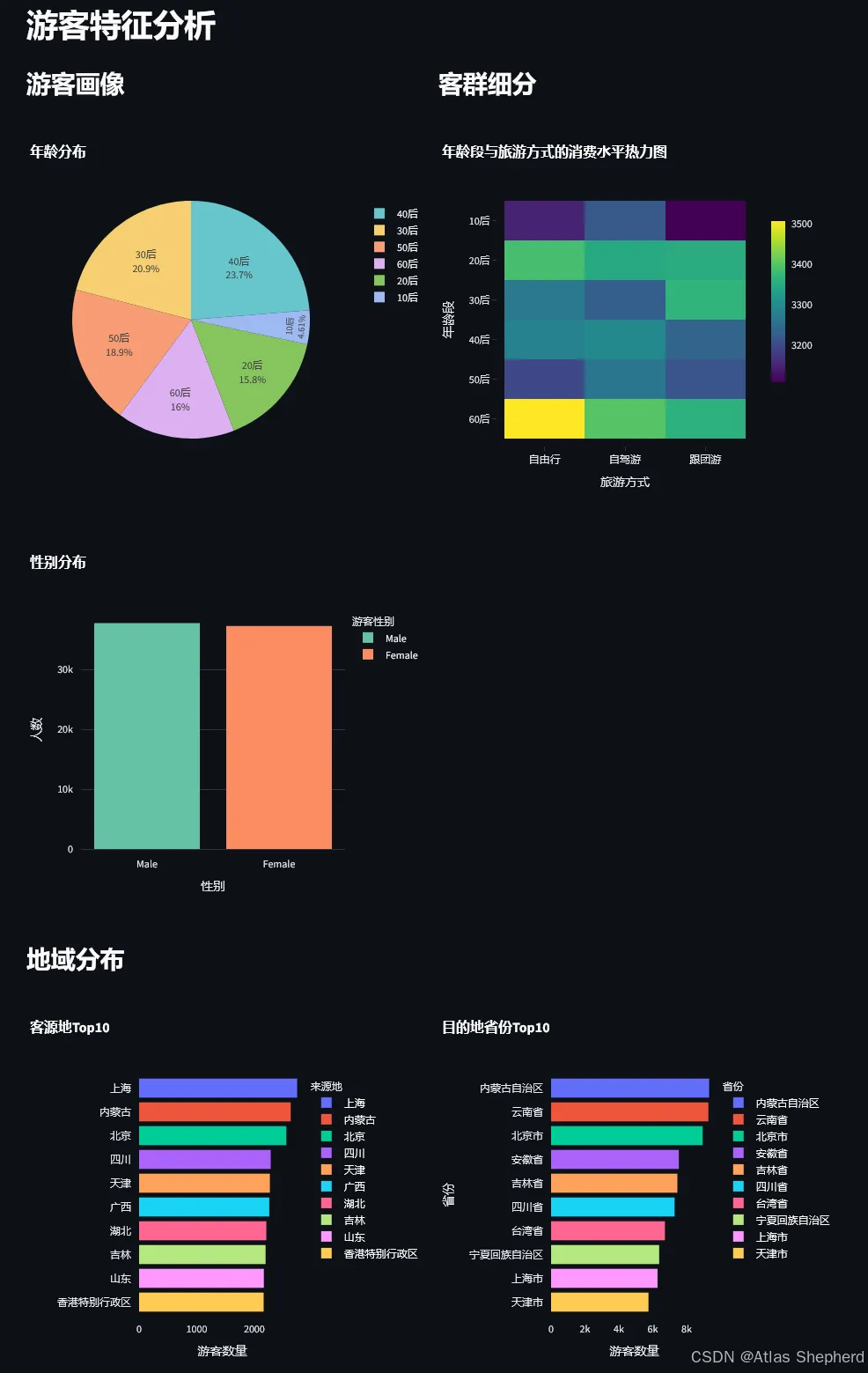
Tab1: 游客特征分析

分析维度:

  1. 人口统计学特征

    • 年龄分布(饼图)
    • 性别分布(柱状图)
  2. 客群细分

    • 年龄段×旅游方式×消费金额(热力图)
    • 揭示不同客群的消费偏好
  3. 地域分布

    • 客源地Top10
    • 目的地省份Top10

业务价值: 帮助制定精准营销策略,识别核心客群

Tab2: 消费行为分析

分析内容:

# 消费分布
px.histogram(x='消费金额(元)', nbins=50)

# 箱线图分析异常值
px.box(x='游客性别', y='消费金额(元)')
px.box(x='旅游方式', y='消费金额(元)')

# 价格敏感度
px.scatter(x='门票价格', y='消费金额', size='满意度')

关键洞察:

  • 消费金额分布形态(是否正态/偏态)
  • 不同群体的消费差异
  • 价格与消费的相关性

Tab3: 景点/景区分析

核心图表:

图表类型
分析目的
热门景点Top20
识别流量高地
景区销量Top20
识别收入高地
景点类型偏好
产品优化方向
综合表现散点图
销量vs满意度矩阵

业务应用:

  • 高销量低满意度 → 需要改进服务
  • 低销量高满意度 → 需要加强营销
  • 双高 → 明星产品,可复制经验

Tab4: 时间维度分析

时间粒度分析:

# 月度趋势
monthly_visitors = df_filtered.groupby('月份')['游客编号'].count()

# 季度分析(双Y轴)
fig_quarterly.add_trace(go.Bar(...))# 游客量
fig_quarterly.add_trace(go.Scatter(...))# 消费金额

# 周度规律
weekday_names ={1:'周一',2:'周二',...}

业务价值:

  • 识别旅游旺季/淡季
  • 周末vs工作日差异
  • 人力资源调度依据

Tab5: 满意度与情感分析

分析框架:

满意度分析├── 分布统计 (直方图 + 统计表格)├── 情感倾向 (饼图)├── 驱动因素│   ├── 消费金额 vs 满意度│   ├── 游玩时长 vs 满意度│   └── 景点数量 vs 满意度└── 问题诊断 (低满意度 < 3.0)    ├── 低满意度景点类型    └── 低满意度旅游方式

关键代码:

low_satisfaction = df_filtered[df_filtered['满意度评分']<3.0]

Tab6: 分析模型

这是项目的技术核心,包含6种分析方法:

1. 关联规则分析

association_data = df_filtered.groupby(['旅游方式','景点类型']).size().unstack()
px.imshow(association_data)# 热力图

2. K-Means聚类分析

cluster_features = df_filtered[['消费金额(元)','游玩时长(天)','景点数量','满意度评分']]
scaler = StandardScaler()
cluster_scaled = scaler.fit_transform(cluster_features)
kmeans = KMeans(n_clusters=4, random_state=42)

聚类业务意义:

客群
特征
营销策略
高消费长停留
高端客户
VIP服务
低消费短停留
价格敏感
优惠促销
高满意度
忠诚客户
会员计划
低满意度
风险客户
服务改进

3. 线性回归分析

lr_model = LinearRegression()
lr_model.fit(X_train, y_train)
feature_importance = pd.DataFrame({'特征':[...],'系数': lr_model.coef_})

预测目标: 消费金额
影响因素: 年龄、游玩时长、景点数量、门票价格

4. 随机森林分类

rf_model = RandomForestClassifier(n_estimators=100)
df_filtered['满意度标签']= pd.cut(df_filtered['满意度评分'],
                                    bins=[0,3,4,5],
                                    labels=['低','中','高'])

预测目标: 满意度等级
评估指标: 训练/测试集准确率

5. 时间序列预测

monthly_data['3月移动平均']= monthly_data['游客编号'].rolling(window=3, center=True).mean()

6. 路径分析

px.treemap(path=['来源地','省份'], values='游客数量')

Tab7: 综合可视化展示

高级图表类型:

图表
用途
技术要点
雷达图
多维度对比
go.Scatterpolar
漏斗图
转化分析
px.funnel
散点图矩阵
变量关系
px.scatter_matrix
热力图
密度分布
px.imshow
子图组合
综合趋势
make_subplots

雷达图归一化代码:

for col in columns:
    type_radar_norm[col]=(type_radar[col]- type_radar[col].min())/(type_radar[col].max()- type_radar[col].min())

四、后期优化方向

4.1 性能优化

# 问题:每次筛选都重新计算所有图表
# 建议:使用@st.cache_data缓存处理后的数据

@st.cache_data
deffilter_data(df, year, month, province):
return df[(df['年份'].isin(year))&...]

4.2 错误处理

# 当前代码缺少空数据检查
if df_filtered.empty:
    st.warning(" 当前筛选条件下无数据,请调整筛选条件")
    st.stop()

4.3 数据上传功能

# 替代硬编码路径
uploaded_file = st.sidebar.file_uploader("上传数据文件",type=['csv'])
if uploaded_file:
    df = pd.read_csv(uploaded_file)

4.4 模型持久化

# 当前模型每次运行都重新训练
# 建议:保存训练好的模型
import joblib
joblib.dump(lr_model,'models/regression_model.pkl')

4.5 代码结构优化

# 建议将每个Tab封装为函数
defrender_visitor_tab(df_filtered):
    st.header("游客特征分析")
...

defrender_consumption_tab(df_filtered):
    st.header("消费行为分析")
...

五、场景

5.1 旅游平台运营

场景
使用模块
决策支持
营销活动策划
Tab1游客特征
目标客群定位
定价策略优化
Tab2消费行为
价格敏感度分析
产品推荐
Tab3景点分析
热门景点推荐
资源调度
Tab4时间维度
旺季人力安排
服务改进
Tab5满意度
问题诊断
客户分群
Tab6聚类模型
精准营销

5.2 景区管理

  • 游客流量预测
  • 满意度监控预警
  • 景点组合优化
  • 收入结构分析

六、后期扩展方向

6.1 数据层面

# 添加更多数据源
- 天气数据(影响旅游决策)
- 节假日日历
- 竞品数据
- 社交媒体情感数据

6.2 模型层面

# 高级模型
- Prophet时间序列预测
- XGBoost/LightGBM分类
- 关联规则(Apriori)
- 用户行为序列分析

6.3 功能层面

# 交互功能
- 数据导出(Excel/CSV)
- 报告自动生成(PDF)
- 预警系统(邮件/短信)
- 权限管理(多用户)

6.4 部署层面

# 生产部署
- Docker容器化
- 数据库连接(SQL/MySQL)
- 定时数据更新
- 负载均衡

七、运行

7.1 环境准备

# 创建虚拟环境
python -m venv tourism_env
source tourism_env/bin/activate  # Windows: tourism_env\Scripts\activate

# 安装依赖
pip install pandas numpy streamlit plotly scikit-learn

7.2 数据准备

# dataset.csv 应包含以下字段
必需字段:
- 游客编号, 游玩日期, 年份, 月份, 省份
- 消费金额(元), 满意度评分, 景点名称
- 游客性别, 年龄段, 旅游方式, 来源地
- 景点类型, 景点门票价格(元), 景区销量
- 游玩时长(天), 景点数量, 评论情感倾向
- 星期, 年月, 游客年龄

7.3 运行命令

streamlit run app.py

7.4 访问地址

http://localhost:8501

八、代码

import pandas as pdimport numpy as npimport streamlit as stimport plotly.express as pximport plotly.graph_objects as gofrom plotly.subplots import make_subplotsimport plotly.figure_factory as fffrom sklearn.cluster import KMeansfrom sklearn.preprocessing import StandardScalerfrom sklearn.linear_model import LinearRegressionfrom sklearn.ensemble import RandomForestClassifierfrom sklearn.model_selection import train_test_splitfrom sklearn.metrics import classification_reportimport warningswarnings.filterwarnings('ignore')# 页面配置st.set_page_config(    page_title="旅游数据多维度分析平台",    page_icon="🏔️",    layout="wide",    initial_sidebar_state="expanded")# 自定义CSSst.markdown("""<style>    .main-title {        font-size: 2.5rem;        font-weight: bold;        color: #1f77b4;        text-align: center;        margin-bottom: 1rem;    }    .metric-card {        background: linear-gradient(135deg, #667eea 0%, #764ba2 100%);        padding: 1rem;        border-radius: 10px;        color: white;        text-align: center;    }    .stMetric {        background-color: #f0f2f6;        padding: 1rem;        border-radius: 10px;    }</style>""", unsafe_allow_html=True)# 标题st.markdown('<p class="main-title">🏔️ 旅游数据多维度分析平台</p>', unsafe_allow_html=True)st.markdown("---")# 加载数据@st.cache_datadef load_data():    df = pd.read_csv('dataset.csv')    # 转换日期    df['游玩日期'] = pd.to_datetime(df['游玩日期'])    df['年月'] = pd.to_datetime(df['年月'], format='%y-%b', errors='coerce')    return dfdf = load_data()# 侧边栏筛选st.sidebar.header("📊 数据筛选")selected_year = st.sidebar.multiselect("选择年份"sorted(df['年份'].unique()), default=sorted(df['年份'].unique()))selected_month = st.sidebar.multiselect("选择月份"sorted(df['月份'].unique()), default=sorted(df['月份'].unique()))selected_province = st.sidebar.multiselect("选择省份"sorted(df['省份'].unique()), default=sorted(df['省份'].unique())[:10])# 应用筛选df_filtered = df[    (df['年份'].isin(selected_year)) &    (df['月份'].isin(selected_month)) &    (df['省份'].isin(selected_province))]# 顶部指标卡col1, col2, col3, col4 = st.columns(4)with col1:    st.metric("总游客数", f"{df_filtered['游客编号'].nunique():,}")with col2:    st.metric("总消费金额", f"¥{df_filtered['消费金额(元)'].sum():,.0f}")with col3:    st.metric("平均满意度", f"{df_filtered['满意度评分'].mean():.2f}")with col4:    st.metric("热门景点数", f"{df_filtered['景点名称'].nunique():,}")st.markdown("---")# 选项卡tab1, tab2, tab3, tab4, tab5, tab6, tab7 = st.tabs([    "👥 游客特征""💰 消费行为""🏛️ 景点分析"    "📅 时间维度""😊 满意度分析""🤖 高级模型""🗺️ 可视化"])# ==================== 选项卡1: 游客特征分析 ====================with tab1:    st.header("游客特征分析")    col1, col2 = st.columns(2)    with col1:        st.subheader("游客画像")        # 年龄分布        fig_age = px.pie(            df_filtered,             values='游客编号'            names='年龄段',            title='年龄分布',            color_discrete_sequence=px.colors.qualitative.Pastel        )        fig_age.update_traces(textposition='inside', textinfo='percent+label')        st.plotly_chart(fig_age, use_container_width=True)        # 性别分布        gender_data = df_filtered['游客性别'].value_counts().reset_index()        gender_data.columns = ['游客性别''count']        fig_gender = px.bar(            gender_data,            x='游客性别',            y='count',            title='性别分布',            color='游客性别',            color_discrete_sequence=px.colors.qualitative.Set2        )        fig_gender.update_layout(xaxis_title="性别", yaxis_title="人数")        st.plotly_chart(fig_gender, use_container_width=True)    with col2:        st.subheader("客群细分")        # 年龄段+旅游方式+消费金额热力图        heatmap_data = df_filtered.groupby(['年龄段''旅游方式'])['消费金额(元)'].mean().reset_index()        heatmap_pivot = heatmap_data.pivot(index='年龄段', columns='旅游方式', values='消费金额(元)')        fig_heatmap = px.imshow(            heatmap_pivot,            title='年龄段与旅游方式的消费水平热力图',            color_continuous_scale='Viridis',            aspect="auto"        )        st.plotly_chart(fig_heatmap, use_container_width=True)    # 地域分布    st.subheader("地域分布")    col1, col2 = st.columns(2)    with col1:        # 客源地Top10        source_top10 = df_filtered['来源地'].value_counts().head(10).reset_index()        source_top10.columns = ['来源地''count']        fig_source = px.bar(            source_top10,            x='count',            y='来源地',            orientation='h',            title='客源地Top10',            color='来源地',            color_discrete_sequence=px.colors.qualitative.Plotly        )        fig_source.update_layout(yaxis_title="", xaxis_title="游客数量")        st.plotly_chart(fig_source, use_container_width=True)    with col2:        # 目的地省份Top10        province_top10 = df_filtered['省份'].value_counts().head(10).reset_index()        province_top10.columns = ['省份''count']        fig_province = px.bar(            province_top10,            x='count',            y='省份',            title='目的地省份Top10',            color='省份',            color_discrete_sequence=px.colors.qualitative.Plotly        )        fig_province.update_layout(xaxis_title="游客数量", yaxis_title="省份")        st.plotly_chart(fig_province, use_container_width=True)# ==================== 选项卡2: 消费行为分析 ====================with tab2:    st.header("消费行为分析")    col1, col2 = st.columns(2)    with col1:        st.subheader("消费水平分析")        # 消费金额分布        fig_spending_dist = px.histogram(            df_filtered,            x='消费金额(元)',            nbins=50,            title='消费金额分布',            color_discrete_sequence=['#1f77b4']        )        st.plotly_chart(fig_spending_dist, use_container_width=True)        # 消费统计        st.markdown("### 消费统计")        stats_data = {            '指标': ['平均消费''中位数消费''最高消费''最低消费'],            '金额': [                f"¥{df_filtered['消费金额(元)'].mean():,.2f}",                f"¥{df_filtered['消费金额(元)'].median():,.2f}",                f"¥{df_filtered['消费金额(元)'].max():,.2f}",                f"¥{df_filtered['消费金额(元)'].min():,.2f}"            ]        }        st.table(pd.DataFrame(stats_data))    with col2:        st.subheader("消费影响因素")        # 性别与消费        fig_gender_spending = px.box(            df_filtered,            x='游客性别',            y='消费金额(元)',            title='性别与消费金额关系',            color='游客性别'        )        st.plotly_chart(fig_gender_spending, use_container_width=True)        # 旅游方式与消费        fig_travel_spending = px.box(            df_filtered,            x='旅游方式',            y='消费金额(元)',            title='旅游方式与消费金额关系',            color='旅游方式'        )        st.plotly_chart(fig_travel_spending, use_container_width=True)    # 价格敏感度分析    st.subheader("价格敏感度分析")    price_sensitivity = df_filtered.groupby('景点类型').agg({        '景点门票价格(元)''mean',        '消费金额(元)''mean',        '满意度评分''mean'    }).reset_index()    fig_price = px.scatter(        price_sensitivity,        x='景点门票价格(元)',        y='消费金额(元)',        size='满意度评分',        hover_name='景点类型',        title='门票价格与消费金额关系(气泡大小表示满意度)',        size_max=50,        color='满意度评分',        color_continuous_scale='RdYlGn'    )    st.plotly_chart(fig_price, use_container_width=True)# ==================== 选项卡3: 景点/景区分析 ====================with tab3:    st.header("景点/景区分析")    col1, col2 = st.columns(2)    with col1:        st.subheader("热门景点Top20")        scenic_top20 = df_filtered.groupby('景点名称').agg({            '景点数量''count',            '景区销量''first',            '满意度评分''mean'        }).sort_values('景点数量', ascending=False).head(20).reset_index()        fig_scenic = px.bar(            scenic_top20,            x='景点数量',            y='景点名称',            orientation='h',            title='热门景点Top20(按游客量)',            color='满意度评分',            color_continuous_scale='RdYlGn',            hover_data=['景区销量']        )        fig_scenic.update_layout(yaxis_title="", xaxis_title="游客数量")        st.plotly_chart(fig_scenic, use_container_width=True)    with col2:        st.subheader("景区销量Top20")        sales_top20 = df_filtered.groupby('景点名称').agg({            '景区销量''first',            '满意度评分''mean'        }).sort_values('景区销量', ascending=False).head(20).reset_index()        fig_sales = px.bar(            sales_top20,            x='景区销量',            y='景点名称',            orientation='h',            title='景区销量Top20',            color='满意度评分',            color_continuous_scale='RdYlGn'        )        fig_sales.update_layout(yaxis_title="", xaxis_title="销量")        st.plotly_chart(fig_sales, use_container_width=True)    # 景点类型偏好    st.subheader("景点类型偏好分析")    col1, col2 = st.columns(2)    with col1:        # 各类型景点游客量        type_count = df_filtered['景点类型'].value_counts().reset_index()        type_count.columns = ['景点类型''count']        fig_type_count = px.pie(            type_count,            values='count',            names='景点类型',            title='各类型景点游客占比',            hole=0.4        )        st.plotly_chart(fig_type_count, use_container_width=True)    with col2:        # 各类型景点满意度        type_satisfaction = df_filtered.groupby('景点类型')['满意度评分'].mean().sort_values(ascending=False).reset_index()        fig_type_satisfaction = px.bar(            type_satisfaction,            x='景点类型',            y='满意度评分',            title='各类型景点满意度评分',            color='满意度评分',            color_continuous_scale='RdYlGn'        )        fig_type_satisfaction.update_layout(xaxis_title="景点类型", yaxis_title="满意度评分")        st.plotly_chart(fig_type_satisfaction, use_container_width=True)    # 景区综合表现    st.subheader("景区综合表现分析")    scenic_performance = df_filtered.groupby('景点名称').agg({        '景区销量''first',        '满意度评分''mean',        '景点门票价格(元)''mean'        }).reset_index()    fig_performance = px.scatter(        scenic_performance,        x='景区销量',        y='满意度评分',        size='景点门票价格(元)',        hover_name='景点名称',        title='景区销量与满意度关系(气泡大小表示平均门票价格)',        size_max=60,        color='满意度评分',        color_continuous_scale='RdYlGn'    )    st.plotly_chart(fig_performance, use_container_width=True)# ==================== 选项卡4: 时间维度分析 ====================with tab4:    st.header("时间维度分析")    # 季节性分析    st.subheader("季节性分析")    col1, col2 = st.columns(2)    with col1:        # 月度游客量趋势        monthly_visitors = df_filtered.groupby('月份')['游客编号'].count().reset_index()        fig_monthly = px.line(            monthly_visitors,            x='月份',            y='游客编号',            title='月度游客量趋势',            markers=True,            line_shape='spline'        )        fig_monthly.update_layout(xaxis_title="月份", yaxis_title="游客数量")        st.plotly_chart(fig_monthly, use_container_width=True)    with col2:        # 季度分析        quarterly_data = df_filtered.groupby('季度').agg({            '游客编号''count',            '消费金额(元)''sum'        }).reset_index()        fig_quarterly = go.Figure()        fig_quarterly.add_trace(go.Bar(            x=quarterly_data['季度'],            y=quarterly_data['游客编号'],            name='游客数量',            marker_color='#1f77b4'        ))        fig_quarterly.add_trace(go.Scatter(            x=quarterly_data['季度'],            y=quarterly_data['消费金额(元)'] / 1000,            name='消费金额(千元)',            yaxis='y2',            line=dict(color='#ff7f0e', width=3)        ))        fig_quarterly.update_layout(            title='季度游客量与消费趋势',            xaxis=dict(title='季度'),            yaxis=dict(title='游客数量', side='left'),            yaxis2=dict(title='消费金额(千元)', side='right', overlaying='y'),            barmode='group'        )        st.plotly_chart(fig_quarterly, use_container_width=True)    # 周度规律    st.subheader("周度规律分析")    col1, col2 = st.columns(2)    with col1:        # 星期游客分布        weekday_names = {1'周一'2'周二'3'周三'4'周四'5'周五'6'周六'7'周日'}        weekday_data = df_filtered.groupby('星期').agg({            '游客编号''count',            '消费金额(元)''mean'        }).reset_index()        weekday_data['星期名称'] = weekday_data['星期'].map(weekday_names)        fig_weekday = px.bar(            weekday_data,            x='星期名称',            y='游客编号',            title='星期游客量分布',            color='游客编号',            color_continuous_scale='Blues'        )        st.plotly_chart(fig_weekday, use_container_width=True)    with col2:        # 周末vs工作日消费对比        weekday_data['是否周末'] = weekday_data['星期'].apply(lambda x'周末' if x in [67else '工作日')        weekend_spending = weekday_data.groupby('是否周末').agg({            '游客编号''sum',            '消费金额(元)''mean'        }).reset_index()        fig_weekend = px.bar(            weekend_spending,            x='是否周末',            y='消费金额(元)',            title='周末与工作日平均消费对比',            color='是否周末',            text='消费金额(元)'        )        fig_weekend.update_traces(texttemplate='%{text:.0f}', textposition='outside')        st.plotly_chart(fig_weekend, use_container_width=True)    # 趋势分析    st.subheader("趋势分析")    monthly_trend = df_filtered.groupby('年月').agg({        '游客编号''count',        '消费金额(元)''sum',        '满意度评分''mean'    }).reset_index()    fig_trend = make_subplots(        rows=2, cols=2,        subplot_titles=('游客量趋势''消费金额趋势''满意度趋势''综合趋势'),        specs=[[{"secondary_y": True}, {"secondary_y": True}],               [{"secondary_y": True}, {"type""scatter"}]]    )    fig_trend.add_trace(        go.Scatter(x=monthly_trend['年月'], y=monthly_trend['游客编号'], name='游客量'),        row=1, col=1    )    fig_trend.add_trace(        go.Scatter(x=monthly_trend['年月'], y=monthly_trend['消费金额(元)'], name='消费金额'),        row=1, col=2    )    fig_trend.add_trace(        go.Scatter(x=monthly_trend['年月'], y=monthly_trend['满意度评分'], name='满意度'),        row=2, col=1    )    fig_trend.add_trace(        go.Scatter(x=monthly_trend['年月'], y=monthly_trend['游客编号'], name='游客量'),        row=2, col=2    )    fig_trend.add_trace(        go.Scatter(x=monthly_trend['年月'], y=monthly_trend['消费金额(元)']/1000, name='消费(千)'),        row=2, col=2    )    fig_trend.update_layout(height=800, showlegend=True, title_text="业务趋势综合分析")    st.plotly_chart(fig_trend, use_container_width=True)# ==================== 选项卡5: 满意度与情感分析 ====================with tab5:    st.header("满意度与情感分析")    col1, col2 = st.columns(2)    with col1:        st.subheader("满意度评分分布")        fig_satisfaction_dist = px.histogram(            df_filtered,            x='满意度评分',            nbins=20,            title='满意度评分分布',            color_discrete_sequence=['#2ecc71']        )        st.plotly_chart(fig_satisfaction_dist, use_container_width=True)        # 满意度统计        sat_stats = {            '指标': ['平均满意度''最高满意度''最低满意度''标准差'],            '数值': [                f"{df_filtered['满意度评分'].mean():.2f}",                f"{df_filtered['满意度评分'].max():.2f}",                f"{df_filtered['满意度评分'].min():.2f}",                f"{df_filtered['满意度评分'].std():.2f}"            ]        }        st.table(pd.DataFrame(sat_stats))    with col2:        st.subheader("情感倾向分析")        sentiment_data = df_filtered['评论情感倾向'].value_counts().reset_index()        sentiment_data.columns = ['评论情感倾向''count']        fig_sentiment = px.pie(            sentiment_data,            values='count',            names='评论情感倾向',            title='评论情感倾向分布',            hole=0.4,            color_discrete_sequence=px.colors.qualitative.Pastel        )        st.plotly_chart(fig_sentiment, use_container_width=True)    # 满意度驱动因素    st.subheader("满意度驱动因素分析")    col1, col2 = st.columns(2)    with col1:        # 消费金额与满意度关系        fig_spending_sat = px.scatter(            df_filtered.sample(min(5000len(df_filtered))),            x='消费金额(元)',            y='满意度评分',            title='消费金额与满意度关系',            color='旅游方式',            opacity=0.6        )        st.plotly_chart(fig_spending_sat, use_container_width=True)    with col2:        # 游玩时长与满意度关系        fig_duration_sat = px.box(            df_filtered,            x='游玩时长(天)',            y='满意度评分',            title='游玩时长与满意度关系',            color='游玩时长(天)'        )        st.plotly_chart(fig_duration_sat, use_container_width=True)    # 景点数量与满意度    st.subheader("景点数量与满意度关系")    scenic_count_sat = df_filtered.groupby('景点数量')['满意度评分'].mean().reset_index()    fig_scenic_sat = px.line(        scenic_count_sat,        x='景点数量',        y='满意度评分',        title='景点数量与平均满意度关系',        markers=True,        line_shape='spline'    )    fig_scenic_sat.update_layout(xaxis_title="景点数量", yaxis_title="平均满意度")    st.plotly_chart(fig_scenic_sat, use_container_width=True)    # 问题诊断 - 低满意度分析    st.subheader("问题诊断 - 低满意度分析")    low_satisfaction = df_filtered[df_filtered['满意度评分'] < 3.0]    col1, col2 = st.columns(2)    with col1:        # 低满意度景点类型        low_sat_type = low_satisfaction['景点类型'].value_counts().head(10).reset_index()        low_sat_type.columns = ['景点类型''count']        fig_low_sat_type = px.bar(            low_sat_type,            x='count',            y='景点类型',            orientation='h',            title='低满意度景点类型Top10',            color='景点类型',            color_discrete_sequence=px.colors.qualitative.Plotly        )        st.plotly_chart(fig_low_sat_type, use_container_width=True)    with col2:        # 低满意度旅游方式        low_sat_travel = low_satisfaction['旅游方式'].value_counts().reset_index()        low_sat_travel.columns = ['旅游方式''count']        fig_low_sat_travel = px.pie(            low_sat_travel,            values='count',            names='旅游方式',            title='低满意度旅游方式分布',            hole=0.4        )        st.plotly_chart(fig_low_sat_travel, use_container_width=True)# ==================== 选项卡6: 高级分析模型 ====================with tab6:    st.header("高级分析模型")    # 1. 关联规则分析(简化版)    st.subheader("1. 旅游方式与景点类型偏好关联分析")    association_data = df_filtered.groupby(['旅游方式''景点类型']).size().unstack(fill_value=0)    association_heatmap = px.imshow(        association_data,        title='旅游方式与景点类型偏好热力图',        color_continuous_scale='YlOrRd',        aspect="auto",        text_auto=True    )    st.plotly_chart(association_heatmap, use_container_width=True)    # 2. 聚类分析 - 客群分群    st.subheader("2. 基于消费行为的客群聚类分析")    # 准备聚类数据    cluster_features = df_filtered[['消费金额(元)''游玩时长(天)''景点数量''满意度评分']].dropna()    scaler = StandardScaler()    cluster_scaled = scaler.fit_transform(cluster_features)    # 执行K-means聚类    kmeans = KMeans(n_clusters=4, random_state=42, n_init=10)    df_filtered.loc[cluster_features.index, '客群'] = kmeans.fit_predict(cluster_scaled)    # 可视化聚类结果    fig_cluster = px.scatter_3d(        df_filtered.sample(min(2000len(df_filtered))),        x='消费金额(元)',        y='游玩时长(天)',        z='景点数量',        color='客群',        title='客群聚类3D可视化',        hover_data=['满意度评分''旅游方式'],        color_discrete_sequence=px.colors.qualitative.Set3    )    st.plotly_chart(fig_cluster, use_container_width=True)    # 客群特征分析    cluster_summary = df_filtered.groupby('客群').agg({        '消费金额(元)': ['mean''std'],        '游玩时长(天)''mean',        '景点数量''mean',        '满意度评分''mean',        '游客编号''count'    }).round(2)    st.write("客群特征汇总:")    st.dataframe(cluster_summary)    # 3. 回归分析 - 预测消费金额    st.subheader("3. 消费金额影响因素回归分析")    # 准备回归数据    regression_df = df_filtered[['消费金额(元)''游客年龄''游玩时长(天)''景点数量''景点门票价格(元)']].dropna()    X = regression_df[['游客年龄''游玩时长(天)''景点数量''景点门票价格(元)']]    y = regression_df['消费金额(元)']    X_train, X_test, y_train, y_test = train_test_split(X, y, test_size=0.2, random_state=42)    # 训练模型    lr_model = LinearRegression()    lr_model.fit(X_train, y_train)    # 特征重要性    feature_importance = pd.DataFrame({        '特征': ['游客年龄''游玩时长''景点数量''门票价格'],        '系数': lr_model.coef_    })    fig_importance = px.bar(        feature_importance,        x='系数',        y='特征',        orientation='h',        title='消费金额影响因素回归系数',        color='系数',        color_continuous_scale='RdYlGn'    )    st.plotly_chart(fig_importance, use_container_width=True)    # 模型评估    train_score = lr_model.score(X_train, y_train)    test_score = lr_model.score(X_test, y_test)    st.write(f"训练集R²得分: {train_score:.4f}")    st.write(f"测试集R²得分: {test_score:.4f}")    # 4. 分类模型 - 预测满意度高低    st.subheader("4. 满意度预测分类模型")    # 创建满意度标签    df_filtered['满意度标签'] = pd.cut(df_filtered['满意度评分'],                                         bins=[0345],                                         labels=['低满意度''中满意度''高满意度'])    # 准备分类数据    classification_df = df_filtered[['消费金额(元)''游玩时长(天)''景点数量''满意度标签']].dropna()    if len(classification_df) > 1000:        classification_sample = classification_df.sample(5000, random_state=42)        X_clf = classification_sample[['消费金额(元)''游玩时长(天)''景点数量']]        y_clf = classification_sample['满意度标签']        X_train_clf, X_test_clf, y_train_clf, y_test_clf = train_test_split(X_clf, y_clf, test_size=0.2, random_state=42)        # 训练随机森林分类器        rf_model = RandomForestClassifier(n_estimators=100, random_state=42)        rf_model.fit(X_train_clf, y_train_clf)        # 特征重要性        rf_importance = pd.DataFrame({            '特征': ['消费金额''游玩时长''景点数量'],            '重要性': rf_model.feature_importances_        })        fig_rf_importance = px.bar(            rf_importance,            x='重要性',            y='特征',            orientation='h',            title='满意度预测特征重要性',            color='重要性',            color_continuous_scale='Viridis'        )        st.plotly_chart(fig_rf_importance, use_container_width=True)        # 模型性能        train_score_clf = rf_model.score(X_train_clf, y_train_clf)        test_score_clf = rf_model.score(X_test_clf, y_test_clf)        st.write(f"分类模型训练集准确率: {train_score_clf:.4f}")        st.write(f"分类模型测试集准确率: {test_score_clf:.4f}")    # 5. 时间序列预测(简化版)    st.subheader("5. 游客量趋势预测")    monthly_data = df_filtered.groupby('年月')['游客编号'].count().reset_index()    fig_forecast = px.line(        monthly_data,        x='年月',        y='游客编号',        title='游客量月度趋势',        markers=True    )    # 添加趋势线    fig_forecast.add_scatter(        x=monthly_data['年月'],        y=monthly_data['游客编号'].rolling(window=3, center=True).mean(),        mode='lines',        name='3月移动平均',        line=dict(color='red', dash='dash')    )    st.plotly_chart(fig_forecast, use_container_width=True)    # 6. 路径分析    st.subheader("6. 游客路径分析 - 客源地→目的地")    # 计算客源地到目的地的流量    path_data = df_filtered.groupby(['来源地''省份']).size().reset_index(name='游客数量')    path_data = path_data.sort_values('游客数量', ascending=False).head(20)    fig_path = px.treemap(        path_data,        path=['来源地''省份'],        values='游客数量',        title='客源地→目的地流量Top20',        color='游客数量',        color_continuous_scale='YlOrRd'    )    st.plotly_chart(fig_path, use_container_width=True)# ==================== 选项卡7: 可视化展示 ====================with tab7:    st.header("综合可视化展示")    # 1. 景点类型多维度对比 - 雷达图    st.subheader("景点类型多维度对比")    type_radar = df_filtered.groupby('景点类型').agg({        '游客编号''count',        '消费金额(元)''mean',        '满意度评分''mean',        '景点门票价格(元)''mean',        '景区销量''mean'    }).reset_index()    # 归一化数据    type_radar_norm = type_radar.copy()    for col in ['游客编号''消费金额(元)''满意度评分''景点门票价格(元)''景区销量']:        type_radar_norm[col] = (type_radar[col] - type_radar[col].min()) / (type_radar[col].max() - type_radar[col].min())    # 重命名列以简化显示    type_radar_norm = type_radar_norm.rename(columns={        '游客编号''游客数量',        '消费金额(元)''消费水平',        '满意度评分''满意度',        '景点门票价格(元)''门票价格',        '景区销量''景区销量'    })    # 选择Top5景点类型    top5_types = type_radar.nlargest(5'游客编号')['景点类型']    radar_data = type_radar_norm[type_radar_norm['景点类型'].isin(top5_types)]    fig_radar = go.Figure()    categories = ['游客数量''消费水平''满意度''门票价格''景区销量']    for attraction_type in radar_data['景点类型'].unique():        values = radar_data[radar_data['景点类型'] == attraction_type][categories].values[0]        values = list(values) + [values[0]]  # 闭合雷达图        fig_radar.add_trace(go.Scatterpolar(            r=values,            theta=categories + [categories[0]],            fill='toself',            name=attraction_type        ))    fig_radar.update_layout(        polar=dict(radialaxis=dict(visible=True, range=[01])),        showlegend=True,        title="景点类型多维度对比雷达图"    )    st.plotly_chart(fig_radar, use_container_width=True)    # 2. 旅游方式转化漏斗图    st.subheader("旅游方式转化漏斗图")    travel_funnel = df_filtered['旅游方式'].value_counts().reset_index()    travel_funnel.columns = ['旅游方式''游客数量']    fig_funnel = px.funnel(        travel_funnel,        x='游客数量',        y='旅游方式',        title='各旅游方式游客数量漏斗图',        color_discrete_sequence=px.colors.qualitative.Pastel    )    st.plotly_chart(fig_funnel, use_container_width=True)    # 3. 消费与满意度散点图矩阵    st.subheader("消费与满意度散点图矩阵")    scatter_df = df_filtered.sample(min(2000len(df_filtered)), random_state=42)    fig_scatter_matrix = px.scatter_matrix(        scatter_df,        dimensions=['消费金额(元)''游玩时长(天)''景点数量''满意度评分'],        color='旅游方式',        title='消费与满意度关键指标散点图矩阵'    )    st.plotly_chart(fig_scatter_matrix, use_container_width=True)    # 4. 地理分布热力图(简化版 - 按省份)    st.subheader("目的地省份景点类型游客量热力图")    province_heatmap = df_filtered.groupby(['省份''景点类型'])['游客编号'].count().reset_index()    province_pivot = province_heatmap.pivot(index='省份', columns='景点类型', values='游客编号').fillna(0)    fig_province_heatmap = px.imshow(        province_pivot,        title='各省份景点类型游客量热力图',        color_continuous_scale='YlOrRd',        aspect="auto"    )    st.plotly_chart(fig_province_heatmap, use_container_width=True)    # 5. 综合趋势图    st.subheader("综合趋势分析 - 月度多指标")    comprehensive_trend = df_filtered.groupby('年月').agg({        '游客编号''count',        '消费金额(元)''sum',        '满意度评分''mean',        '游玩时长(天)''mean'    }).reset_index()    fig_comprehensive = make_subplots(        rows=2, cols=2,        subplot_titles=('月度游客量''月度消费总额''月度满意度''月度平均游玩时长')    )    fig_comprehensive.add_trace(        go.Scatter(x=comprehensive_trend['年月'], y=comprehensive_trend['游客编号'], name='游客量'),        row=1, col=1    )    fig_comprehensive.add_trace(        go.Scatter(x=comprehensive_trend['年月'], y=comprehensive_trend['消费金额(元)'], name='消费额'),        row=1, col=2    )    fig_comprehensive.add_trace(        go.Scatter(x=comprehensive_trend['年月'], y=comprehensive_trend['满意度评分'], name='满意度'),        row=2, col=1    )    fig_comprehensive.add_trace(        go.Scatter(x=comprehensive_trend['年月'], y=comprehensive_trend['游玩时长(天)'], name='游玩时长'),        row=2, col=2    )    fig_comprehensive.update_layout(height=600, showlegend=False, title_text="月度综合趋势分析")    st.plotly_chart(fig_comprehensive, use_container_width=True)# 页脚st.markdown("---")st.markdown("""<div style='text-align: center; color: #666;'>    <p>🏔️ 旅游数据多维度分析平台 | 基于 Streamlit & Plotly 构建</p></div>""", unsafe_allow_html=True)

最新文章

随机文章

基本 文件 流程 错误 SQL 调试
  1. 请求信息 : 2026-03-27 10:01:20 HTTP/2.0 GET : https://f.mffb.com.cn/a/482770.html
  2. 运行时间 : 0.100746s [ 吞吐率:9.93req/s ] 内存消耗:5,000.18kb 文件加载:140
  3. 缓存信息 : 0 reads,0 writes
  4. 会话信息 : SESSION_ID=122bf9079d013532940d6c940066e6de
  1. /yingpanguazai/ssd/ssd1/www/f.mffb.com.cn/public/index.php ( 0.79 KB )
  2. /yingpanguazai/ssd/ssd1/www/f.mffb.com.cn/vendor/autoload.php ( 0.17 KB )
  3. /yingpanguazai/ssd/ssd1/www/f.mffb.com.cn/vendor/composer/autoload_real.php ( 2.49 KB )
  4. /yingpanguazai/ssd/ssd1/www/f.mffb.com.cn/vendor/composer/platform_check.php ( 0.90 KB )
  5. /yingpanguazai/ssd/ssd1/www/f.mffb.com.cn/vendor/composer/ClassLoader.php ( 14.03 KB )
  6. /yingpanguazai/ssd/ssd1/www/f.mffb.com.cn/vendor/composer/autoload_static.php ( 4.90 KB )
  7. /yingpanguazai/ssd/ssd1/www/f.mffb.com.cn/vendor/topthink/think-helper/src/helper.php ( 8.34 KB )
  8. /yingpanguazai/ssd/ssd1/www/f.mffb.com.cn/vendor/topthink/think-validate/src/helper.php ( 2.19 KB )
  9. /yingpanguazai/ssd/ssd1/www/f.mffb.com.cn/vendor/topthink/think-orm/src/helper.php ( 1.47 KB )
  10. /yingpanguazai/ssd/ssd1/www/f.mffb.com.cn/vendor/topthink/think-orm/stubs/load_stubs.php ( 0.16 KB )
  11. /yingpanguazai/ssd/ssd1/www/f.mffb.com.cn/vendor/topthink/framework/src/think/Exception.php ( 1.69 KB )
  12. /yingpanguazai/ssd/ssd1/www/f.mffb.com.cn/vendor/topthink/think-container/src/Facade.php ( 2.71 KB )
  13. /yingpanguazai/ssd/ssd1/www/f.mffb.com.cn/vendor/symfony/deprecation-contracts/function.php ( 0.99 KB )
  14. /yingpanguazai/ssd/ssd1/www/f.mffb.com.cn/vendor/symfony/polyfill-mbstring/bootstrap.php ( 8.26 KB )
  15. /yingpanguazai/ssd/ssd1/www/f.mffb.com.cn/vendor/symfony/polyfill-mbstring/bootstrap80.php ( 9.78 KB )
  16. /yingpanguazai/ssd/ssd1/www/f.mffb.com.cn/vendor/symfony/var-dumper/Resources/functions/dump.php ( 1.49 KB )
  17. /yingpanguazai/ssd/ssd1/www/f.mffb.com.cn/vendor/topthink/think-dumper/src/helper.php ( 0.18 KB )
  18. /yingpanguazai/ssd/ssd1/www/f.mffb.com.cn/vendor/symfony/var-dumper/VarDumper.php ( 4.30 KB )
  19. /yingpanguazai/ssd/ssd1/www/f.mffb.com.cn/vendor/topthink/framework/src/think/App.php ( 15.30 KB )
  20. /yingpanguazai/ssd/ssd1/www/f.mffb.com.cn/vendor/topthink/think-container/src/Container.php ( 15.76 KB )
  21. /yingpanguazai/ssd/ssd1/www/f.mffb.com.cn/vendor/psr/container/src/ContainerInterface.php ( 1.02 KB )
  22. /yingpanguazai/ssd/ssd1/www/f.mffb.com.cn/app/provider.php ( 0.19 KB )
  23. /yingpanguazai/ssd/ssd1/www/f.mffb.com.cn/vendor/topthink/framework/src/think/Http.php ( 6.04 KB )
  24. /yingpanguazai/ssd/ssd1/www/f.mffb.com.cn/vendor/topthink/think-helper/src/helper/Str.php ( 7.29 KB )
  25. /yingpanguazai/ssd/ssd1/www/f.mffb.com.cn/vendor/topthink/framework/src/think/Env.php ( 4.68 KB )
  26. /yingpanguazai/ssd/ssd1/www/f.mffb.com.cn/app/common.php ( 0.03 KB )
  27. /yingpanguazai/ssd/ssd1/www/f.mffb.com.cn/vendor/topthink/framework/src/helper.php ( 18.78 KB )
  28. /yingpanguazai/ssd/ssd1/www/f.mffb.com.cn/vendor/topthink/framework/src/think/Config.php ( 5.54 KB )
  29. /yingpanguazai/ssd/ssd1/www/f.mffb.com.cn/config/app.php ( 0.95 KB )
  30. /yingpanguazai/ssd/ssd1/www/f.mffb.com.cn/config/cache.php ( 0.78 KB )
  31. /yingpanguazai/ssd/ssd1/www/f.mffb.com.cn/config/console.php ( 0.23 KB )
  32. /yingpanguazai/ssd/ssd1/www/f.mffb.com.cn/config/cookie.php ( 0.56 KB )
  33. /yingpanguazai/ssd/ssd1/www/f.mffb.com.cn/config/database.php ( 2.48 KB )
  34. /yingpanguazai/ssd/ssd1/www/f.mffb.com.cn/vendor/topthink/framework/src/think/facade/Env.php ( 1.67 KB )
  35. /yingpanguazai/ssd/ssd1/www/f.mffb.com.cn/config/filesystem.php ( 0.61 KB )
  36. /yingpanguazai/ssd/ssd1/www/f.mffb.com.cn/config/lang.php ( 0.91 KB )
  37. /yingpanguazai/ssd/ssd1/www/f.mffb.com.cn/config/log.php ( 1.35 KB )
  38. /yingpanguazai/ssd/ssd1/www/f.mffb.com.cn/config/middleware.php ( 0.19 KB )
  39. /yingpanguazai/ssd/ssd1/www/f.mffb.com.cn/config/route.php ( 1.89 KB )
  40. /yingpanguazai/ssd/ssd1/www/f.mffb.com.cn/config/session.php ( 0.57 KB )
  41. /yingpanguazai/ssd/ssd1/www/f.mffb.com.cn/config/trace.php ( 0.34 KB )
  42. /yingpanguazai/ssd/ssd1/www/f.mffb.com.cn/config/view.php ( 0.82 KB )
  43. /yingpanguazai/ssd/ssd1/www/f.mffb.com.cn/app/event.php ( 0.25 KB )
  44. /yingpanguazai/ssd/ssd1/www/f.mffb.com.cn/vendor/topthink/framework/src/think/Event.php ( 7.67 KB )
  45. /yingpanguazai/ssd/ssd1/www/f.mffb.com.cn/app/service.php ( 0.13 KB )
  46. /yingpanguazai/ssd/ssd1/www/f.mffb.com.cn/app/AppService.php ( 0.26 KB )
  47. /yingpanguazai/ssd/ssd1/www/f.mffb.com.cn/vendor/topthink/framework/src/think/Service.php ( 1.64 KB )
  48. /yingpanguazai/ssd/ssd1/www/f.mffb.com.cn/vendor/topthink/framework/src/think/Lang.php ( 7.35 KB )
  49. /yingpanguazai/ssd/ssd1/www/f.mffb.com.cn/vendor/topthink/framework/src/lang/zh-cn.php ( 13.70 KB )
  50. /yingpanguazai/ssd/ssd1/www/f.mffb.com.cn/vendor/topthink/framework/src/think/initializer/Error.php ( 3.31 KB )
  51. /yingpanguazai/ssd/ssd1/www/f.mffb.com.cn/vendor/topthink/framework/src/think/initializer/RegisterService.php ( 1.33 KB )
  52. /yingpanguazai/ssd/ssd1/www/f.mffb.com.cn/vendor/services.php ( 0.14 KB )
  53. /yingpanguazai/ssd/ssd1/www/f.mffb.com.cn/vendor/topthink/framework/src/think/service/PaginatorService.php ( 1.52 KB )
  54. /yingpanguazai/ssd/ssd1/www/f.mffb.com.cn/vendor/topthink/framework/src/think/service/ValidateService.php ( 0.99 KB )
  55. /yingpanguazai/ssd/ssd1/www/f.mffb.com.cn/vendor/topthink/framework/src/think/service/ModelService.php ( 2.04 KB )
  56. /yingpanguazai/ssd/ssd1/www/f.mffb.com.cn/vendor/topthink/think-trace/src/Service.php ( 0.77 KB )
  57. /yingpanguazai/ssd/ssd1/www/f.mffb.com.cn/vendor/topthink/framework/src/think/Middleware.php ( 6.72 KB )
  58. /yingpanguazai/ssd/ssd1/www/f.mffb.com.cn/vendor/topthink/framework/src/think/initializer/BootService.php ( 0.77 KB )
  59. /yingpanguazai/ssd/ssd1/www/f.mffb.com.cn/vendor/topthink/think-orm/src/Paginator.php ( 11.86 KB )
  60. /yingpanguazai/ssd/ssd1/www/f.mffb.com.cn/vendor/topthink/think-validate/src/Validate.php ( 63.20 KB )
  61. /yingpanguazai/ssd/ssd1/www/f.mffb.com.cn/vendor/topthink/think-orm/src/Model.php ( 23.55 KB )
  62. /yingpanguazai/ssd/ssd1/www/f.mffb.com.cn/vendor/topthink/think-orm/src/model/concern/Attribute.php ( 21.05 KB )
  63. /yingpanguazai/ssd/ssd1/www/f.mffb.com.cn/vendor/topthink/think-orm/src/model/concern/AutoWriteData.php ( 4.21 KB )
  64. /yingpanguazai/ssd/ssd1/www/f.mffb.com.cn/vendor/topthink/think-orm/src/model/concern/Conversion.php ( 6.44 KB )
  65. /yingpanguazai/ssd/ssd1/www/f.mffb.com.cn/vendor/topthink/think-orm/src/model/concern/DbConnect.php ( 5.16 KB )
  66. /yingpanguazai/ssd/ssd1/www/f.mffb.com.cn/vendor/topthink/think-orm/src/model/concern/ModelEvent.php ( 2.33 KB )
  67. /yingpanguazai/ssd/ssd1/www/f.mffb.com.cn/vendor/topthink/think-orm/src/model/concern/RelationShip.php ( 28.29 KB )
  68. /yingpanguazai/ssd/ssd1/www/f.mffb.com.cn/vendor/topthink/think-helper/src/contract/Arrayable.php ( 0.09 KB )
  69. /yingpanguazai/ssd/ssd1/www/f.mffb.com.cn/vendor/topthink/think-helper/src/contract/Jsonable.php ( 0.13 KB )
  70. /yingpanguazai/ssd/ssd1/www/f.mffb.com.cn/vendor/topthink/think-orm/src/model/contract/Modelable.php ( 0.09 KB )
  71. /yingpanguazai/ssd/ssd1/www/f.mffb.com.cn/vendor/topthink/framework/src/think/Db.php ( 2.88 KB )
  72. /yingpanguazai/ssd/ssd1/www/f.mffb.com.cn/vendor/topthink/think-orm/src/DbManager.php ( 8.52 KB )
  73. /yingpanguazai/ssd/ssd1/www/f.mffb.com.cn/vendor/topthink/framework/src/think/Log.php ( 6.28 KB )
  74. /yingpanguazai/ssd/ssd1/www/f.mffb.com.cn/vendor/topthink/framework/src/think/Manager.php ( 3.92 KB )
  75. /yingpanguazai/ssd/ssd1/www/f.mffb.com.cn/vendor/psr/log/src/LoggerTrait.php ( 2.69 KB )
  76. /yingpanguazai/ssd/ssd1/www/f.mffb.com.cn/vendor/psr/log/src/LoggerInterface.php ( 2.71 KB )
  77. /yingpanguazai/ssd/ssd1/www/f.mffb.com.cn/vendor/topthink/framework/src/think/Cache.php ( 4.92 KB )
  78. /yingpanguazai/ssd/ssd1/www/f.mffb.com.cn/vendor/psr/simple-cache/src/CacheInterface.php ( 4.71 KB )
  79. /yingpanguazai/ssd/ssd1/www/f.mffb.com.cn/vendor/topthink/think-helper/src/helper/Arr.php ( 16.63 KB )
  80. /yingpanguazai/ssd/ssd1/www/f.mffb.com.cn/vendor/topthink/framework/src/think/cache/driver/File.php ( 7.84 KB )
  81. /yingpanguazai/ssd/ssd1/www/f.mffb.com.cn/vendor/topthink/framework/src/think/cache/Driver.php ( 9.03 KB )
  82. /yingpanguazai/ssd/ssd1/www/f.mffb.com.cn/vendor/topthink/framework/src/think/contract/CacheHandlerInterface.php ( 1.99 KB )
  83. /yingpanguazai/ssd/ssd1/www/f.mffb.com.cn/app/Request.php ( 0.09 KB )
  84. /yingpanguazai/ssd/ssd1/www/f.mffb.com.cn/vendor/topthink/framework/src/think/Request.php ( 55.78 KB )
  85. /yingpanguazai/ssd/ssd1/www/f.mffb.com.cn/app/middleware.php ( 0.25 KB )
  86. /yingpanguazai/ssd/ssd1/www/f.mffb.com.cn/vendor/topthink/framework/src/think/Pipeline.php ( 2.61 KB )
  87. /yingpanguazai/ssd/ssd1/www/f.mffb.com.cn/vendor/topthink/think-trace/src/TraceDebug.php ( 3.40 KB )
  88. /yingpanguazai/ssd/ssd1/www/f.mffb.com.cn/vendor/topthink/framework/src/think/middleware/SessionInit.php ( 1.94 KB )
  89. /yingpanguazai/ssd/ssd1/www/f.mffb.com.cn/vendor/topthink/framework/src/think/Session.php ( 1.80 KB )
  90. /yingpanguazai/ssd/ssd1/www/f.mffb.com.cn/vendor/topthink/framework/src/think/session/driver/File.php ( 6.27 KB )
  91. /yingpanguazai/ssd/ssd1/www/f.mffb.com.cn/vendor/topthink/framework/src/think/contract/SessionHandlerInterface.php ( 0.87 KB )
  92. /yingpanguazai/ssd/ssd1/www/f.mffb.com.cn/vendor/topthink/framework/src/think/session/Store.php ( 7.12 KB )
  93. /yingpanguazai/ssd/ssd1/www/f.mffb.com.cn/vendor/topthink/framework/src/think/Route.php ( 23.73 KB )
  94. /yingpanguazai/ssd/ssd1/www/f.mffb.com.cn/vendor/topthink/framework/src/think/route/RuleName.php ( 5.75 KB )
  95. /yingpanguazai/ssd/ssd1/www/f.mffb.com.cn/vendor/topthink/framework/src/think/route/Domain.php ( 2.53 KB )
  96. /yingpanguazai/ssd/ssd1/www/f.mffb.com.cn/vendor/topthink/framework/src/think/route/RuleGroup.php ( 22.43 KB )
  97. /yingpanguazai/ssd/ssd1/www/f.mffb.com.cn/vendor/topthink/framework/src/think/route/Rule.php ( 26.95 KB )
  98. /yingpanguazai/ssd/ssd1/www/f.mffb.com.cn/vendor/topthink/framework/src/think/route/RuleItem.php ( 9.78 KB )
  99. /yingpanguazai/ssd/ssd1/www/f.mffb.com.cn/route/app.php ( 1.72 KB )
  100. /yingpanguazai/ssd/ssd1/www/f.mffb.com.cn/vendor/topthink/framework/src/think/facade/Route.php ( 4.70 KB )
  101. /yingpanguazai/ssd/ssd1/www/f.mffb.com.cn/vendor/topthink/framework/src/think/route/dispatch/Controller.php ( 4.74 KB )
  102. /yingpanguazai/ssd/ssd1/www/f.mffb.com.cn/vendor/topthink/framework/src/think/route/Dispatch.php ( 10.44 KB )
  103. /yingpanguazai/ssd/ssd1/www/f.mffb.com.cn/app/controller/Index.php ( 4.81 KB )
  104. /yingpanguazai/ssd/ssd1/www/f.mffb.com.cn/app/BaseController.php ( 2.05 KB )
  105. /yingpanguazai/ssd/ssd1/www/f.mffb.com.cn/vendor/topthink/think-orm/src/facade/Db.php ( 0.93 KB )
  106. /yingpanguazai/ssd/ssd1/www/f.mffb.com.cn/vendor/topthink/think-orm/src/db/connector/Mysql.php ( 5.44 KB )
  107. /yingpanguazai/ssd/ssd1/www/f.mffb.com.cn/vendor/topthink/think-orm/src/db/PDOConnection.php ( 52.47 KB )
  108. /yingpanguazai/ssd/ssd1/www/f.mffb.com.cn/vendor/topthink/think-orm/src/db/Connection.php ( 8.39 KB )
  109. /yingpanguazai/ssd/ssd1/www/f.mffb.com.cn/vendor/topthink/think-orm/src/db/ConnectionInterface.php ( 4.57 KB )
  110. /yingpanguazai/ssd/ssd1/www/f.mffb.com.cn/vendor/topthink/think-orm/src/db/builder/Mysql.php ( 16.58 KB )
  111. /yingpanguazai/ssd/ssd1/www/f.mffb.com.cn/vendor/topthink/think-orm/src/db/Builder.php ( 24.06 KB )
  112. /yingpanguazai/ssd/ssd1/www/f.mffb.com.cn/vendor/topthink/think-orm/src/db/BaseBuilder.php ( 27.50 KB )
  113. /yingpanguazai/ssd/ssd1/www/f.mffb.com.cn/vendor/topthink/think-orm/src/db/Query.php ( 15.71 KB )
  114. /yingpanguazai/ssd/ssd1/www/f.mffb.com.cn/vendor/topthink/think-orm/src/db/BaseQuery.php ( 45.13 KB )
  115. /yingpanguazai/ssd/ssd1/www/f.mffb.com.cn/vendor/topthink/think-orm/src/db/concern/TimeFieldQuery.php ( 7.43 KB )
  116. /yingpanguazai/ssd/ssd1/www/f.mffb.com.cn/vendor/topthink/think-orm/src/db/concern/AggregateQuery.php ( 3.26 KB )
  117. /yingpanguazai/ssd/ssd1/www/f.mffb.com.cn/vendor/topthink/think-orm/src/db/concern/ModelRelationQuery.php ( 20.07 KB )
  118. /yingpanguazai/ssd/ssd1/www/f.mffb.com.cn/vendor/topthink/think-orm/src/db/concern/ParamsBind.php ( 3.66 KB )
  119. /yingpanguazai/ssd/ssd1/www/f.mffb.com.cn/vendor/topthink/think-orm/src/db/concern/ResultOperation.php ( 7.01 KB )
  120. /yingpanguazai/ssd/ssd1/www/f.mffb.com.cn/vendor/topthink/think-orm/src/db/concern/WhereQuery.php ( 19.37 KB )
  121. /yingpanguazai/ssd/ssd1/www/f.mffb.com.cn/vendor/topthink/think-orm/src/db/concern/JoinAndViewQuery.php ( 7.11 KB )
  122. /yingpanguazai/ssd/ssd1/www/f.mffb.com.cn/vendor/topthink/think-orm/src/db/concern/TableFieldInfo.php ( 2.63 KB )
  123. /yingpanguazai/ssd/ssd1/www/f.mffb.com.cn/vendor/topthink/think-orm/src/db/concern/Transaction.php ( 2.77 KB )
  124. /yingpanguazai/ssd/ssd1/www/f.mffb.com.cn/vendor/topthink/framework/src/think/log/driver/File.php ( 5.96 KB )
  125. /yingpanguazai/ssd/ssd1/www/f.mffb.com.cn/vendor/topthink/framework/src/think/contract/LogHandlerInterface.php ( 0.86 KB )
  126. /yingpanguazai/ssd/ssd1/www/f.mffb.com.cn/vendor/topthink/framework/src/think/log/Channel.php ( 3.89 KB )
  127. /yingpanguazai/ssd/ssd1/www/f.mffb.com.cn/vendor/topthink/framework/src/think/event/LogRecord.php ( 1.02 KB )
  128. /yingpanguazai/ssd/ssd1/www/f.mffb.com.cn/vendor/topthink/think-helper/src/Collection.php ( 16.47 KB )
  129. /yingpanguazai/ssd/ssd1/www/f.mffb.com.cn/vendor/topthink/framework/src/think/facade/View.php ( 1.70 KB )
  130. /yingpanguazai/ssd/ssd1/www/f.mffb.com.cn/vendor/topthink/framework/src/think/View.php ( 4.39 KB )
  131. /yingpanguazai/ssd/ssd1/www/f.mffb.com.cn/vendor/topthink/framework/src/think/Response.php ( 8.81 KB )
  132. /yingpanguazai/ssd/ssd1/www/f.mffb.com.cn/vendor/topthink/framework/src/think/response/View.php ( 3.29 KB )
  133. /yingpanguazai/ssd/ssd1/www/f.mffb.com.cn/vendor/topthink/framework/src/think/Cookie.php ( 6.06 KB )
  134. /yingpanguazai/ssd/ssd1/www/f.mffb.com.cn/vendor/topthink/think-view/src/Think.php ( 8.38 KB )
  135. /yingpanguazai/ssd/ssd1/www/f.mffb.com.cn/vendor/topthink/framework/src/think/contract/TemplateHandlerInterface.php ( 1.60 KB )
  136. /yingpanguazai/ssd/ssd1/www/f.mffb.com.cn/vendor/topthink/think-template/src/Template.php ( 46.61 KB )
  137. /yingpanguazai/ssd/ssd1/www/f.mffb.com.cn/vendor/topthink/think-template/src/template/driver/File.php ( 2.41 KB )
  138. /yingpanguazai/ssd/ssd1/www/f.mffb.com.cn/vendor/topthink/think-template/src/template/contract/DriverInterface.php ( 0.86 KB )
  139. /yingpanguazai/ssd/ssd1/www/f.mffb.com.cn/runtime/temp/067d451b9a0c665040f3f1bdd3293d68.php ( 11.98 KB )
  140. /yingpanguazai/ssd/ssd1/www/f.mffb.com.cn/vendor/topthink/think-trace/src/Html.php ( 4.42 KB )
  1. CONNECT:[ UseTime:0.000571s ] mysql:host=127.0.0.1;port=3306;dbname=f_mffb;charset=utf8mb4
  2. SHOW FULL COLUMNS FROM `fenlei` [ RunTime:0.000885s ]
  3. SELECT * FROM `fenlei` WHERE `fid` = 0 [ RunTime:0.000288s ]
  4. SELECT * FROM `fenlei` WHERE `fid` = 63 [ RunTime:0.000310s ]
  5. SHOW FULL COLUMNS FROM `set` [ RunTime:0.000492s ]
  6. SELECT * FROM `set` [ RunTime:0.000212s ]
  7. SHOW FULL COLUMNS FROM `article` [ RunTime:0.000620s ]
  8. SELECT * FROM `article` WHERE `id` = 482770 LIMIT 1 [ RunTime:0.000906s ]
  9. UPDATE `article` SET `lasttime` = 1774576880 WHERE `id` = 482770 [ RunTime:0.021001s ]
  10. SELECT * FROM `fenlei` WHERE `id` = 66 LIMIT 1 [ RunTime:0.000417s ]
  11. SELECT * FROM `article` WHERE `id` < 482770 ORDER BY `id` DESC LIMIT 1 [ RunTime:0.000646s ]
  12. SELECT * FROM `article` WHERE `id` > 482770 ORDER BY `id` ASC LIMIT 1 [ RunTime:0.000373s ]
  13. SELECT * FROM `article` WHERE `id` < 482770 ORDER BY `id` DESC LIMIT 10 [ RunTime:0.002299s ]
  14. SELECT * FROM `article` WHERE `id` < 482770 ORDER BY `id` DESC LIMIT 10,10 [ RunTime:0.001080s ]
  15. SELECT * FROM `article` WHERE `id` < 482770 ORDER BY `id` DESC LIMIT 20,10 [ RunTime:0.000807s ]
0.102318s
