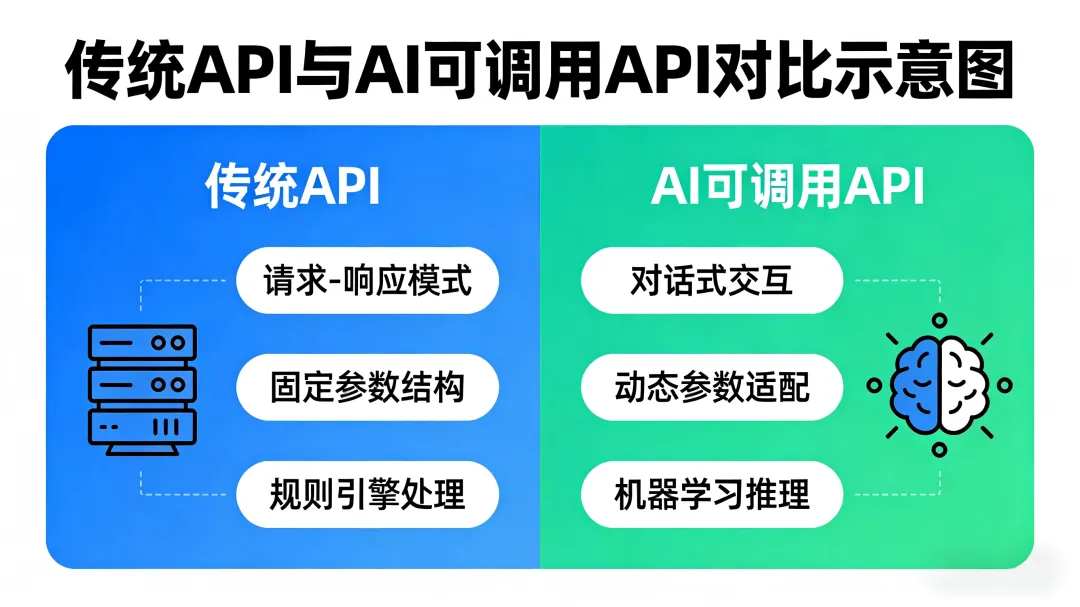
随着人工智能技术的快速发展,越来越多的企业开始探索将AI能力与现有业务系统深度融合。然而,在实践过程中,一个普遍存在的挑战显现出来:企业拥有丰富成熟的API资产,但AI Agent往往难以直接有效地调用这些接口。本文将深入探讨企业API的AI化改造路径,提供"零代码改造"的完整解决方案。
一、API AI化改造的战略价值
1.1 现状分析:能力闲置与调用障碍
大多数企业的技术架构中积累了大量的API资源,涵盖订单管理、库存控制、客户服务、审批流程、财务结算、报表生成等核心业务领域。这些接口各自功能明确,在传统调用场景下表现稳定。
但当企业尝试引入AI Agent时,面临的核心挑战包括:
语义理解鸿沟:传统API文档面向开发者设计,缺乏AI可理解的上下文和语义信息
调用机制缺失:AI系统缺少选择合适的接口、构建正确参数、解析返回结果的能力
错误处理盲区:AI难以理解失败场景并提供有效的恢复机制
1.2 技术痛点:结构化信息与智能理解的矛盾
传统API接口设计注重数据的结构化交换,但缺乏业务语义的显式表达。这种设计模式在AI调用场景下暴露出明显不足:
参数映射模糊:AI难以理解字段间的业务逻辑关系
接口选择困惑:在功能相似的多个接口中难以做出最优选择
错误处理混乱:统一的错误码机制无法为AI提供足够的决策信息
1.3 解决方案:标准化协议与中间层改造
通过引入Model Context Protocol(MCP)等标准化协议,在不修改现有业务系统的基础上,构建AI可理解的语义层和可控调用通道。这种"零代码改造"方案的核心优势包括:
无侵入性:现有系统代码无需修改,降低改造风险
标准化接入:统一接口描述规范,降低AI集成复杂度
集中治理:统一的鉴权、监控、审计机制,提升管理效率
(表1:传统API与AI化API特性对比)
维度 | 传统API | AI化API |
|---|
目标用户 | 开发者 | AI Agent |
接口描述 | 技术文档 | 语义描述 |
错误处理 | 错误码 | 恢复策略 |
参数验证 | 格式验证 | 语义验证 |
调用频率 | 手动调用 | 自动调用 |
监控需求 | 性能监控 | 智能监控 |
二、改造前评估与规划
2.1 MCP协议的技术价值
Model Context Protocol本质上是AI与后端服务之间的通信标准协议,其主要价值体现在:
语义标准化:为API提供机器可读的语义描述
调用标准化:统一的调用模式降低AI集成复杂度
治理标准化:统一的访问控制、监控和审计机制
2.2 API改造优先级评估模型
class APIReadinessEvaluator: """API AI化改造就绪度评估模型""" def __init__(self, config: EvaluationConfig): self.frequency_analyzer = APIFrequencyAnalyzer(config.frequency_config) self.value_assessor = BusinessValueAssessor(config.value_config) self.stability_evaluator = StabilityEvaluator(config.stability_config) self.risk_analyzer = RiskAnalyzer(config.risk_config) async def evaluate_api_readiness( self, api_list: List[APIProfile] ) -> EvaluationResult: """评估API改造就绪度""" evaluation_results = [] for api_profile in api_list: # 1. 使用频率分析 frequency_score = await self.frequency_analyzer.analyze( api_profile.usage_metrics ) # 2. 业务价值评估 value_score = await self.value_assessor.assess( api_profile.business_context ) # 3. 接口稳定性评估 stability_score = await self.stability_evaluator.evaluate( api_profile.stability_metrics ) # 4. 改造风险分析 risk_assessment = await self.risk_analyzer.analyze( api_profile.risk_factors ) # 5. 综合评分 readiness_score = self._calculate_readiness_score( frequency_score, value_score, stability_score, risk_assessment ) evaluation_results.append(APIReadinessResult( api_profile=api_profile, frequency_score=frequency_score, value_score=value_score, stability_score=stability_score, risk_assessment=risk_assessment, readiness_score=readiness_score, priority_level=self._determine_priority(readiness_score), recommendations=self._generate_recommendations( frequency_score, value_score, stability_score, risk_assessment ) )) return EvaluationResult( api_evaluations=evaluation_results, summary=self._generate_summary(evaluation_results) ) def _calculate_readiness_score( self, frequency_score: float, value_score: float, stability_score: float, risk_assessment: RiskAssessment ) -> float: """计算就绪度综合评分""" # 权重配置 weights = { 'frequency': 0.3, 'value': 0.4, 'stability': 0.2, 'risk': 0.1 } # 风险因素调整 risk_adjustment = 1.0 - risk_assessment.risk_level * 0.1 score = ( frequency_score * weights['frequency'] + value_score * weights['value'] + stability_score * weights['stability'] ) * risk_adjustment return min(100, max(0, score * 100)) def _determine_priority(self, score: float) -> PriorityLevel: """确定优先级等级""" if score >= 80: return PriorityLevel.P1 elif score >= 60: return PriorityLevel.P2 elif score >= 40: return PriorityLevel.P3 else: return PriorityLevel.P4
2.3 安全风险评估框架
在API改造前,必须进行全面的安全风险评估:
数据敏感性分析:识别涉及敏感数据的接口
权限模型评估:分析现有权限控制机制是否满足AI调用需求
合规性检查:确保改造方案符合数据保护法规要求
攻击面评估:分析AI调用可能引入的新安全风险
三、五阶段零代码改造实施框架
3.1 第一阶段:API语义化分析与描述生成
class APISemanticAnalyzer: """API语义化分析器""" def __init__(self, config: SemanticConfig): self.api_parser = APIParser(config.parsing_config) self.semantic_extractor = SemanticExtractor(config.extraction_config) self.description_generator = DescriptionGenerator(config.generation_config) self.example_builder = ExampleBuilder(config.example_config) async def analyze_and_describe( self, api_definition: APIDefinition ) -> SemanticDescription: """分析API并生成语义描述""" # 1. API结构解析 parsed_api = await self.api_parser.parse(api_definition) # 2. 语义信息提取 semantic_info = await self.semantic_extractor.extract(parsed_api) # 3. 描述生成 description = await self.description_generator.generate( parsed_api, semantic_info ) # 4. 示例构建 examples = await self.example_builder.build( parsed_api, semantic_info ) return SemanticDescription( api_info=parsed_api, semantic_info=semantic_info, description=description, examples=examples, validation_rules=self._generate_validation_rules(parsed_api) )class DescriptionGenerator: """语义描述生成器""" async def generate( self, api: ParsedAPI, semantic_info: SemanticInfo ) -> APIDescription: """生成API语义描述""" description = APIDescription() # 1. 功能语义化描述 description.functional_desc = await self._generate_functional_description( api, semantic_info ) # 2. 参数语义化描述 description.parameter_descs = await self._generate_parameter_descriptions( api.parameters, semantic_info ) # 3. 返回值语义化描述 description.response_desc = await self._generate_response_description( api.response_schema, semantic_info ) # 4. 错误处理描述 description.error_handling = await self._generate_error_handling( api.error_codes, semantic_info ) # 5. 使用限制描述 description.limitations = await self._generate_limitations( api.limits, semantic_info ) return description async def _generate_functional_description( self, api: ParsedAPI, semantic_info: SemanticInfo ) -> FunctionalDescription: """生成功能语义化描述""" return FunctionalDescription( purpose=f"该接口用于{semantic_info.business_purpose}", capabilities=await self._extract_capabilities(api, semantic_info), constraints=await self._extract_constraints(api, semantic_info), prerequisites=await self._extract_prerequisites(api, semantic_info), typical_scenarios=semantic_info.usage_scenarios )3.2 第二阶段:MCP描述文件标准化配置class MCPDescriptor: """MCP描述文件生成器""" def __init__(self, config: MCPConfig): self.schema_validator = SchemaValidator(config.validation_config) self.template_renderer = TemplateRenderer(config.template_config) self.security_configurator = SecurityConfigurator(config.security_config) async def generate_mcp_descriptor( self, semantic_desc: SemanticDescription ) -> MCPDescriptor: """生成MCP描述文件""" # 1. 验证语义描述 validation_result = await self.schema_validator.validate(semantic_desc) if not validation_result.is_valid: raise InvalidDescriptionError(validation_result.errors) # 2. 渲染描述模板 descriptor_template = self._select_template(semantic_desc.api_info.type) descriptor_content = await self.template_renderer.render( descriptor_template, semantic_desc ) # 3. 添加安全配置 security_config = await self.security_configurator.configure( semantic_desc.api_info ) descriptor_content.security = security_config # 4. 添加监控配置 monitoring_config = self._configure_monitoring(semantic_desc) descriptor_content.monitoring = monitoring_config return MCPDescriptor( name=semantic_desc.api_info.name, version=semantic_desc.api_info.version, content=descriptor_content, validation_result=validation_result, generation_time=datetime.now() ) def _select_template(self, api_type: APIType) -> Template: """选择描述模板""" templates = { APIType.QUERY: QUERY_API_TEMPLATE, APIType.MUTATION: MUTATION_API_TEMPLATE, APIType.SUBSCRIPTION: SUBSCRIPTION_API_TEMPLATE } return templates.get(api_type, DEFAULT_TEMPLATE)
(图3:MCP描述文件结构示意图)
3.3 第三阶段:AI网关配置与管理
class AIGatewayConfigurator: """AI网关配置器""" def __init__(self, config: GatewayConfig): self.endpoint_manager = EndpointManager(config.endpoint_config) self.auth_manager = AuthManager(config.auth_config) self.rate_limit_manager = RateLimitManager(config.rate_limit_config) self.monitoring_manager = MonitoringManager(config.monitoring_config) async def configure_gateway( self, mcp_descriptor: MCPDescriptor, backend_api: BackendAPI ) -> GatewayConfiguration: """配置AI网关""" # 1. 创建MCP服务端点 mcp_endpoint = await self.endpoint_manager.create_mcp_endpoint( mcp_descriptor, backend_api ) # 2. 配置认证机制 auth_config = await self.auth_manager.configure( mcp_descriptor, backend_api ) # 3. 配置限流策略 rate_limit_config = await self.rate_limit_manager.configure( mcp_descriptor, backend_api ) # 4. 配置监控 monitoring_config = await self.monitoring_manager.configure( mcp_descriptor, backend_api ) # 5. 配置安全策略 security_config = self._configure_security_policies(mcp_descriptor) return GatewayConfiguration( endpoint=mcp_endpoint, authentication=auth_config, rate_limiting=rate_limit_config, monitoring=monitoring_config, security=security_config, routing=self._configure_routing(mcp_descriptor, backend_api) ) def _configure_security_policies( self, mcp_descriptor: MCPDescriptor ) -> SecurityConfiguration: """配置安全策略""" return SecurityConfiguration( # 最小权限原则 least_privilege=True, # 数据脱敏策略 data_masking_policies=[ DataMaskingPolicy( field_pattern=".*phone.*", masking_type=MaskingType.PARTIAL, mask_char="*", visible_chars=3 ), DataMaskingPolicy( field_pattern=".*id_card.*", masking_type=MaskingType.FULL ) ], # 访问审计配置 audit_config=AuditConfig( enabled=True, log_all_requests=True, retention_days=180 ), # 敏感数据检测 sensitive_data_detection=SensitiveDataDetection( enabled=True, detection_patterns=SENSITIVE_PATTERNS ) )
3.4 第四阶段:工具注册与验证测试
class ToolRegistrationValidator: """工具注册与验证器""" def __init__(self, config: ValidationConfig): self.functional_tester = FunctionalTester(config.functional_config) self.semantic_validator = SemanticValidator(config.semantic_config) self.error_handler = ErrorHandler(config.error_config) self.performance_tester = PerformanceTester(config.performance_config) async def register_and_validate( self, mcp_tool: MCPTool, gateway_config: GatewayConfiguration ) -> ValidationResult: """注册工具并执行验证""" validation_steps = [] # 1. 基础功能测试 functional_result = await self.functional_tester.test( mcp_tool, gateway_config ) validation_steps.append(ValidationStep( name="基础功能测试", result=functional_result )) # 2. 语义理解测试 semantic_result = await self.semantic_validator.validate( mcp_tool, gateway_config ) validation_steps.append(ValidationStep( name="语义理解测试", result=semantic_result )) # 3. 异常处理测试 error_result = await self.error_handler.test( mcp_tool, gateway_config ) validation_steps.append(ValidationStep( name="异常处理测试", result=error_result )) # 4. 性能压力测试 performance_result = await self.performance_tester.test( mcp_tool, gateway_config ) validation_steps.append(ValidationStep( name="性能压力测试", result=performance_result )) # 5. 端到端集成测试 e2e_result = await self._run_e2e_tests(mcp_tool, gateway_config) validation_steps.append(ValidationStep( name="端到端集成测试", result=e2e_result )) return ValidationResult( tool=mcp_tool, validation_steps=validation_steps, overall_status=self._determine_overall_status(validation_steps), recommendations=self._generate_recommendations(validation_steps) ) async def _run_e2e_tests( self, mcp_tool: MCPTool, gateway_config: GatewayConfiguration ) -> E2EResult: """执行端到端集成测试""" test_scenarios = [ E2EScenario( name="正常流程测试", user_query="查询订单12345的状态", expected_actions=["选择订单查询工具", "正确填充参数", "返回订单信息"], success_criteria=["工具选择正确", "参数填充正确", "结果解析正确"] ), E2EScenario( name="边界情况测试", user_query="查询不存在的订单", expected_actions=["选择订单查询工具", "处理错误情况"], success_criteria=["工具选择正确", "错误处理恰当"] ), E2EScenario( name="模糊查询测试", user_query="帮我看看最新的订单", expected_actions=["请求澄清", "提供建议"], success_criteria=["正确处理模糊查询", "引导用户提供准确信息"] ) ] test_results = [] for scenario in test_scenarios: result = await self._execute_e2e_scenario( scenario, mcp_tool, gateway_config ) test_results.append(result) return E2EResult( scenarios=test_scenarios, results=test_results, pass_rate=sum(1 for r in test_results if r.passed) / len(test_results) )
3.5 第五阶段:上线运营与持续优化
class ProductionMonitoringOptimizer: """生产环境监控与优化器""" def __init__(self, config: MonitoringConfig): self.metrics_collector = MetricsCollector(config.metrics_config) self.anomaly_detector = AnomalyDetector(config.anomaly_config) self.optimization_advisor = OptimizationAdvisor(config.optimization_config) self.feedback_analyzer = FeedbackAnalyzer(config.feedback_config) async def monitor_and_optimize( self, deployed_tools: List[DeployedTool], time_range: TimeRange ) -> OptimizationReport: """监控与优化""" # 1. 收集关键指标 metrics = await self.metrics_collector.collect(deployed_tools, time_range) # 2. 异常检测 anomalies = await self.anomaly_detector.detect(metrics) # 3. 用户反馈分析 feedback_analysis = await self.feedback_analyzer.analyze( deployed_tools, time_range ) # 4. 优化建议生成 optimization_suggestions = await self.optimization_advisor.advise( metrics=metrics, anomalies=anomalies, feedback_analysis=feedback_analysis ) # 5. 生成报告 report = OptimizationReport( time_range=time_range, deployed_tools=deployed_tools, metrics_summary=self._summarize_metrics(metrics), key_anomalies=anomalies, user_feedback=feedback_analysis, optimization_suggestions=optimization_suggestions, kpis=self._calculate_kpis(metrics, feedback_analysis) ) return report def _calculate_kpis( self, metrics: ToolMetrics, feedback: FeedbackAnalysis ) -> Dict[str, float]: """计算关键绩效指标""" return { # 成功率指标 "success_rate": metrics.success_count / max(1, metrics.total_requests), # 响应时间指标 "avg_response_time": metrics.total_response_time / max(1, metrics.total_requests), "p95_response_time": metrics.p95_response_time, # 使用频率指标 "requests_per_hour": metrics.total_requests / max(1, metrics.hours_in_period), # 错误分布 "error_distribution": metrics.error_distribution, # 用户满意度 "user_satisfaction_score": feedback.satisfaction_score, # 工具有效性 "tool_effectiveness_score": self._calculate_effectiveness_score( metrics, feedback ) } def _summarize_metrics(self, metrics: ToolMetrics) -> MetricsSummary: """汇总指标""" return MetricsSummary( total_requests=metrics.total_requests, success_rate=metrics.success_count / max(1, metrics.total_requests), avg_latency=metrics.total_response_time / max(1, metrics.total_requests), error_breakdown=metrics.error_distribution, top_errors=self._get_top_errors(metrics.error_details) )
(表2:运营监控指标体系)
指标类别 | 具体指标 | 监控频率 | 报警阈值 |
|---|
成功率指标 | 调用成功率 | 实时 | < 99.5% |
| 工具选择准确率 | 5分钟 | < 95% |
性能指标 | 平均响应时间 | 1分钟 | > 2s |
| P95响应时间 | 1分钟 | > 5s |
| 超时率 | 5分钟 | > 1% |
使用指标 | 调用频率 | 实时 | 波动 > 50% |
| 工具分布 | 每小时 | 集中度 > 80% |
错误指标 | 错误类型分布 | 实时 | 新错误类型 |
| 错误恢复率 | 5分钟 | < 90% |
业务指标 | 用户满意度 | 每天 | < 4.0/5.0 |
| 任务完成率 | 每小时 | < 85% |
四、关键技术实现要点
4.1 语义化描述的最佳实践
class SemanticDescriptionBuilder: """语义化描述构建器""" def build_semantic_description( self, api: APIDefinition ) -> SemanticDescription: """构建高质量语义描述""" description = SemanticDescription() # 1. 明确功能边界 description.capabilities = self._describe_capabilities(api) description.limitations = self._describe_limitations(api) # 2. 参数语义增强 description.parameters = self._enhance_parameters(api.parameters) # 3. 返回值语义解释 description.responses = self._explain_responses(api.responses) # 4. 错误语义映射 description.error_handling = self._map_errors(api.errors) # 5. 使用场景示例 description.usage_examples = self._provide_examples(api) # 6. 前置条件与依赖 description.prerequisites = self._list_prerequisites(api) return description def _enhance_parameters(self, parameters: List[Parameter]) -> List[EnhancedParameter]: """增强参数语义描述""" enhanced_params = [] for param in parameters: enhanced = EnhancedParameter( name=param.name, type=param.type, required=param.required, # 语义增强 semantic_description=self._generate_semantic_desc(param), # 约束条件 constraints=self._extract_constraints(param), # 使用示例 examples=self._generate_examples(param), # 关联参数 related_params=self._find_related_params(param, parameters), # 业务含义 business_meaning=self._explain_business_meaning(param) ) enhanced_params.append(enhanced) return enhanced_params
4.2 错误处理与容错机制设计
class IntelligentErrorHandler: """智能错误处理器""" def __init__(self, config: ErrorHandlingConfig): self.error_classifier = ErrorClassifier(config.classification_config) self.recovery_strategist = RecoveryStrategist(config.recovery_config) self.user_message_generator = UserMessageGenerator(config.message_config) async def handle_error( self, error: APIError, context: ErrorContext ) -> ErrorHandlingResult: """处理API错误""" # 1. 错误分类 error_type = await self.error_classifier.classify(error, context) # 2. 确定恢复策略 recovery_strategy = await self.recovery_strategist.determine_strategy( error_type, context ) # 3. 生成用户消息 user_message = await self.user_message_generator.generate( error, error_type, recovery_strategy ) # 4. 执行恢复操作 recovery_result = await self._execute_recovery( recovery_strategy, context ) return ErrorHandlingResult( original_error=error, error_type=error_type, recovery_strategy=recovery_strategy, user_message=user_message, recovery_result=recovery_result, should_retry=self._should_retry(error_type, recovery_strategy) ) async def _execute_recovery( self, strategy: RecoveryStrategy, context: ErrorContext ) -> RecoveryResult: """执行恢复操作""" if strategy.type == RecoveryType.RETRY: return await self._execute_retry(strategy, context) elif strategy.type == RecoveryType.FALLBACK: return await self._execute_fallback(strategy, context) elif strategy.type == RecoveryType.ALTERNATIVE: return await self._execute_alternative(strategy, context) elif strategy.type == RecoveryType.CLARIFICATION: return await self._execute_clarification(strategy, context) else: return RecoveryResult( success=False, message="不支持的恢复策略" ) async def _execute_retry( self, strategy: RetryStrategy, context: ErrorContext ) -> RecoveryResult: """执行重试""" retry_config = strategy.config for attempt in range(retry_config.max_attempts): try: # 等待退避时间 if attempt > 0: backoff_time = retry_config.base_delay * (2 ** (attempt - 1)) await asyncio.sleep(min(backoff_time, retry_config.max_delay)) # 执行重试 result = await context.retry_function() if result.success: return RecoveryResult( success=True, message=f"第{attempt + 1}次重试成功" ) except Exception as e: if attempt == retry_config.max_attempts - 1: return RecoveryResult( success=False, message=f"重试{retry_config.max_attempts}次后仍失败: {str(e)}" ) return RecoveryResult( success=False, message="重试失败" )
五、典型应用场景实现
5.1 ERP订单查询AI化改造
class ERPOrderQueryTool: """ERP订单查询工具""" def __init__(self, erp_client: ERPClient): self.erp_client = erp_client self.cache = QueryCache() self.validator = OrderQueryValidator() @mcp_tool( name="query_order", description="查询ERP系统中的订单信息。可以根据订单号、客户号、日期范围等条件查询订单详情,包括订单状态、金额、商品信息、物流信息等。", parameters={ "order_id": { "type": "string", "description": "订单编号,如:SO202401010001", "required": False }, "customer_id": { "type": "string", "description": "客户编号", "required": False }, "start_date": { "type": "string", "description": "开始日期,格式:YYYY-MM-DD", "required": False }, "end_date": { "type": "string", "description": "结束日期,格式:YYYY-MM-DD", "required": False }, "status": { "type": "string", "description": "订单状态:pending, processing, shipped, completed, cancelled", "required": False } }, returns={ "description": "订单信息列表,包含订单详情、商品信息、物流状态等", "schema": { "type": "array", "items": { "type": "object", "properties": { "order_id": {"type": "string"}, "customer_name": {"type": "string"}, "total_amount": {"type": "number"}, "status": {"type": "string"}, "items": {"type": "array"}, "shipping_info": {"type": "object"} } } } } ) async def query_order( self, order_id: Optional[str] = None, customer_id: Optional[str] = None, start_date: Optional[str] = None, end_date: Optional[str] = None, status: Optional[str] = None ) -> List[Order]: """查询订单信息""" # 1. 参数验证 validation_result = await self.validator.validate( order_id=order_id, customer_id=customer_id, start_date=start_date, end_date=end_date, status=status ) if not validation_result.is_valid: raise ValidationError(validation_result.errors) # 2. 缓存检查 cache_key = self._generate_cache_key( order_id, customer_id, start_date, end_date, status ) cached_result = await self.cache.get(cache_key) if cached_result: return cached_result # 3. 构建查询条件 query_conditions = self._build_query_conditions( order_id, customer_id, start_date, end_date, status ) # 4. 执行ERP查询 try: orders = await self.erp_client.query_orders(query_conditions) # 5. 数据转换 transformed_orders = self._transform_orders(orders) # 6. 缓存结果 await self.cache.set(cache_key, transformed_orders, ttl=300) return transformed_orders except ERPError as e: # 7. 错误处理 if e.code == "ORDER_NOT_FOUND": return [] elif e.code == "ACCESS_DENIED": raise PermissionError("无权访问订单信息") elif e.code == "SYSTEM_ERROR": raise ServiceUnavailableError("ERP系统暂时不可用,请稍后重试") else: raise APIError(f"查询订单失败: {e.message}")
5.2 智能出行助手天气查询
class WeatherQueryTool: """天气查询工具""" def __init__(self, weather_client: WeatherClient): self.weather_client = weather_client self.geocoder = Geocoder() self.activity_advisor = ActivityAdvisor() @mcp_tool( name="query_weather", description="查询指定城市的天气信息,包括温度、湿度、风速、降水概率、紫外线指数等。可提供出行建议。", parameters={ "city": { "type": "string", "description": "城市名称,如:北京、上海", "required": True }, "date": { "type": "string", "description": "日期,格式:YYYY-MM-DD,默认为今天", "required": False }, "activity": { "type": "string", "description": "计划进行的活动:hiking, cycling, picnic, running等", "required": False } }, returns={ "description": "天气信息及活动建议", "schema": { "type": "object", "properties": { "city": {"type": "string"}, "date": {"type": "string"}, "temperature": { "type": "object", "properties": { "min": {"type": "number"}, "max": {"type": "number"}, "current": {"type": "number"} } }, "conditions": {"type": "string"}, "humidity": {"type": "number"}, "wind_speed": {"type": "number"}, "precipitation": {"type": "number"}, "uv_index": {"type": "number"}, "activity_advice": {"type": "string"}, "clothing_suggestion": {"type": "string"} } } } ) async def query_weather( self, city: str, date: Optional[str] = None, activity: Optional[str] = None ) -> WeatherInfo: """查询天气信息""" # 1. 验证输入 if not city: raise ValidationError("城市名称不能为空") # 2. 地理位置解析 location = await self.geocoder.geocode(city) if not location: raise LocationNotFoundError(f"找不到城市: {city}") # 3. 获取天气数据 try: weather_data = await self.weather_client.get_weather( latitude=location.latitude, longitude=location.longitude, date=date or datetime.now().strftime("%Y-%m-%d") ) except WeatherAPIError as e: # 降级处理:使用缓存数据 cached_data = await self._get_cached_weather(location.city_code) if cached_data: weather_data = cached_data else: raise ServiceUnavailableError("天气服务暂时不可用") # 4. 生成活动建议 activity_advice = None if activity: activity_advice = await self.activity_advisor.get_advice( weather_data, activity ) # 5. 生成衣物建议 clothing_suggestion = self._get_clothing_suggestion(weather_data) return WeatherInfo( city=city, date=date or datetime.now().strftime("%Y-%m-%d"), temperature=weather_data.temperature, conditions=weather_data.conditions, humidity=weather_data.humidity, wind_speed=weather_data.wind_speed, precipitation=weather_data.precipitation, uv_index=weather_data.uv_index, activity_advice=activity_advice, clothing_suggestion=clothing_suggestion )
六、高级优化策略
6.1 批量处理与性能优化
class BatchProcessingOptimizer: """批量处理优化器""" def __init__(self, config: BatchConfig): self.batch_scheduler = BatchScheduler(config.scheduling_config) self.cache_manager = CacheManager(config.cache_config) self.connection_pool = ConnectionPool(config.pool_config) async def optimize_batch_processing( self, requests: List[ToolRequest] ) -> BatchResult: """优化批量处理""" # 1. 请求批量化 batched_requests = self._batch_requests(requests) # 2. 连接池复用 connections = await self.connection_pool.acquire(len(batched_requests)) # 3. 并发执行 tasks = [] for i, batch in enumerate(batched_requests): task = self._process_batch(batch, connections[i]) tasks.append(task) batch_results = await asyncio.gather(*tasks, return_exceptions=True) # 4. 结果聚合 aggregated_results = self._aggregate_results(batch_results) # 5. 缓存管理 await self.cache_manager.update(aggregated_results) # 6. 资源释放 await self.connection_pool.release_all(connections) return BatchResult( results=aggregated_results, metrics=BatchMetrics( total_requests=len(requests), batch_count=len(batched_requests), avg_batch_size=len(requests) / len(batched_requests), processing_time=self._calculate_processing_time(batch_results) ) ) def _batch_requests(self, requests: List[ToolRequest]) -> List[List[ToolRequest]]: """批量化请求""" # 基于请求类型分组 grouped_requests = {} for request in requests: key = self._get_request_key(request) if key not in grouped_requests: grouped_requests[key] = [] grouped_requests[key].append(request) # 分批处理 batches = [] for key, group in grouped_requests.items(): # 确保每批不超过最大大小 for i in range(0, len(group), self.config.max_batch_size): batch = group[i:i + self.config.max_batch_size] batches.append(batch) return batches6.2 版本管理与兼容性保障class VersionCompatibilityManager: """版本兼容性管理器""" def __init__(self, config: VersionConfig): self.version_parser = VersionParser(config.parsing_config) self.compatibility_checker = CompatibilityChecker(config.checking_config) self.migration_planner = MigrationPlanner(config.migration_config) async def manage_version_compatibility( self, current_version: str, new_version: str, api_changes: List[APIChange] ) -> VersionCompatibilityPlan: """管理版本兼容性""" # 1. 版本解析 current_semver = self.version_parser.parse(current_version) new_semver = self.version_parser.parse(new_version) # 2. 兼容性检查 compatibility = await self.compatibility_checker.check( current_semver, new_semver, api_changes ) # 3. 迁移计划 migration_plan = await self.migration_planner.plan( current_semver, new_semver, compatibility, api_changes ) # 4. 回滚策略 rollback_strategy = self._create_rollback_strategy( current_version, new_version, migration_plan ) return VersionCompatibilityPlan( current_version=current_version, new_version=new_version, compatibility=compatibility, migration_plan=migration_plan, rollback_strategy=rollback_strategy, testing_recommendations=self._generate_testing_recommendations( compatibility, api_changes ) ) def _create_rollback_strategy( self, current_version: str, new_version: str, migration_plan: MigrationPlan ) -> RollbackStrategy: """创建回滚策略""" return RollbackStrategy( # 自动回滚条件 auto_rollback_conditions=[ AutoRollbackCondition( metric="error_rate", threshold=0.05, # 5%错误率 duration=300 # 5分钟 ), AutoRollbackCondition( metric="response_time_p95", threshold=5000, # 5秒 duration=300 ) ], # 回滚步骤 steps=[ RollbackStep( step=1, action="停止新版本流量", timeout=60 ), RollbackStep( step=2, action="恢复旧版本配置", timeout=120 ), RollbackStep( step=3, action="验证回滚结果", timeout=60 ) ], # 数据恢复 data_recovery=DataRecoveryPlan( backup_enabled=True, backup_interval=3600, # 每小时备份 retention_days=7 ) )
七、运维与问题排查
7.1 全链路监控体系
class EndToEndMonitoring: """端到端监控体系""" def __init__(self, config: MonitoringConfig): self.metric_collector = MetricCollector(config.collection_config) self.trace_collector = TraceCollector(config.tracing_config) self.log_aggregator = LogAggregator(config.logging_config) self.alert_manager = AlertManager(config.alert_config) async def setup_monitoring( self, deployed_tools: List[DeployedTool] ) -> MonitoringSystem: """设置监控系统""" monitoring_system = MonitoringSystem() # 1. 指标收集 for tool in deployed_tools: tool_metrics = await self.metric_collector.setup_tool_metrics(tool) monitoring_system.add_tool_metrics(tool.name, tool_metrics) # 2. 分布式追踪 tracing_config = await self.trace_collector.setup_tracing(deployed_tools) monitoring_system.tracing = tracing_config # 3. 日志聚合 logging_config = await self.log_aggregator.setup_logging(deployed_tools) monitoring_system.logging = logging_config # 4. 告警配置 alert_config = await self.alert_manager.setup_alerts(deployed_tools) monitoring_system.alerts = alert_config # 5. 仪表板配置 dashboards = self._setup_dashboards(deployed_tools) monitoring_system.dashboards = dashboards return monitoring_system def _setup_dashboards( self, deployed_tools: List[DeployedTool] ) -> List[Dashboard]: """设置监控仪表板""" dashboards = [] # 概览仪表板 overview_dashboard = Dashboard( name="AI工具概览", widgets=[ Widget( type="time_series", title="总请求量", metrics=["tool_requests_total"], aggregation="sum" ), Widget( type="gauge", title="成功率", metrics=["tool_success_rate"], thresholds=[0.99, 0.95, 0.9] ), Widget( type="heatmap", title="响应时间分布", metrics=["tool_response_time_histogram"] ) ] ) dashboards.append(overview_dashboard) # 每个工具的详细仪表板 for tool in deployed_tools: tool_dashboard = Dashboard( name=f"{tool.name} 详细监控", widgets=[ Widget( type="time_series", title=f"{tool.name} 请求量", metrics=[f"tool_{tool.name}_requests_total"] ), Widget( type="pie", title=f"{tool.name} 错误分布", metrics=[f"tool_{tool.name}_errors_by_type"] ), Widget( type="table", title=f"{tool.name} 最近调用", metrics=[f"tool_{tool.name}_recent_calls"] ) ] ) dashboards.append(tool_dashboard) return dashboards
7.2 问题排查与诊断
class DiagnosticTroubleshooter: """诊断与故障排查器""" def __init__(self, config: TroubleshootingConfig): self.log_analyzer = LogAnalyzer(config.analysis_config) self.trace_analyzer = TraceAnalyzer(config.tracing_config) self.metric_analyzer = MetricAnalyzer(config.metric_config) self.root_cause_analyzer = RootCauseAnalyzer(config.root_cause_config) async def troubleshoot( self, issue: IssueReport ) -> TroubleshootingResult: """故障排查""" # 1. 日志分析 log_analysis = await self.log_analyzer.analyze( issue.time_range, issue.affected_components ) # 2. 追踪分析 trace_analysis = await self.trace_analyzer.analyze( issue.trace_ids, issue.time_range ) # 3. 指标分析 metric_analysis = await self.metric_analyzer.analyze( issue.time_range, issue.affected_metrics ) # 4. 根因分析 root_cause = await self.root_cause_analyzer.analyze( log_analysis=log_analysis, trace_analysis=trace_analysis, metric_analysis=metric_analysis ) # 5. 解决方案建议 solutions = self._suggest_solutions(root_cause) return TroubleshootingResult( issue=issue, log_analysis=log_analysis, trace_analysis=trace_analysis, metric_analysis=metric_analysis, root_cause=root_cause, suggested_solutions=solutions, prevention_measures=self._suggest_prevention(root_cause) ) def _suggest_solutions( self, root_cause: RootCauseAnalysis ) -> List[Solution]: """建议解决方案""" solutions = [] if root_cause.category == RootCauseCategory.CONFIGURATION: solutions.append(Solution( type=SolutionType.CONFIGURATION_FIX, description="修正配置参数", steps=[ "检查API网关配置", "验证认证配置", "更新路由规则" ], estimated_time="5分钟" )) elif root_cause.category == RootCauseCategory.NETWORK: solutions.append(Solution( type=SolutionType.NETWORK_FIX, description="修复网络连接问题", steps=[ "检查防火墙规则", "验证DNS解析", "测试网络连通性" ], estimated_time="15分钟" )) elif root_cause.category == RootCauseCategory.PERFORMANCE: solutions.append(Solution( type=SolutionType.PERFORMANCE_OPTIMIZATION, description="性能优化", steps=[ "增加资源配额", "优化数据库查询", "启用缓存" ], estimated_time="30分钟" )) return solutions
八、总结与展望
8.1 核心价值总结
企业API的AI化改造不是简单的技术升级,而是企业智能化转型的关键基础设施。通过"零代码改造"路径,企业可以实现:
能力释放:将现有API资产转化为AI可理解、可调用的智能工具
效率提升:显著降低AI集成成本,缩短上线时间
质量保障:通过标准化协议确保调用可靠性和安全性
持续演进:建立可持续的API能力演进机制
8.2 未来发展趋势
智能化增强:AI工具的动态优化和自适应调整
生态化扩展:企业内外API工具的开放与共享
自动化运营:基于AI的自动化监控、诊断和优化
低代码集成:可视化工具配置和编排
8.3 实施建议
渐进式推进:从核心高频API开始,逐步扩展
度量驱动:建立完善的监控和评估体系
安全优先:确保数据安全和隐私保护
持续迭代:基于使用反馈不断优化
通过API的AI化改造,企业能够构建真正的智能业务系统,将现有技术资产转化为竞争优势,推动业务创新和效率提升。这不仅是一次技术升级,更是企业智能化转型的关键里程碑。