TVM FFI 深度剖析:Python 如何调用 C++
- 2026-10-11 06:05:21
从 Apache TVM 源码逐层拆解 Foreign Function Interface 的完整架构
TVM 的核心编译器、runtime、内存管理全部由 C++ 实现,而用户接口层是 Python。两者之间通过 tvm-ffi[1] 这个独立的 FFI(Foreign Function Interface)库连接。要理解 TVM 的工作方式,必须先理解这个桥梁。
整体架构图
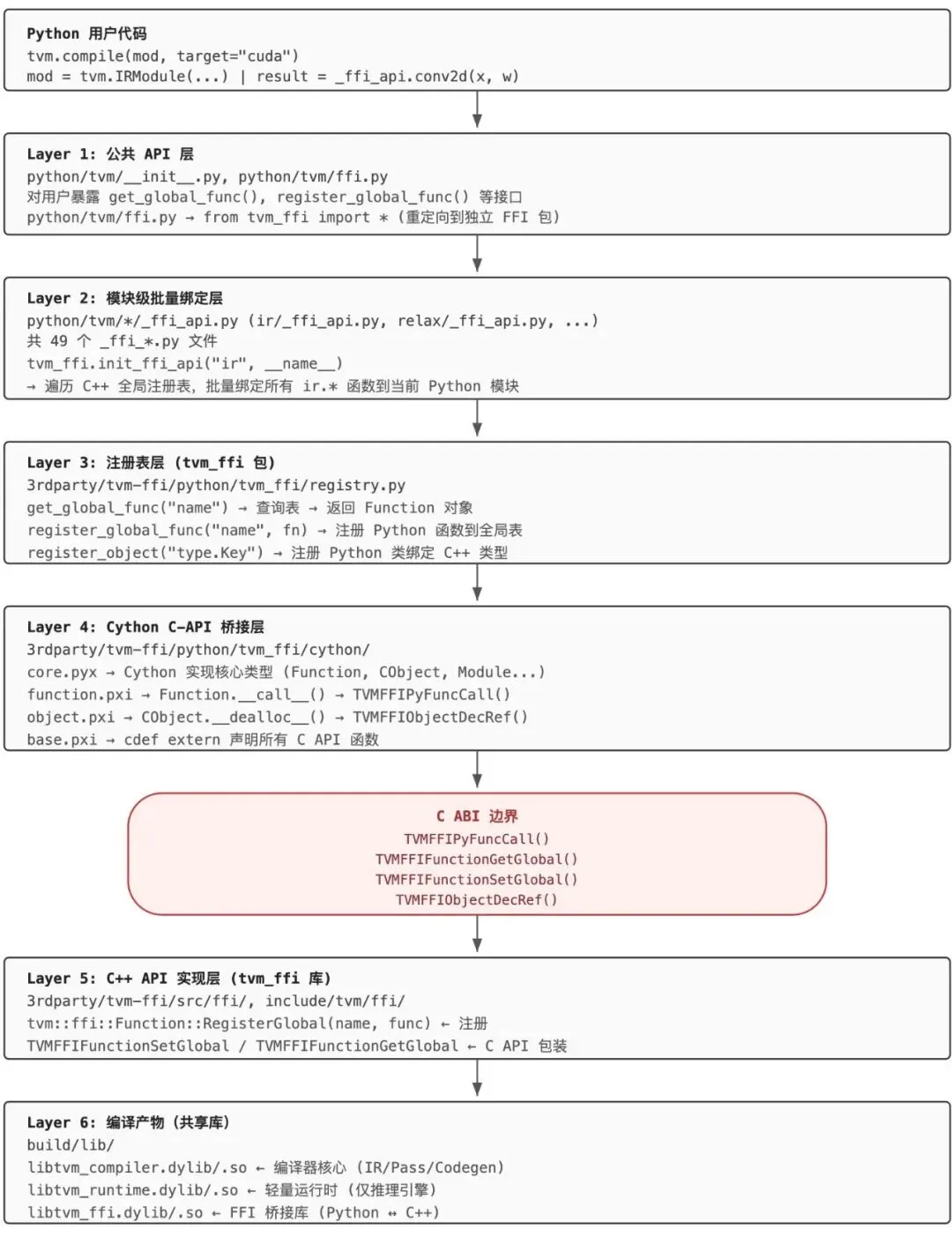
Layer 6 — 物理根基:编译产物(多库拆分)
最底层的基础 — TVM 的 C++ 代码在编译期(
cmake --build阶段)就编译好了。
编译过程
# Step 1: CMake 配置(根据 config.cmake 选择后端)cmake .. -DUSE_LLVM=ON -DUSE_CUDA=ON# Step 2: 编译cmake --build . --parallel# Step 3: 产物(不是单一 libtvm.so,而是拆分为三个库)build/lib/libtvm_compiler.dylib # 编译器核心(含所有 IR/Pass/Operator/Codegen)build/lib/libtvm_runtime.dylib # 轻量级 runtime(仅推理执行所需)build/lib/libtvm_ffi.dylib # FFI 桥接库(Python ↔ C++ 的函数注册/调用)build/lib/libtvm_ffi_static.a # FFI 静态库(用于 MicroTVM 等嵌入式场景)
为什么拆成三个库?
libtvm_compiler | ||
libtvm_runtime | ||
libtvm_ffi | ||
libtvm_ffi_static.a |
Python 侧加载(tvm_ffi Cython 扩展)
# base.pxi 通过 cdef extern 声明 libtvm_ffi.dylib 中的 C API 符号:# int TVMFFIFunctionGetGlobal(TVMFFIByteArray* name, TVMFFIObjectHandle* out)# int TVMFFIFunctionSetGlobal(TVMFFIByteArray* name, TVMFFIObjectHandle f, int override)# int TVMFFIObjectDecRef(TVMFFIObjectHandle obj)# ... 等等
当 Python 执行 import tvm_ffi 时,Cython 编译生成的 C 扩展自动 load,进而可以调用 libtvm_compiler.dylib 和 libtvm_runtime.dylib 中暴露的所有 C++ API。
关键理解:C++ 不是在 Python 调用时才编译的,而是在
pip install tvm或cmake --build时就已经编译成 build/lib/ 下的.dylib/.so了。Python 只是通过 tvm-ffi 的 Cython 扩展访问这些已存在的库。
Layer 5 — C++ API 实现层:全局注册表 + 类型擦除
FFI 在 C++ 侧的"接线板",由 tvm-ffi 库提供(
3rdparty/tvm-ffi/src/ffi/)。两个核心机制:
全局函数注册表
tvm-ffi 在 C++ 侧维护一个全局的函数表:
全局注册表(tvm::ffi 内部)┌──────────────────────────────────────────────────┐│ "ir.conv2d" → Function ││ "relax.op.nn.matmul" → Function ││ "tirx.build" → Function ││ "ffi.FunctionListGlobalNamesFunctor" → Function ││ "ffi.Array" → Function ││ ... │└──────────────────────────────────────────────────┘
C++ 侧注册
// 方式1: 通过 tvm::ffi C++ APItvm::ffi::Function::RegisterGlobal("ir.conv2d").set_body_typed([](Expr data, Expr weight, ...) {return conv2d(data, weight, ...);});// 方式2: 通过反射注册表自动注册 (tvm::ffi::reflection)// 在静态初始化阶段,注册表条目自动调用 TVMFFIFunctionSetGlobalFromMethodInfo
Python 侧注册
import tvm_ffi@tvm_ffi.register_global_func("my.echo")def echo(x):return x# 内部调用 TVMFFIFunctionSetGlobal("my.echo", packed_func, override=0)
双向 FFI — 之后 Python 注册的函数可以直接被 C++ 或其他语言调用。
静态初始化:当
libtvm_compiler.dylib被dlopen加载时,所有 C++ static 初始化代码自动执行,注册表就已填满。Python 侧不需要任何手动注册。
类型擦除的 Function 对象
tvm-ffi 的核心类型是 Function,定义在 include/tvm/ffi/function.h:
任何 callable 都可以包装成 Function:C++ lambda: 通过 make_function_wrapperC 函数指针: 通过 TVMFFIFunctionCreatePython 函数: 通过 _convert_to_ffi_func (Cython)统一的调用约定:(const AnyView* args, int32_t num_args, Any* rv) → void其中 AnyView 是类型擦除的值容器:int, float, string, ObjectRef, DLTensor*, ...
Layer 4 — Cython C-API 桥接层:零拷贝穿越
最精细、性能最关键的一层。位于
3rdparty/tvm-ffi/python/tvm_ffi/cython/。
为什么用 Cython 而不是纯 ctypes?
nogil | ||
关键文件与职责
cython/ 目录结构├── base.pxi ← cdef extern: 声明 C API 符号├── core.pyx ← Cython 主模块: 导入时触发加载├── function.pxi ← Function 类 + 查找/注册逻辑├── object.pxi ← CObject 类: 句柄 + ref-counting├── tensor.pxi ← Tensor/DLTensor: DLPack 协议└── tvm_ffi_python_helpers.h ← TVMFFIPyFuncCall C 实现
base.pxi — C 函数声明
# 这不是实现,只是声明 "libtvm_ffi.dylib 中有这些 C API 符号"cdef extern from "tvm/ffi/c_api.h":intTVMFFIFunctionGetGlobal(TVMFFIByteArray* name, TVMFFIObjectHandle* out) nogilint TVMFFIFunctionSetGlobal(TVMFFIByteArray* name, TVMFFIObjectHandle f, intoverride) nogilint TVMFFIObjectDecRef(TVMFFIObjectHandle obj) nogil...# Python helper (在 tvm_ffi_python_helpers.h 中实现):cdef extern from "tvm_ffi_python_helpers.h":int TVMFFIPyFuncCall(void* func_handle, PyObject* py_arg_tuple,TVMFFIAny* result, int* c_api_ret_code,int release_gil, const DLPackExchangeAPI** c_ctx_dlpack_api)...
function.pxi — Function 类(实际调用入口)
cdef class Function(CObject):cdef int c_release_gildef __call__(self, *args:Any) -> Any:cdef TVMFFIAny resultcdef int c_api_ret_codecdef const DLPackExchangeAPI* c_ctx_dlpack_api = NULL# Step 1: 初始化返回值result.type_index = kTVMFFINoneresult.v_int64 = 0# Step 2: 调用 Python helper —— PyObject* 直接传入,C 层完成转换TVMFFIPyFuncCall((<CObject>self).chandle, <PyObject*>args,&result, &c_api_ret_code,self.release_gil,&c_ctx_dlpack_api)# Step 3: 检查错误码if c_api_ret_code == 0:return make_ret(result, c_ctx_dlpack_api)if c_api_ret_code == -2:raise raise_existing_error()error = move_from_last_error()raise error.py_error()
Function.__call__()= 穿越点 — Python 调用在此进入libtvm_ffi.dylib地址空间,路由到libtvm_compiler.dylib中的 C++ 函数。
关键性能设计:
TVMFFIPyFuncCall接受PyObject*元组并在 C 层遍历转换(PyArgDispatcher),整个参数列表只需 一次 语言边界穿越。
_get_global_func 实现
def _get_global_func(name: str, allow_missing: bool):cdef TVMFFIObjectHandle chandlecdef ByteArrayArg name_arg = ByteArrayArg(c_str(name))# 调用 C API 查找全局函数CHECK_CALL(TVMFFIFunctionGetGlobal(name_arg.cptr(), &chandle))if chandle != NULL:ret = Function.__new__(Function)(<CObject>ret).chandle = chandle # 包装 C++ 句柄return retif allow_missing:return Noneraise ValueError("Cannot find global function %s" % name)
_register_global_func 实现
def _register_global_func(name: str, pyfunc, override: bool) -> Function:if not isinstance(pyfunc, Function):pyfunc = _convert_to_ffi_func(pyfunc) # Python → FunctionCHECK_CALL(TVMFFIFunctionSetGlobal(name_arg.cptr(), pyfunc.chandle, override))return pyfunc
对象引用计数
双向绑定 — Python GC 自动触发 C++ 释放。
cdef class CObject:cdef void* chandledef __dealloc__(self):if self.chandle != NULL:CHECK_CALL(TVMFFIObjectDecRef(self.chandle)) # C++ refcount--self.chandle = NULL
Layer 3 — 注册表层:get_global_func() 与 init_ffi_api()
核心文件:3rdparty/tvm-ffi/python/tvm_ffi/registry.py[2] — Python 代码中最常打交道的入口。
get_global_func() — 按名查找
def get_global_func(name, allow_missing=False):"""按名称从 C++ 全局注册表中查找函数"""return core._get_global_func(name, allow_missing)# core._get_global_func 调用 TVMFFIFunctionGetGlobal# 返回 Function 对象(Python 侧的 C++ Function 包装)
register_global_func() — Python → C++ 注册
def register_global_func(func_name, f=None, override=False):"""将 Python 函数注册到 C++ 全局注册表"""# 内部调用 core._register_global_func# → TVMFFIFunctionSetGlobal(name, packed_func, override)
双向 FFI — C++ 也可以反过来调用 Python 注册的函数(常见于 callback)。
register_object() — Python 类 ↔ C++ 类型绑定
@register_object("tvm.ir.GlobalVar")class GlobalVar(Object):pass
绑定后的效果:
•C++ 返回的 GlobalVar 对象自动包装成 Python GlobalVar•Python 子类自动获得所有 C++ 反射字段的 property 访问
list_global_func_names() — 列出所有函数
def list_global_func_names() -> list[str]:"""列出 C++ 侧注册的所有函数名"""name_functor = get_global_func("ffi.FunctionListGlobalNamesFunctor")()num_names = name_functor(-1)return [name_functor(i) for i in range(num_names)]
init_ffi_api() — 批量绑定(关键!)
def init_ffi_api(namespace: str, target_module_name: str | None = None) -> None:target_module_name = target_module_name if target_module_name else namespace# 去掉可选的 "tvm." 前缀if namespace.startswith("tvm."):prefix = namespace[4:]else:prefix = namespacetarget_module = sys.modules[target_module_name]# 遍历所有已注册的全局函数for name in list_global_func_names():if not name.startswith(prefix):continuefname = name[len(prefix) + 1:] # 提取函数短名if fname.find(".") != -1: # 跳过子命名空间continuef = get_global_func(name)setattr(f, "__name__", fname)setattr(target_module, fname, f) # 挂载为 Python 模块属性
源码验证:3rdparty/tvm-ffi/registry.py:305-352[3]
⚠️ 注意:这是 eager(立即)加载,不是懒加载。
init_ffi_api在 import 时立即遍历所有全局函数名并setattr。
实际调用示例
# python/tvm/ir/_ffi_api.py (实际源码)import tvm_ffitvm_ffi.init_ffi_api("ir", __name__)# namespace="ir" → prefix="ir" → 挂载所有 "ir.*" 函数
from tvm.ir import _ffi_api# _ffi_api.conv2d → 直接是 Function 对象(已在 import 时挂载)result = _ffi_api.conv2d(data, weight)
Layer 2 — 模块级批量绑定层
每个 TVM 子模块一个
_ffi_api.py(共 49 个_ffi_*.py),按模块组织 C++ 函数入口。
python/tvm/├── ir/_ffi_api.py # init_ffi_api("ir", __name__)├── ir/_ffi_analysis_api.py # init_ffi_api("ir.analysis", __name__)├── ir/_ffi_transform_api.py # init_ffi_api("transform", __name__)├── ir/_ffi_instrument_api.py # init_ffi_api("instrument", __name__)├── relax/_ffi_api.py # init_ffi_api("relax", __name__)├── tirx/_ffi_api.py # init_ffi_api("tirx", __name__)├── s_tir/_ffi_api.py # init_ffi_api("s_tir", __name__)├── driver/_ffi_api.py # init_ffi_api("driver", __name__)├── target/_ffi_api.py # init_ffi_api("target", __name__)├── arith/_ffi_api.py # init_ffi_api("arith", __name__)├── runtime/_ffi_api.py # init_ffi_api("runtime", __name__)├── runtime/_ffi_node_api.py # init_ffi_api("node", __name__)├── support.py # init_ffi_api("support", __name__)├── topi/cpp/generic.py # init_ffi_api("topi.generic", ...)├── topi/cpp/cuda.py # init_ffi_api("topi.cuda", ...)├── topi/cpp/x86.py # init_ffi_api("topi.x86", ...)└── ...(共 49 个)
设计优点:C++ 侧新增函数注册后,Python 侧零改动即可调用 — namespace 前缀匹配即自动挂载。
Layer 1 — 公共 API 层
用户可见的入口。
python/tvm/ffi.py直接重导出 tvm_ffi 全部 API。
# python/tvm/ffi.py (实际源码)"""Redirects to tvm_ffi"""from tvm_ffi import *
# python/tvm/__init__.py (实际源码)from tvm_ffi import register_object, register_global_func, get_global_func
用户典型用法:
import tvm# 方式 1: 按名查找f = tvm.get_global_func("relax.op.nn.conv2d")result = f(data, weight)# 方式 2: 通过 _ffi_api(更常用)from tvm.ir import _ffi_apiresult = _ffi_api.conv2d(data, weight)
⏱ 完整调用时序图
以一个真实调用 _ffi_api.conv2d(data, weight) 为例:
═══════════════════════════════════════════════════════════════════════阶段 A: Import 绑定(仅执行一次)═══════════════════════════════════════════════════════════════════════t=0 Python: import tvm.ir._ffi_api│ ↓ init_ffi_api("ir", __name__)t=1 Python: list_global_func_names() → 遍历 C++ 注册表│ → get_global_func("ir.conv2d") → setattr "conv2d"│ → get_global_func("ir.matmul") → setattr "matmul"│ → ... (所有 "ir.*" 一次性挂载)│ ↓ 就绪: _ffi_api.conv2d 已是 Function 对象═══════════════════════════════════════════════════════════════════════阶段 B: 函数调用(每次调用执行)═══════════════════════════════════════════════════════════════════════t=2 Python: _ffi_api.conv2d(data, weight)│ ↓ 进入 Cythont=3 Cython: Function.__call__(self, data, weight)│ result.type_index = kTVMFFINone│ ↓ TVMFFIPyFuncCall(...)t=4 C: PyArgDispatcher 遍历 args 元组,逐元素转换│ Python int→C int, Python Tensor→DLTensor*, ...│ ↓ 构建 AnyView[] 传给 C++t=5 C++: tvm::ffi::Function::Call(args, &ret)│ → 解包 AnyView 参数│ → 调用注册的 lambda: conv2d(Expr, Expr, ...)│ → 返回结果到 Any* ret│ ↓t=6 C: 返回 ret_code=0t=7 Cython: make_ret(result, dlpack_api)│ → type_index switch: Tensor→DLPack, Object→PyClass, ...│ ↓t=8 Python: result = ...
关键性能特点
_ffi_api.xxx 是模块属性,不再查表 | |
PyObject* 在 C 层批量转换,只穿越语言边界一次 | |
void* chandle 裸指针,无序列化 | |
make_ret()type_index switch 精确创建 Python 对象 |
总结
build/lib/ | |||
tvm-ffi/src/ffi/ | Function::RegisterGlobal | ||
cython/function.pxi | TVMFFIPyFuncCall | ||
tvm_ffi/registry.py | get_global_funcinit_ffi_api | ||
python/tvm/*/_ffi_api.py | init_ffi_api("ir", __name__) | ||
python/tvm/__init__.py | from tvm_ffi import ... |
一句话概括:
libtvm_compiler+libtvm_runtime+libtvm_ffi三个库在编译期就已包含所有 C++ 代码和静态初始化的注册表,Python 通过tvm_ffi独立 Cython 扩展以原生速度跨过语言边界,init_ffi_api提供了 zero-boilerplate 的自动函数绑定,用户通过tvm.get_global_func()或_ffi_api.xxx()透明调用 C++ 函数,全程零序列化开销。
•基于 Apache TVM 源码逐行走读验证编写*
References
[1] tvm-ffi: 3rdparty/tvm-ffi/[2]: 3rdparty/tvm-ffi/python/tvm_ffi/registry.py[3] 3rdparty/tvm-ffi/registry.py:305-352: 3rdparty/tvm-ffi/python/tvm_ffi/registry.py#L305-L352
